
Endometriosis and Depression: Living With Pain That Took Years to Get Named

Updated: 2 days ago
Last reviewed: 09/01/2026
Reviewed by: Dr. Kiesa Kelly

If you have endometriosis, the low mood that came with it probably did not arrive as a separate event. It arrived inside the years of pain, the appointments that went nowhere, and the accumulation of being told nothing was really wrong. Endometriosis and depression travel together often enough that the association is well established — but how it gets explained to patients is frequently backwards, and the backwards version costs people years.
The question is rarely whether the pain is real. It is whether the flatness and loss of interest are side effects to wait out until someone treats the endometriosis, or a separate condition you can work on now. This article makes the case that it is the second.
In this article, you'll learn:
How often depression and anxiety occur alongside endometriosis, and why estimates vary so much
What a diagnostic delay measured in years does to a person psychologically
Why "the pain is because you're depressed" is a causal inversion, and what ACOG changed in 2026
How to tell depression apart from the fatigue and grief of any painful chronic condition
What therapy here honestly promises, and what it does not
The short answer: the depression is real, it is separate, and it is treatable
Endometriosis affects an estimated 10% of women and girls of reproductive age worldwide — roughly 190 million people — and also affects transgender men and non-binary people who menstruate. There is no cure; treatment aims at controlling symptoms rather than eliminating the disease [1].
Depression that develops alongside it is a different matter. It has its own diagnostic criteria, its own evidence-based treatments, and its own trajectory. It does not require the pain to resolve first, and it does not require anyone to agree about the cause. Two problems treated in parallel, not one problem you are told to wait out. If you want somewhere to start on the mood side while the workup continues, our specialized therapy services are built for that.
🧭 Key takeaway: The depression that develops alongside endometriosis is diagnosed and treated on its own terms. You do not have to resolve the pain, or win the argument about causation, first.
Why endometriosis and depression travel together
The association is not controversial. A 2023 systematic review found reported prevalence ranging from 9.8% to 98.5% for depressive symptoms and 11.5% to 87.5% for anxiety, with quality of life significantly impaired regardless of the measurement tool used [6]. Those ranges are almost comically wide, because studies differ enormously in who they recruit and what they measure. Anyone quoting one tidy percentage is quoting one study, not the literature.
The stronger evidence compares like with like. A retrospective matched-cohort study using US claims data followed 72,677 women aged 18 to 50 with endometriosis against 147,251 matched women without it, and found adjusted hazard ratios of 1.48 for depression and 1.38 for anxiety [5] — modest numbers across a very large population.
Pain severity is the strongest predictor
The factor most consistently tied to poor mental health in endometriosis is not the disease visible on imaging or at surgery. It is pain: how bad it is, how much of the month it takes, and how much of your life it has rearranged. A 2024 review in Fertility and Sterility concluded that pain likely acts as a mediating factor between the disease and mental health conditions [7], and pain symptoms were among the risk factors identified for incident depression in the matched-cohort data [5].
Depression that tracks your pain is not evidence that it is imaginary. It is evidence that an identifiable stressor is doing identifiable damage — a legitimate treatment target. Anxiety often rides alongside it; the GAD-7 anxiety screener, a validated seven-item measure, is one way to look at that piece [12].
📉 Key takeaway: Pain severity, not lesion severity, is what tracks most closely with depression in endometriosis. Your mood following your pain is a finding, not a character flaw.
What the delay itself does: a mean 9.6 years to a name
Here is the part most page-one results skip. A mixed-methods study in BJOG surveyed 2,017 people with endometriosis across 63 countries. They reported an average 3.7 years between symptom onset and first raising it with a physician, then a further 5.8 years before diagnosis — a mean total delay of 9.6 years [4]. ACOG's 2026 guidance describes waits of four to eleven years on average [3].
Nearly a decade is not a scheduling inconvenience. It is a formative stretch of adult life spent with a body doing something inexplicable and an authority structure saying nothing is wrong. That study's qualitative analysis named the mechanism: physicians normalized symptoms, patients felt ignored because they were treated as unreliable narrators, and characteristics like age, appearance, or weight contributed to dismissal [4].
There is a grief in that arithmetic people rarely name out loud — plans abandoned, a career bent around bad weeks, relationships strained. It is close kin to the grief that accompanies any chronic illness.
For some, the encounters themselves leave a mark that behaves less like sadness and more like a threat response: dread before appointments, a refusal to go back, a body that braces at the sight of an exam table. If that sounds familiar, medical trauma in chronic illness is worth reading.
⏳ Key takeaway: A mean 9.6-year path to diagnosis is not just delayed treatment. It is nearly a decade of being disbelieved, and that exposure is a plausible contributor to depression in its own right.
"It's not in your head": when clinicians got the causation backwards
Being told the pain is because you're depressed
Consider a sequence that will be familiar. You are twenty-six, and you have seen your primary care physician twice and a gynecologist once about pain that flattens you for four or five days a month. The pelvic exam is unremarkable, the ultrasound reads as normal. On the third visit you mention, because it is true, that you have been sleeping badly and feeling low, and the tone of the appointment changes. You leave with an antidepressant prescription, a suggestion to manage your stress, and no plan for the pain — and spend the next four years wondering whether you invented the whole thing.
That is the inversion. The misconception is that low mood explains the pain. The evidence runs the other direction: the pain predicts the depression [5,7]. Getting the arrow backwards closes the gynecologic workup and opens a psychiatric one, and the average person waits years for anyone to reopen the first door.
A second misconception is that a normal scan means there is nothing there. Imaging that does not show endometriosis does not rule it out. This is why ACOG's Clinical Practice Guideline 11, Diagnosis of Endometriosis, published in February 2026, recommends a presumptive clinical diagnosis from history, symptoms, and physical examination rather than waiting for surgical confirmation [2,3]. That reliance on surgical findings, ACOG notes, is itself an important contributor to diagnostic delay [3].
A third misconception is that depression arriving after the pain is not "real" depression. Depression that develops in response to an identifiable stressor is still depression, and responds to the same treatments.
Why that inversion is its own injury, and what ACOG said in 2026
The American Psychiatric Association's patient-facing material describes the pattern plainly: women's chronic pain is often not taken seriously, and studies find that women with endometriosis "often encountered the attitude that they exaggerated or imagined their symptoms or had low pain thresholds" [9]. The same piece notes the mirror image: women who felt acknowledged and understood in health care encounters reported that those experiences made their self-esteem grow, because they felt confirmed and visible [9]. Being believed is not a bedside nicety. It changes what a person concludes about their own body.
ACOG's 2026 guidance moved in this direction institutionally: alongside the shift to presumptive diagnosis, it addresses racial and gender-identity bias, noting that people from marginalized communities may experience additional delays [3].
One caution, since this article critiques a causal inversion and should not commit one: being disbelieved does not cause endometriosis. It adds a psychological injury on top of a painful disease, and that injury deserves treatment.
🪞 Key takeaway: "Your pain is because you're depressed" reverses what the evidence shows. Naming that inversion out loud is often the first useful thing a mental health clinician does with this history.
What depression looks like when you're also in pain
The symptoms that get written off as "just the endo"
Sorting depression from the ordinary wear of a painful condition is harder than checklists make it look, because the two overlap in exactly the places screening instruments ask about.
Here is a second scenario. It is a Tuesday in a good week, meaning the pain is a four rather than an eight. You cancel dinner with a friend anyway — the second time this month — and tell yourself it is because you are tired. You are tired. You have also stopped texting first, stopped playing the game you used to lose whole evenings to, and noticed that nothing on the calendar is anything you want. When you try to explain it, it comes out as "I'm just exhausted," because exhaustion is the word that gets accepted. But the flatness is there on the four-out-of-ten days too.
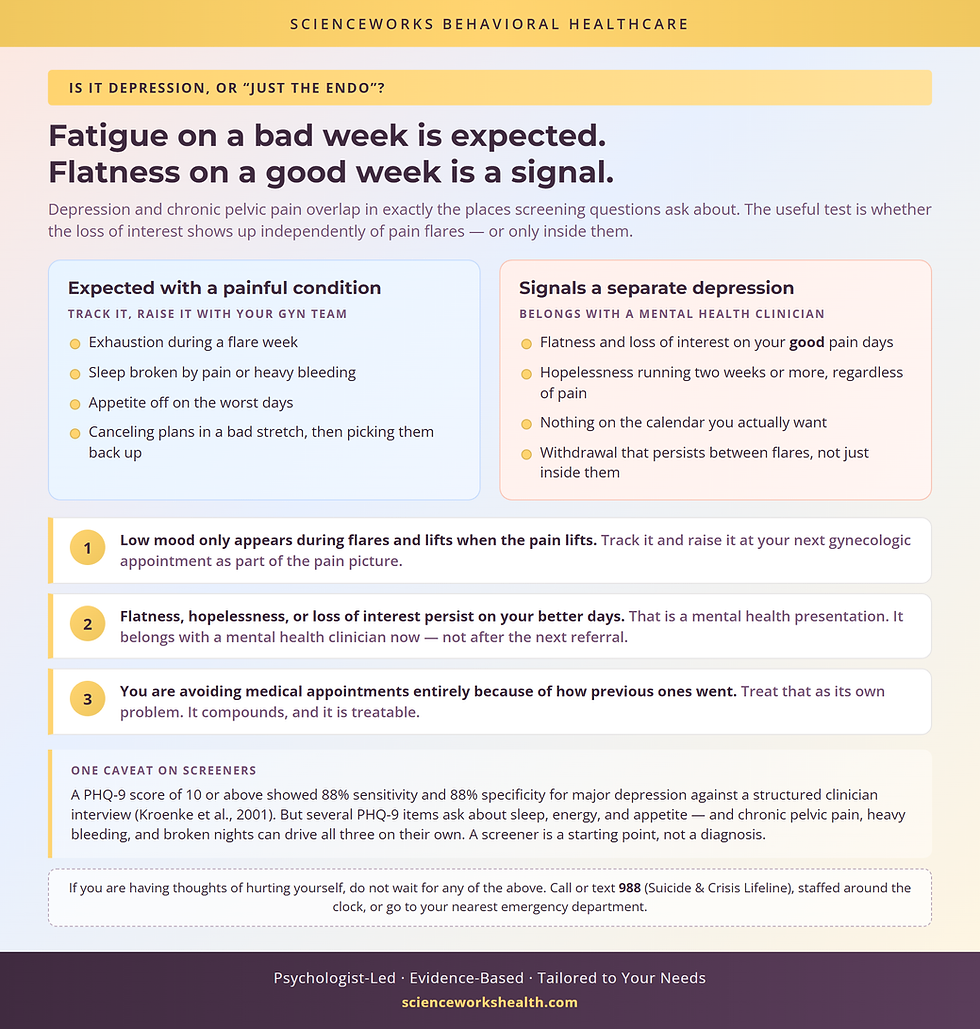
The useful question is not "am I tired?" It is whether the loss of interest shows up independently of pain flares, or only inside them. Fatigue on a bad pain week is expected. Anhedonia on a good week is a signal.
The PHQ-9 depression screener is a validated nine-item measure of severity; a score of 10 or above showed 88% sensitivity and 88% specificity for major depression against a structured clinician interview [11]. One caveat matters here: several PHQ-9 items ask about sleep, energy, and appetite, and chronic pelvic pain, heavy bleeding, and broken nights can drive all three on their own. A screener is a starting point, not a diagnosis; the pattern across items says more than the total.
When to take it to a mental health clinician, not another specialist
A workable decision rule, if you want one to carry out of this article:
If the low mood only appears during flares and lifts when the pain lifts, track it and raise it at your next gynecologic appointment as part of the pain picture.
If the flatness, hopelessness, or loss of interest persist on your better days, or have run for more than two weeks regardless of pain, that is a mental health presentation and belongs with a mental health clinician now — not after the next referral.
If you are avoiding medical appointments entirely because of how previous ones went, treat that as its own problem. It compounds, and it is treatable.
If you are having thoughts of hurting yourself, do not wait for any of the above. Call or text 988 (the 988 Suicide & Crisis Lifeline), which is staffed around the clock, or go to your nearest emergency department. In the matched-cohort data the absolute rate of self-directed violence among women with endometriosis was low — 0.9 per 1,000 person-years — but roughly twice the rate in matched women without it [5]. Low absolute risk, real relative elevation, and worth telling a clinician about.
If you and your clinician cannot tell what is driving what, a structured psychological assessment can sort mood, anxiety, sleep, and trauma responses into a clearer map first.
Four questions worth asking any therapist before you book:
1. Have you worked with clients whose depression developed alongside a chronic pain condition, and how do you approach it differently?
2. How will you tell my depression apart from the fatigue the endometriosis is causing?
3. What are you actually targeting, and what will you not be treating?
4. If my pain does not change over our work together, what would improvement look like?
If you want to talk through fit first, we offer a free consultation.
What actually helps the depression
What the evidence supports, and what it honestly promises
The research base on psychological treatment specifically in endometriosis is small but real. A 2024 systematic review with meta-analysis pooled seven randomized controlled trials covering 757 participants. Psychological interventions improved mental health scores and produced large reductions in anxiety and depression measures, with smaller effects on some pain outcomes. The authors were explicit that most included studies carried a high risk of bias, which limits the certainty of the evidence [8].
That is useful and modest: the mental health effects are the most consistent finding in a small literature, and nobody should sell a seven-trial evidence base as settled science. It is why the Fertility and Sterility review argues for gynecologic and mental health care running together [7], and why ACOG's practice bulletin on chronic pelvic pain makes a parallel case for multidisciplinary care [10].
Two approaches fit well when a symptom will not disappear on schedule. Acceptance and commitment therapy works on your relationship to a persistent symptom and on rebuilding a life around what you value rather than what you can control — the logic behind ACT for chronic illness.
The other is behavioral activation, which addresses something endometriosis is good at producing: a life quietly shrunk to the size of the symptom. When flares repeatedly cancel plans, the plans stop being made, and the withdrawal feeds the depression. Behavioral activation for depression rebuilds that in increments that account for the pain rather than pretending it is not there.
🎯 Key takeaway: In a small, imperfect evidence base, the most consistent gains from psychological treatment in endometriosis are in mood, anxiety, and quality of life. That is the promise we make.

What therapy does not claim to do
Therapy is not a treatment for endometriosis. It does not shrink lesions, and no one should offer it to you as pain relief. A clinician implying that working on your thoughts will fix your pelvic pain is the same inversion in friendlier language.
A fourth misconception belongs here: that agreeing to therapy concedes the pain is psychological. It does not. It treats a second, co-occurring condition that is the more treatable of the two right now. Your gynecologic care continues exactly as it was.
Next step: getting support
If you have been carrying both of these for years, the most useful reframe is the simplest one. There are two conditions here. One is a chronic inflammatory disease with no cure and a long management road. The other is depression, treatable now, on its own terms, whatever the pain does next. You do not have to wait for a laparoscopy, a referral, or anyone's agreement about causation to start on the second.
Feeling weighed down lately?
Depression is treatable, and the right support makes a difference — a clinician can help you understand what's going on and what would help you feel like yourself again.
Frequently Asked Questions
Can endometriosis cause depression?
Endometriosis is consistently associated with higher rates of depression, and pain appears to be the main pathway rather than the condition causing depression directly. In a large US matched-cohort study, women with endometriosis had a meaningfully higher rate of new depression diagnoses than matched women without it, and pain symptoms were among the strongest risk factors. That makes the depression real and worth treating on its own, not a byproduct you have to wait out.
Does treating the endometriosis fix the depression?
Sometimes it helps, and often it is not enough on its own. Medical or surgical management targets the disease; it does not automatically undo years of disrupted sleep, shrinking activity, lost plans, or being disbelieved by clinicians. Depression that has been running for a long time tends to keep its own momentum. We treat the two in parallel rather than sequencing one behind the other, because waiting for the pain to resolve first can cost you years.
Do I have to wait for an endometriosis diagnosis to get help for the depression?
No. Depression is diagnosed and treated on its own criteria, and a pending or uncertain gynecologic workup does not change that. Given that the average time from first symptoms to an endometriosis diagnosis is measured in years, waiting for the gynecologic answer before addressing mood means leaving a treatable condition untreated for a long stretch. You can start the mental health side now and let the medical workup continue in parallel.
Can endometriosis pain and fatigue inflate a PHQ-9 depression score?
Yes, and this is worth knowing before you read your own results. Several PHQ-9 items ask about sleep, energy, and appetite, all of which chronic pelvic pain, heavy bleeding, and disrupted nights can drive on their own. A score can therefore look elevated for reasons that are not primarily mood. That is why a screener is a starting point rather than a diagnosis, and why a clinician reads the pattern across items rather than the total alone.
Is it worth starting therapy if my endometriosis pain isn't going to change?
For many people, yes. The honest promise is not pain relief: therapy is not a treatment for endometriosis and no clinician should offer it as one. What the evidence supports is improvement in mood, anxiety, and quality of life alongside a condition that persists. If your world has narrowed to managing symptoms, that is a target therapy can work on directly, whatever the pain does next.
About the Author
Dr. Kiesa Kelly is a licensed clinical psychologist and the founder of ScienceWorks Behavioral Healthcare. She earned her PhD in Clinical Psychology with a concentration in Neuropsychology from Rosalind Franklin University of Medicine and Science, and completed practica, internship, and an NIH-funded postdoctoral fellowship at the University of Chicago, the University of Wisconsin, the University of Florida, and Vanderbilt University. A neuropsychologist by training, she has more than 20 years of experience with psychological assessment — the work of sorting mood, anxiety, sleep, and trauma responses into a clear picture when several things are happening at once.
Dr. Kelly's therapy training centers on cognitive behavioral therapy, acceptance and commitment therapy, EMDR, and CBT for insomnia — approaches that share a focus on changing your relationship to a symptom, and rebuilding daily life around it, when the symptom itself is not going to disappear on command. She is a PhD clinical psychologist rather than a physician, and does not provide medical, surgical, or medication guidance for endometriosis; that care belongs with your gynecologic team, alongside the mental health work.
References
1. World Health Organization. Endometriosis fact sheet. 15 October 2025. https://www.who.int/news-room/fact-sheets/detail/endometriosis
2. American College of Obstetricians and Gynecologists' Committee on Clinical Practice Guidelines–Gynecology. Diagnosis of Endometriosis. ACOG Clinical Practice Guideline No. 11. Obstetrics & Gynecology. 2026;147(3):432-448. https://doi.org/10.1097/AOG.0000000000006181
3. American College of Obstetricians and Gynecologists. ACOG publishes new endometriosis clinical guidance, aiming to shorten time to diagnosis and improve access to care. News release, February 2026. https://www.acog.org/news/news-releases/2026/02/acog-publishes-new-endometriosis-clinical-guidance-aiming-shorten-time-diagnosis-improve-access-care
4. Requadt E, Nahlik AJ, Jacobsen A, Ross WT. Patient experiences of endometriosis diagnosis: a mixed methods approach. BJOG. 2024;131(7):941-951. https://doi.org/10.1111/1471-0528.17719
5. Estes SJ, Huisingh CE, Chiuve SE, Petruski-Ivleva N, Missmer SA. Depression, anxiety, and self-directed violence in women with endometriosis: a retrospective matched-cohort study. American Journal of Epidemiology. 2021;190(5):843-852. https://doi.org/10.1093/aje/kwaa249
6. Szypłowska M, Tarkowski R, Kułak K. The impact of endometriosis on depressive and anxiety symptoms and quality of life: a systematic review. Frontiers in Public Health. 2023;11:1230303. https://doi.org/10.3389/fpubh.2023.1230303
7. Zippl AL, Reiser E, Seeber B. Endometriosis and mental health disorders: identification and treatment as part of a multimodal approach. Fertility and Sterility. 2024;121(3):370-378. https://doi.org/10.1016/j.fertnstert.2023.12.033
8. del Pino-Sedeño T, Cabrera-Maroto M, Abrante-Luis A, González-Hernández Y, Ortíz Herrera MC. Effectiveness of psychological interventions in endometriosis: a systematic review with meta-analysis. Frontiers in Psychology. 2024;15:1457842. https://doi.org/10.3389/fpsyg.2024.1457842
9. American Psychiatric Association. How endometriosis can impact mental health. APA Blogs. https://www.psychiatry.org/News-room/APA-Blogs/How-Endometriosis-Can-Impact-Mental-Health
10. American College of Obstetricians and Gynecologists. Chronic Pelvic Pain: ACOG Practice Bulletin No. 218. Obstetrics & Gynecology. 2020;135(3):e98-e109. https://doi.org/10.1097/AOG.0000000000003716
12. Spitzer RL, Kroenke K, Williams JB, Löwe B. A brief measure for assessing generalized anxiety disorder: the GAD-7. Archives of Internal Medicine. 2006;166(10):1092-1097. https://doi.org/10.1001/archinte.166.10.1092
Disclaimer
This article is for informational and educational purposes only. It is not medical advice, a diagnosis, or a substitute for care from a qualified clinician, and reading it does not create a clinician–patient relationship. Endometriosis is a medical condition that requires evaluation and management by a medical provider; nothing here is guidance on surgical or medication decisions. If you are in crisis or thinking about harming yourself, call or text 988 (the 988 Suicide & Crisis Lifeline) or go to your nearest emergency department.