
Misophonia in Teenagers: What Parents Notice First and When an Evaluation Helps

Last reviewed: 10/15/2026
Reviewed by: Dr. Kiesa Kelly
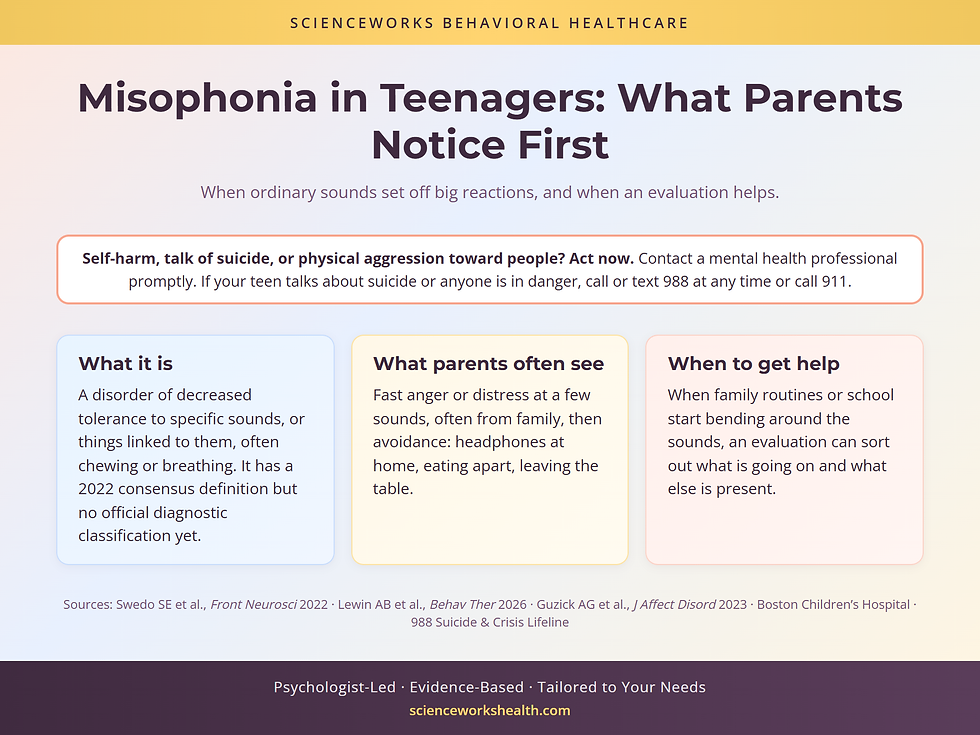
It starts at dinner. Your teenager stiffens when a sibling starts chewing, snaps at you to "stop breathing like that," and then takes the plate to their room. You might wonder if it is attitude, anxiety, or something else entirely. For some families, the answer is misophonia, a condition in which specific everyday sounds trigger intense reactions. Misophonia is often underrecognized, even by health care providers [4], and at home the reactions in teenagers can look like rudeness. If you are trying to understand what you are seeing, our overview of psychological assessments explains how an evaluation can sort it out.
This guide is written for parents. It covers what tends to show up first at home and at school, how misophonia differs from conditions it is often confused with, what the research does and does not yet support, and when an evaluation is worth it.
In this article, you'll learn:
What misophonia is, in plain language
The early signs parents tend to notice at home and at school
How clinicians tell misophonia apart from ADHD, autism, OCD and hearing problems
What treatment research shows for young people, honestly stated
How to respond at home, and when to get an evaluation
Misophonia in teenagers: the short answer
Misophonia is a disorder of decreased tolerance to specific sounds, or to things linked with those sounds [1]. Professional guidance describes it as a strong dislike of certain sounds, often repetitive ones, that leads to negative emotions and reactions [11]. In studies of young people, the most common triggers are ordinary sounds, especially eating sounds [5,10]. An international expert panel agreed on a consensus definition in 2022, which notes that symptoms are typically first observed in childhood or early adolescence [1]. That definition is a starting point for research and care, not a set of diagnostic criteria [1].
Misophonia does not yet have an official diagnostic classification [3]. There are also no evidence-based treatment guidelines for it, and families in one interview study described a long, trial-and-error search for knowledgeable help [4]. That does not mean it is imaginary or untreatable. It means an evaluation needs to be careful, and the claims made about treatment should be honest. Our clinical team works with adolescents as well as adults.
Three misconceptions about misophonia in teens
"My teen is just being rude." The reaction is real, and young people often describe it as beyond their control [6]. In a study of 102 young people with misophonia, almost all reported annoyance or anger when they heard, or expected to hear, a trigger sound [5]. Many also felt anxious, disgusted or sad [5]. In our clinical experience, it helps to treat the irritation as a symptom rather than a choice about how to treat the family.
"They will grow out of it." No one can say that yet. The expert consensus paper notes that there are no prospective long-term studies that define a typical course of misophonia [1]. One small study found that physical and verbal aggression in response to triggers was very common in children aged 7 to 12 but much less common among teenagers [2]. That shift in behavior is not the same as the distress going away. If misophonia is already affecting your family, our specialized therapy page describes our therapy for teens and families, including for anxiety and OCD.
"It's probably just ADHD or autism." Misophonia can occur alongside other conditions, but it is not the same thing. In the 102-youth study, young people with misophonia had more autistic traits than population norms, though fewer than young people with anxiety disorders, and 21% had ADHD [5]. A large UK study that followed children from birth found that those who screened positive for misophonia as adults had more childhood anxiety and depression, but not more ADHD [13]. Studies disagree on how often these conditions overlap. The consensus definition also says misophonia symptoms should not be better explained by another auditory or psychiatric condition [1].
What parents notice first
Trigger sounds and the reaction
The most common triggers in young people are eating sounds. In the 102-youth study, 96% reported eating sounds as triggers, 84% breathing, 66% throat sounds and 54% tapping [5]. The reaction tends to be fast and emotional [6]. Most young people in that study reported verbal outbursts, and half reported physical aggression, such as outbursts or damaging objects [5]. A smaller Polish study found physical aggression mostly in younger children and much less often in teenagers, so this varies by age and sample [2].
Avoidance usually follows. In the same study, most young people covered their ears, used headphones, or ate separately from family [5]. That study recruited families mainly online, and its authors note it may reflect more severe cases, so the percentages describe that group rather than every teen with misophonia [5]. Still, the pattern is a useful guide to what parents tend to see.
A pediatric hospital program describes a common early picture: a few trigger sounds tied to family members, so that a young person who happily eats with friends cannot tolerate a meal at home [6]. Family members can end up feeling they must "walk on eggshells" to avoid setting off a reaction [6].
👂 Key takeaway: Misophonia usually looks like a fast, intense reaction to a few specific, ordinary sounds, often made by family members, followed by avoidance such as eating separately or wearing headphones at home.
At the dinner table, in class and with siblings
These examples are illustrations, not diagnoses.
Your 14-year-old used to chat through dinner. Over the past year, meals have become tense. She watches her younger brother's mouth while he eats, asks him to chew with his mouth closed, then asks again more sharply. When he laughs, she slams her fork down and leaves the table. Afterward she seems ashamed and asks to eat in her room "just for a while." You notice that she does not react this way to restaurant noise or loud music, only to a few quiet sounds at home.
Or: your son's grades have slipped in one class. When you ask why, he finally says the student behind him clicks a pen and sniffs constantly, and he cannot think about anything else. He has asked to move seats and been told no. He comes home drained and irritable. Among young people in mental health care in Germany and Austria who scored above a misophonia questionnaire cut-off, problems most often happened around classmates [7].
Or: the problem is between siblings. One child's breathing or crunching sets off the other, and you are refereeing several times a day. The sibling feels blamed for something they cannot help. You have started changing family routines, like eating in shifts or banning certain snacks, to keep the peace.
In each case, what points toward misophonia is the specific trigger, the outsized reaction, and the way family life has begun to bend around it. In the 102-youth study, family life and relationships were the most commonly impaired area, reported by 93%, followed by interacting with people at 50% and learning or homework at 43% [5].
How it is assessed
What an evaluation looks at
There is no single test for misophonia. Youth questionnaires are new: a 2023 study found none had yet been comprehensively evaluated [8], and newer Dutch-language versions show strong early results but still need replication [9]. In our practice, that means an evaluation relies on a careful interview with both the young person and the parent, supported by questionnaires, rather than on a score alone.
In our clinical experience, a good evaluation looks at three things. First, the trigger pattern: which sounds, which people, how strong the reaction is, and how long it has been going on. Second, impact: what it is costing at home, at school and with friends. Third, what else is present. Rates of other conditions vary widely by sample. In the 102-youth study, 79% met criteria for at least one other psychiatric diagnosis [5], while a clinic sample in the Netherlands found 27% [10]. That spread is a reason to assess carefully rather than assume.
Our article on what a misophonia assessment involves walks through the process step by step. For a young person, the main differences in our practice are that a parent's account of history and family impact sits alongside the teen's own account, and that the evaluation checks how the problem shows up at school.
Telling it apart from ADHD, autism sound sensitivity, OCD and hyperacusis
Several conditions can look like misophonia from the outside:
Hyperacusis is heightened sensitivity to ordinary sounds that most people tolerate well [11]. An audiology letter describes hyperacusis as discomfort or pain at certain sound levels, while misophonia is a reaction to particular sounds at any volume [12]. Experts say separating misophonia from hyperacusis may need to come first [1]. That is a hearing question, and an audiologist may be part of the work-up. Our comparison of misophonia, hyperacusis and phonophobia explains the differences.
ADHD can occur alongside misophonia. In the 102-youth study, 21% had ADHD [5], but in the population study, children who screened positive for misophonia as adults did not have more ADHD than other children [13].
Autism is often raised when a child is sensitive to sound. In the 102-youth study, young people with misophonia had more autistic traits than population norms but fewer than the comparison group with anxiety disorders, and misophonia symptoms were not correlated with those traits [5].
OCD and anxiety often travel with misophonia. In the 102-youth study, 45% had a current anxiety or obsessive-compulsive disorder, though OCD alone was 8% [5].
Because these often co-occur, the honest answer is usually not "which one" but "what is present, and what is driving the most impairment." Anxiety and low mood are worth checking too. Our mental health screening tools are mainly designed for adults, so they suit a parent's own check-in or an older teen completing them with a parent present; they do not replace an evaluation.

Why it happens
The short answer is that no one knows yet. The authors of the 102-youth study called for future work to clarify the mechanisms of misophonia [5]. What families and clinicians do describe is a pattern that feeds itself. In an interview study of young people and parents, themes included hypervigilance for triggers, anxiety in advance of them, escape, and automatic negative interpretations, along with conflict, resentment and family accommodation at home [14]. Researchers have proposed that these processes may help keep misophonia going in a household, even when no one is doing anything wrong [14].
What actually helps
What the evidence does, and does not yet, support for teens
Treatment research for young people is early. A randomized trial in young people was published online in 2025. It compared a cognitive behavioral approach called the Unified Protocol with a psychoeducation and relaxation program, delivered in ten telehealth sessions to 43 young people [3]. About half of those who received the cognitive behavioral approach (54%) responded, compared with about a quarter (25%) of the comparison group [3]. The cognitive behavioral approach did better on some, but not all, measures, and the study had no long-term follow-up [3].
Before that trial, the evidence for young people came from a handful of case reports and small case series [5], such as an early report of two girls, ages 11 and 17, treated with exposure-based cognitive behavioral therapy [15]. A 2026 review of 30 published reports, not limited to young people, found cognitive behavioral approaches feasible and often associated with improvement, but said the evidence falls short of firm claims about how well they work [16].
So the honest summary is that cognitive behavioral approaches are the most commonly described [16] and look promising, and that no treatment for teen misophonia is established yet.
🧪 Key takeaway: In one small trial, about half of young people who received a cognitive behavioral approach responded, compared with a quarter of those who received relaxation training. The research is promising but early, so be cautious of any program that promises a cure.
Family accommodation: what the research shows
Family accommodation means the changes families make to reduce a child's distress, like eating separately, avoiding certain foods, or changing routines. In a study of 102 families, it was nearly universal: more than 70% of parents reported assisting the child, taking part in misophonia-related behaviors, and modifying family routines [17]. Parents also more often reported distress and anger from the child when they did not accommodate, compared with parents of children with anxiety disorders [17].
More accommodation was linked with more severe misophonia [17]. That link does not prove that accommodation makes symptoms worse. The study could not separate helpful adjustments from unhelpful ones, and its authors say that adjustments that improve daily functioning and quality of life should also be considered [17]. In the early case report, family accommodation was reduced step by step as each girl progressed in treatment [15].
In our clinical experience, a useful way to think about it is that some adjustments keep life running, like headphones during homework or a seat change at school, while others quietly shrink the family's life over time, like every meal eaten apart. The goal is not to remove every support overnight. It is to work with a clinician on which changes to keep and which to reduce gradually. For school adjustments specifically, our guide to misophonia accommodations at work and school explains why a 504 plan is usually the realistic route.
🏠 Key takeaway: Some accommodation helps your family function. Families who accommodate more tend to report more severe symptoms, but research cannot yet say which causes which, so choose adjustments on purpose with a clinician rather than dropping them all.
When to get evaluated
A rough rule of thumb, based on clinical experience rather than a research cutoff. The first point overrides all the others:
If your teen hurts themselves during or after triggers, talks about self-harm or suicide, or becomes physically aggressive toward people, act now, whatever else is true. Contact a mental health professional promptly, and if anyone is in danger or your teen talks about suicide, call or text 988 at any time [18] or call 911. In one small Polish study, nearly half of the 27 teenagers reported hurting themselves during trigger sounds, for example by scratching or pinching [2], so it is worth asking directly.
If it is affecting school, friendships or sleep, your teen seems anxious or low, or there are angry outbursts or broken things, get an evaluation sooner, because other conditions often travel with misophonia [5].
If family routines have started to bend around the sounds, such as separate meals, regular conflict or siblings feeling blamed, an evaluation can help you understand what is going on and what to do.
If the reactions are occasional, there is no aggression, self-harm or talk of suicide, your teen does not seem anxious or low, and they can still join family meals, sleep and focus at school, keep talking about it at calm moments and watch the pattern.
If you are choosing a provider, these questions can help:
Do you evaluate misophonia in adolescents, and how do you assess it?
Will the evaluation also look at anxiety, OCD, ADHD, autism and mood?
How do you rule out hyperacusis or a hearing problem, and when do you refer to an audiologist?
How will you involve us as parents, and will you look at what is happening at school?
What will we leave with: a diagnosis only, or specific recommendations for home and school?
🧭 Key takeaway: Self-harm, talk of suicide or physical aggression means getting help now. If the sounds are reshaping family life or school, an evaluation is worth it.

Next step: getting support
Living with misophonia in a family is hard for everyone, including the teenager who feels both the anger and the guilt afterward. It is not a parenting failure and it is not your child being difficult. It is a recognized pattern that deserves a careful look. A thorough evaluation can tell you whether misophonia is the right name, what else may be going on, and where to start. If you would like to talk through what you are seeing, you can contact us and our team will help you figure out a next step.
Frequently Asked Questions
How can you tell if your teen has misophonia?
Look for a consistent pattern rather than general irritability. With misophonia, specific sounds, often chewing or breathing, set off a fast surge of anger, irritation or distress that seems out of proportion, and the reactions are often strongest toward family. Many teens start avoiding shared meals or wearing headphones at home. An evaluation can clarify whether misophonia fits and check for related conditions.
Will my teen grow out of misophonia?
No one can promise that, because there are not yet good long-term studies of how misophonia changes over time. One small study found that outbursts in response to triggers were more common in younger children than in teenagers, but that does not mean the distress fades. Waiting to see is not a plan. If it is affecting family life or school, an evaluation and treatment are worth considering now.
Is misophonia a form of ADHD or autism?
No. Misophonia is its own condition, but it can occur alongside ADHD, autism, anxiety or OCD. Studies disagree on how often. One US study found that 21% of youth with misophonia had ADHD and that their autistic traits were somewhat above population norms, while a UK population study found no extra ADHD. A careful evaluation looks for each condition rather than assuming one explains everything.
How can I help my child with misophonia at home?
Start by taking the reactions seriously rather than treating them as rudeness, and talk about triggers at a calm moment instead of mid-reaction. Some adjustments, like headphones at dinner, can help your family function. Families who accommodate more tend to report more severe symptoms, though that does not show accommodation causes them. A clinician can help you decide which adjustments to keep and which to change over time.
About the Author
Dr. Kiesa Kelly is a licensed clinical psychologist and the founder of ScienceWorks Behavioral Healthcare, with more than 20 years of experience in psychological assessment and evidence-based treatment. Her clinical training includes work at the University of Chicago, Vanderbilt University, and the University of Wisconsin, and her background includes NIH-funded research training.
Her practice focuses on assessment and treatment across neurodevelopmental and anxiety-spectrum presentations in adults and adolescents, including sensory sensitivity and the differential-diagnosis questions that arise when sound intolerance, anxiety, and autistic traits appear together. She reviews ScienceWorks clinical content for accuracy before publication.
References
1. Swedo SE, Baguley DM, Denys D, et al. Consensus definition of misophonia: a Delphi study. Front Neurosci. 2022;16:841816. https://doi.org/10.3389/fnins.2022.841816
2. Siepsiak M, Turek A, Michałowska M, Gambin M, Dragan WŁ. Misophonia in children and adolescents: age differences, risk factors, psychiatric and psychological correlates. A pilot study with mothers' involvement. Child Psychiatry Hum Dev. 2025;56(3):758-771. https://doi.org/10.1007/s10578-023-01593-y
3. Lewin AB, Milgram L, Cepeda SL, et al. Treatment of youth misophonia: a randomized controlled trial comparing transdiagnostic cognitive-behavioral therapy to psychoeducation and relaxation training. Behav Ther. 2026;57(1):63-78. https://doi.org/10.1016/j.beth.2025.04.006
4. Rodriguez-Barajas S, Sadek SJ, Rast CE, Storch EA, Guzick AG. A qualitative study of treatment experiences among youth with misophonia and their parents. J Psychiatr Pract. 2026;32(1):15-21. https://doi.org/10.1097/PRA.0000000000000905
5. Guzick AG, Cervin M, Smith EEA, et al. Clinical characteristics, impairment, and psychiatric morbidity in 102 youth with misophonia. J Affect Disord. 2023;324:395-402. Corrected in: J Affect Disord. 2024;348:410. https://doi.org/10.1016/j.jad.2022.12.083
6. Boston Children's Hospital. Misophonia. Accessed October 15, 2026. https://www.childrenshospital.org/conditions-treatments/misophonia
7. Pfeiffer E, Krech F, Allroggen M, et al. Misophonia in a large treatment-seeking child and adolescent sample in mental health care in Germany and Austria. BMC Psychiatry. 2026;26(1):292. https://doi.org/10.1186/s12888-026-07979-1
8. Cervin M, Guzick AG, Clinger J, et al. Measuring misophonia in youth: a psychometric evaluation of child and parent measures. J Affect Disord. 2023;338:180-186. https://doi.org/10.1016/j.jad.2023.05.093
9. Rappoldt LR, Kan KJ, Dalmeijer L, et al. Psychometric validation of the new Misophonia Screening List-Child and Youth and AMISOS-Y (Dutch child- and parent-report versions) for assessing misophonia in youth. Child Psychiatry Hum Dev. 2026;57(4):1195-1209. https://doi.org/10.1007/s10578-024-01781-4
10. Rappoldt LR, de Wit C, van der Pol MM, et al. Clinical characteristics of children and adolescents with misophonia. Clin Pediatr (Phila). 2026. https://doi.org/10.1177/00099228261467192
11. American Speech-Language-Hearing Association. Tinnitus and hyperacusis [Practice Portal]. Accessed October 15, 2026. https://www.asha.org/practice-portal/clinical-topics/tinnitus-and-hyperacusis/
12. Campbell J. Letter to the editor: misophonia: a need for audiological diagnostic guidelines. J Am Acad Audiol. 2023;34(7-08):176-180. https://doi.org/10.1055/a-2125-7645
13. Rinaldi LJ, Simner J. Mental health difficulties in children who develop misophonia: an examination of ADHD, depression & anxiety. Child Psychiatry Hum Dev. 2025;56(2):520-532. https://doi.org/10.1007/s10578-023-01569-y
14. Guzick AG, Rast CE, Maddox BB, et al. "How can I get out of this?": a qualitative study of the phenomenology and functional impact of misophonia in youth and families. Psychopathology. 2025;58(1):33-43. https://doi.org/10.1159/000535044
15. McGuire JF, Wu MS, Storch EA. Cognitive-behavioral therapy for 2 youths with misophonia. J Clin Psychiatry. 2015;76(5):573-574. https://doi.org/10.4088/JCP.14cr09343
16. Detroy N, Norena AJ. Cognitive-behavioural therapy applied to misophonia, a scoping review. Hear Res. 2026;477:109661. https://doi.org/10.1016/j.heares.2026.109661
17. Storch EA, Guzick AG, D'Souza J, et al. Family accommodation in children and adolescents with misophonia. Behav Ther. 2024;55(3):595-604. https://doi.org/10.1016/j.beth.2023.09.001
18. 988 Suicide & Crisis Lifeline. Accessed October 15, 2026. https://988lifeline.org/
Disclaimer
This article is for informational and educational purposes only and is not a substitute for professional medical or mental health advice, diagnosis, or treatment. Reading it does not create a clinician-patient relationship. Misophonia questionnaires cannot diagnose misophonia or any other condition on their own. If your child is in crisis or talking about harming themselves, call or text 988, or call 911 in an emergency.