
Prioritization and Planning With ADHD: How to Decide What Matters Most

Updated: Aug 7
Last reviewed: 07/22/2026
Reviewed by: Dr. Kiesa Kelly
You sit down with a full to-do list and a real intention to get things done, and within minutes you are answering an email that could have waited while the thing that actually mattered sits untouched. For a lot of adults with ADHD, the hardest part of a busy day is not the work itself. It is deciding what to do first, and then getting yourself to actually do it. Prioritization and planning with ADHD can feel like a skill everyone else was handed and you somehow missed.
The good news is that this is not a character flaw, and it is not something you are stuck with. Prioritizing is an executive-function skill, and executive function is exactly the area where ADHD creates the most friction — it is also the area that structured executive-function coaching is built to strengthen. Once you understand why the usual advice fails, you can build a way of deciding that works with your brain instead of against it.
In this article, you'll learn:
Why prioritizing feels so hard with ADHD, at the level of how the brain actually works
The real reason urgent tasks keep beating important ones
A step-by-step way to decide what matters most on any given day
How to build external structure so your plan survives contact with a real day
A simple decision rule you can use before you leave this page
When it makes sense to get support for planning and follow-through
Why prioritizing is so hard with ADHD
Prioritizing looks like a single decision, but it is actually a stack of executive-function tasks happening at once. You have to hold several options in mind, weigh each one against your goals, imagine future consequences, resist the pull of whatever feels good right now, and then start. Research on adults with ADHD finds that the large majority fall into the clinically impaired range across everyday executive-function skills like time management, self-organization, and self-motivation [1]. So if this feels genuinely harder for you than it seems to be for other people, that impression is backed by the evidence.
One of the clearest ways to understand this comes from the work of psychologist Russell Barkley, who describes ADHD as involving a kind of "temporal myopia" — a tendency for behavior to be governed by what is close to the present moment rather than by future consequences [2]. Prioritizing is fundamentally about the future. It asks you to value a report due Friday over an inbox that is pinging now. When the future feels faint and the present feels loud, the sort collapses.
Let me name three common misconceptions early, because they often keep people stuck.
Myth: it's a willpower problem
In reality, willpower is not the bottleneck. The difficulty is with the brain-based systems that activate a task and sustain attention on it, which is why trying harder rarely produces a different result. Building external structure works better than pushing harder [3].
Myth: you should be able to keep it all in your head
Working memory — the mental scratchpad that holds your options while you compare them — is one of the executive functions most affected by ADHD. Getting tasks out of your head and onto paper is not a crutch; it is the correct tool for a working-memory limitation.
Myth: everyone struggles with this equally
Everyone does occasionally lose track of priorities. The difference with ADHD is consistency and cost — the pattern shows up most days and carries real consequences at work, at home, and in how you feel about yourself. A structured self-check like the ASRS screener can help you see whether that broader pattern fits.
Key takeaway: 🧠 Prioritizing is an executive-function skill, and ADHD affects executive function directly. The problem is not effort — it is the machinery of holding, weighing, and starting.
The real problem: urgency keeps hijacking importance
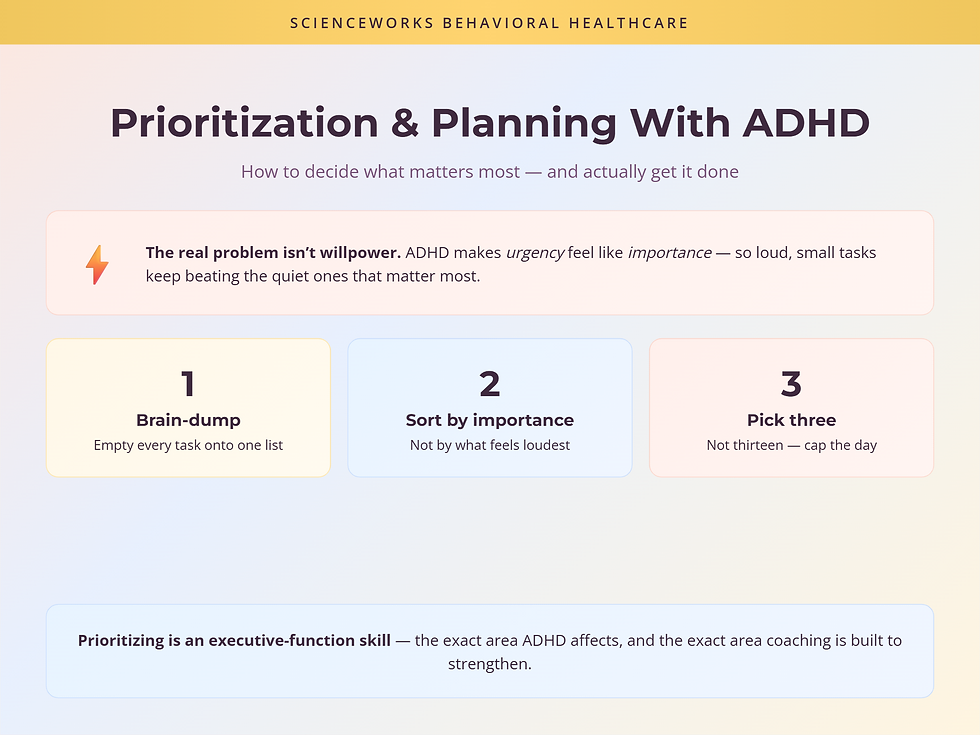
Here is the pattern almost every adult with ADHD recognizes. The tasks that get done are the ones with a deadline breathing down your neck. The tasks that quietly matter most — the ones that would move your career, your health, or your relationships forward — keep sliding because nothing is forcing them to the front. ADHD brains respond powerfully to urgency, novelty, interest, and challenge. Plain importance, on its own, generates almost no pull.
Consider a worked example. You start the morning meaning to draft a proposal that could genuinely change your quarter. But your phone shows two new messages, so you answer them. Then you notice an overdue form, so you handle that because it is finally urgent. By the time you look up, it is noon, you have been busy every minute, and the proposal has not been opened. You did not waste the morning being lazy. You spent it responding to whatever was loudest, because loud reads as important when your brain is calibrated to urgency.
Or take a home version. You decide today is the day you finally deal with the pile of paperwork on the counter. You walk over, feel the weight of not knowing where to start, and suddenly reorganizing the pantry feels urgent instead. The paperwork is important but shapeless; the pantry is concrete and gives a quick hit of progress. So you clean the pantry, and the important thing waits another week.
The fix is not to feel more motivated. It is to make importance visible and external, so it does not have to compete with urgency inside your head, where urgency always wins. If this urgency-driven pattern is costing you across many areas of life, a structured psychological assessment can clarify what is driving it.
How to decide what matters most
You do not need a complicated system. You need a short, repeatable sequence that takes the decision out of your head. Here is a version built specifically for how ADHD works.
Step one: brain-dump everything first
Before you can prioritize, you have to see the whole field. Set a two-minute timer and write down every task pulling at your attention — big, small, work, home, all of it — on one list. This empties your working memory onto the page so you are choosing among visible options instead of a swirl. Do not sort yet. Just get it out.
Step two: sort by importance, not urgency
Now sort. The Eisenhower Matrix — dividing tasks into urgent-and-important, important-but-not-urgent, urgent-but-not-important, and neither — is a useful tool here, precisely because it forces the distinction ADHD blurs [4]. The quadrant to guard is important-but-not-urgent, because that is where your meaningful goals live and where ADHD tasks quietly die. One ADHD-aware adjustment matters: the matrix only helps if you commit to acting on your sort, so pair it with the next step rather than treating the sort as the finish line.
Step three: pick three, not thirteen
A sorted list of twenty tasks is still overwhelming, and overwhelm triggers shutdown. So narrow hard. Many ADHD clinicians and coaches recommend choosing just three priorities for the day — sometimes framed as the "Rule of 3," or the related "1-3-5 rule," where you plan one big thing, three medium things, and five small things. The exact numbers matter less than the ceiling. Three real priorities you finish beats thirteen you feel guilty about. Circle your three, and let everything else be optional.
Key takeaway: 📋 Brain-dump, then sort by importance, then cap your day at three priorities. The cap is what protects you from overwhelm and from urgency creeping back in.

Build scaffolding so the plan survives the day
A plan you make at 9 a.m. is useless if it lives only in your memory by 11. Because ADHD affects the ability to hold intentions over time, the plan has to live outside your head. This is where an executive-function coaching approach spends most of its energy — not on motivation, but on the practical scaffolding that makes follow-through possible.
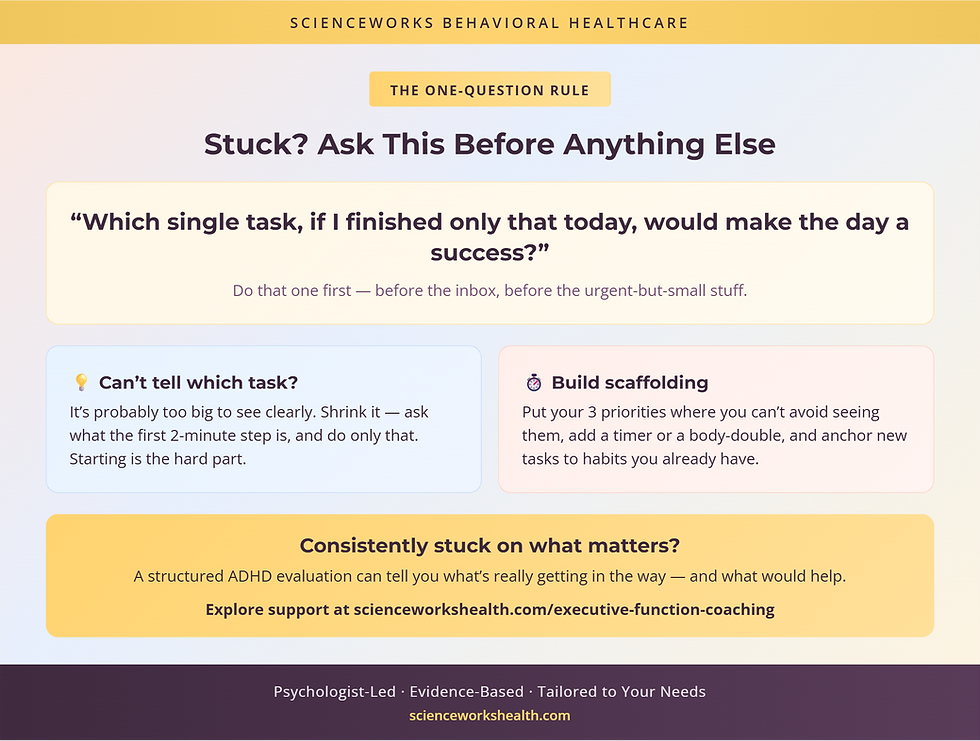
A few kinds of scaffolding that reliably help: put your three priorities somewhere you cannot avoid seeing them, like a sticky note on your monitor or a single line at the top of a notes app. Attach the hardest priority to a fixed time or a body-double — a person working alongside you, in the room or on a video call, whose presence adds just enough accountability to start. Use timers to create the urgency your brain wants; a task with a 25-minute countdown often feels startable when the open-ended version does not. And build tiny anchors, linking a new task to something you already do, so it rides an existing habit instead of requiring a fresh decision.
None of this is about discipline. It is about arranging your environment so the right task is the easy one to start. For many adults, structured executive-function support is what turns these tactics from things you read about into things you actually do.
A simple decision rule you can use today
When you feel stuck at the start of a block of time, run this rule: Which single task, if I finished only that today, would make the day a success? Do that one first, before the inbox, before the urgent-but-small stuff, before anything else opens the door to drift. If you genuinely cannot tell which task that is, it usually means the task is too big to see clearly — so shrink it. Ask what the first two-minute step would be, and do only that. Starting is the hard part; momentum handles a surprising amount of the rest.
If task activation is your consistent sticking point — if you know what matters and still cannot make yourself begin — that is worth paying attention to. Difficulty starting important tasks, even ones you care about, is a hallmark of how ADHD affects executive function, and it responds well to the right support. If that fits, our mental health screening page walks through what a screener can and cannot tell you, and how it fits into a full evaluation.
Key takeaway: ✅ When stuck, ask which one task would make the day a success — then shrink it to a two-minute first step and start there.
When planning support is worth getting
Some weeks, a few good tools are enough. But if difficulty prioritizing and following through is consistently costing you — missed deadlines, stalled goals, a running feeling of being behind, or the self-criticism that builds up when effort does not translate into results — it may be worth looking closer. Chronic planning struggles are one of the most common reasons adults seek an ADHD evaluation, and they are also one of the most treatable.
Support comes in a few forms, and they are not mutually exclusive. Executive-function coaching builds the practical systems for planning and follow-through. Therapy helps with the anxiety, low mood, and self-criticism that so often travel alongside ADHD and quietly make prioritizing even harder. Medication, prescribed and managed by a physician or psychiatric provider, improves focus for many people. A structured evaluation can help you sort out which combination actually fits your life rather than guessing.
If you are talking with a provider about ADHD and executive function, a few questions are worth asking directly: Does the evaluation look at how ADHD shows up in adults specifically, including masking and years of compensation? What executive-function skills does it actually measure, and how? If I lack childhood records, how is developmental history gathered? And what will I walk away with — a diagnostic label alone, or concrete recommendations I can use for planning and follow-through?
Frequently Asked Questions
How do you decide what to do first with ADHD?
Start by getting every task out of your head and onto one list, then sort by importance rather than by whatever feels loudest right now. Pick the single task that moves your day forward most and start there, even if it is not urgent. ADHD makes urgency feel like importance, so a written list and a fixed number of daily priorities protect you from reacting to noise instead of choosing on purpose.
Why do important tasks feel impossible with ADHD (ADHD paralysis)?
ADHD paralysis usually happens when a task feels big, boring, or unclear, and your brain cannot generate enough urgency or interest to start. This is a difficulty with task activation, not laziness or a lack of caring. Breaking the task into a first two-minute step, adding a deadline or an accountability partner, or lowering the stakes can give the brain the signal it needs to begin.
Does the Eisenhower Matrix work for ADHD?
The Eisenhower Matrix can help, but only with an ADHD-aware adjustment. Sorting tasks by urgent versus important is useful because ADHD tends to over-serve urgent tasks and neglect important-but-not-urgent ones, which is exactly where meaningful goals live. The catch is that the matrix assumes you will act on your sort; pairing it with a hard limit on daily tasks and external reminders makes it far more workable.
How do I choose between coaching, medication, and therapy for ADHD?
It depends on what is getting in your way. Executive-function coaching targets practical systems like planning and follow-through; therapy helps with the anxiety, low mood, or self-criticism that often travel with ADHD; and medication, prescribed by a physician or psychiatric provider, can improve focus for many people. These are not either-or choices, and a structured evaluation can help you decide which combination fits your situation.
Does telehealth executive-function coaching work?
Yes, telehealth coaching works well for many adults, and the structure of regular video sessions can itself support follow-through. Coaching is conversation-based and skills-focused, so it translates cleanly to video, and doing it from your own home means you build systems in the actual environment where you work. We serve clients across Tennessee this way and can help you decide whether coaching is the right starting point.
Wondering if ADHD explains the pattern?
A structured ADHD evaluation can tell you whether what you're noticing is ADHD, something else, or both — and what would actually help.
About ScienceWorks
ScienceWorks Behavioral Healthcare was founded by Dr. Kiesa Kelly, a licensed clinical psychologist with more than 20 years of experience in psychological assessment and evidence-based treatment. Our clinical team specializes in ADHD, autism, and executive-function evaluations for adults and adolescents, alongside anxiety, OCD, trauma, and related concerns.
We are a telehealth-forward practice serving Tennessee, with an in-person option at our Nashville office. Executive-function coaching and structured ADHD assessment are core parts of what we do, and every article we publish is reviewed by a licensed clinician for accuracy before it goes live.
References
1. Barkley RA, Murphy KR. The nature of executive function (EF) deficits in daily life activities in adults with ADHD and their relationship to EF tests. J Psychopathol Behav Assess. 2011;33(2):137-158. https://link.springer.com/article/10.1007/s10862-011-9217-x
2. Barkley RA. Behavioral inhibition, sustained attention, and executive functions: constructing a unifying theory of ADHD. Psychol Bull. 1997;121(1):65-94. https://pubmed.ncbi.nlm.nih.gov/9000892/
3. Nimmo-Smith V, et al. A meta-analysis of the intervention effect of cognitive behavioral therapy on executive function and symptoms in adults with ADHD. J Affect Disord. 2025. https://www.sciencedirect.com/science/article/abs/pii/S0165032725025492
4. CHADD. ADHD and rarely on time: it's not just about time management. Attention Magazine. https://chadd.org/attention-article/adhd-rarely-on-time-its-not-just-about-time-management/
5. Silverstein MJ, et al. Executive and motivational pathways to ADHD traits in the general population: a structural equation model of working memory, attention, delay discounting, and decision-making. BMC Psychol. 2026. https://link.springer.com/article/10.1186/s40359-026-04279-x
6. ADDitude Editors. 7 executive function deficits linked to ADHD. ADDitude Magazine. https://www.additudemag.com/7-executive-function-deficits-linked-to-adhd/
7. Medical News Today. ADHD and executive function: symptoms and management. https://www.medicalnewstoday.com/articles/adhd-executive-function
8. Centers for Disease Control and Prevention. Attention-deficit/hyperactivity disorder (ADHD) in adults. https://www.cdc.gov/adhd/data/index.html
9. Pettersson R, et al. Effectiveness of a digital cognitive behavioral therapy intervention for adults with ADHD: a randomized controlled trial. Psychol Med. 2025. https://www.cambridge.org/core/journals/psychological-medicine/article/effectiveness-of-attexis-a-digital-intervention-based-on-cognitive-behavioral-therapy-for-adults-with-adhd-a-randomized-controlled-trial/BBB55FF99ADF58005B1BD9B00AD0AF96
Disclaimer
This article is for informational and educational purposes only and is not a substitute for professional medical or mental health advice, diagnosis, or treatment. Reading it does not create a clinician-patient relationship. If you have concerns about ADHD, executive function, or your mental health, consult a qualified professional. If you are experiencing a mental health emergency, call or text 988 to reach the Suicide and Crisis Lifeline.