
Religious Trauma Therapy: What the First Few Sessions Look Like

Last reviewed: 09/30/2026
Reviewed by: Dr. Kiesa Kelly

You have made the appointment, or you are close to it, and a new worry has taken over: what will actually happen in the room? You may picture a therapist who wants to debate your theology. You may expect to relive, in the first hour, the worst thing that happened in a church, a youth group, or your family's kitchen. Or you may not know how to explain a world the therapist has never lived in.
This guide walks through the first sessions of religious trauma therapy, roughly the first three: what they are for, what you will likely be asked, and what you can expect to walk away with.
In this article, you'll learn:
What the first few sessions are for, and what they are not for
Three beliefs that make the start feel harder than it needs to be
What usually happens in session one, and in sessions two and three
How early work changes if you are still part of your community
What early progress can look like, and when something is not working
Specific questions to raise with your clinician by the third session
The short answer: what the first sessions of religious trauma therapy are for
The first few sessions are mostly for understanding, safety, and agreeing on a plan, not for processing the hardest memories. Our page on religious trauma therapy in Nashville covers how we offer this work in person and by telehealth. Patient information on the APA's PTSD guideline website notes that it is common for therapists to hold several assessment or evaluation sessions before suggesting a treatment plan [1]. For people with PTSD who have additional needs, including complex PTSD, the UK's NICE guideline recommends building in extra time to develop trust, with longer or more sessions as needed [2].
A note on scope: religious trauma describes a kind of experience rather than a single diagnosis, and not everyone affected meets criteria for PTSD. The APA and NICE guidelines cited here were written for PTSD [3][2]. We draw on them because much of early religious trauma work uses the same principles.
That slower start is deliberate. NICE notes that people with PTSD may be apprehensive, anxious, or ashamed, and may find trust hard to build [2]. After religious harm, a therapist can feel like one more authority figure, and a good opening respects that.
Three beliefs make the first session feel riskier than it is.
"I will have to relive the worst of it right away." Not usually in the first sessions. NICE lists psychoeducation about trauma reactions, and strategies for managing arousal and flashbacks, among the parts of trauma-focused treatment [2]. In our clinical experience, those usually come before the most painful memory work, and when memory work starts depends on the approach and on you.
"The therapist will want me to leave my faith, or to stay in it." A competent clinician's job is not to choose a destination for your beliefs. The American Psychological Association's ethics code asks psychologists to respect religious differences and people's right to self-determination, and to try to eliminate the effect of their own biases on their work [4]. A 2024 scoping review of the religious and spiritual abuse literature likewise urges helping professionals to stay aware of their biases so they do not impose their own beliefs on clients [5].
"If parts of my faith still comfort me, it cannot really be trauma." Mixed feelings are common and do not disqualify you. The same review found that some survivors find religious language or rituals triggering, while others find comfort in them as they renegotiate what they mean [5]. A review of adults abused by Catholic clergy as children found that some left the Church while keeping their belief in God [6]. If you are still unsure whether your experience counts, we cover that question in who religious trauma therapy helps.
Key takeaway: 🧭 The first sessions are for understanding and trust, not for proving your experience or deciding your beliefs.

Your first session: history, safety, and what you want
The first appointment usually looks more like a structured conversation than therapy as people picture it. Psychologists are expected to explain, as early as is feasible, what therapy will involve, how it is likely to go, and the limits of confidentiality, and to leave room for your questions [4]. You will likely be asked what brought you in now, what your days look like, how you are sleeping, and what you hope will be different.
Many clinicians also use a short questionnaire at the start. The PCL-5 is a 20-item self-report measure of PTSD symptoms that takes about 5 to 10 minutes [7]. It has sound psychometric support [8], and clinicians use it to screen and to track change over time. It is not a diagnosis on its own; the gold standard for diagnosing PTSD is a structured clinical interview [7]. Your answers give you and your clinician a baseline to compare against later.
Questions about religion come up too, but their purpose is context, not judgment. A clinician may ask what tradition you grew up in, what your family's involvement looks like now, and whether anything religious still sets off a strong reaction. You decide how much detail to share. Our guide to what a trauma therapy intake looks like covers the general mechanics of a trauma intake in more depth.
Safety is also part of the first conversation. When an assessment shows significant risk of harm to yourself or others, NICE recommends creating a risk management and safety plan as part of initial treatment planning [2]. That is standard practice, not a sign that something is wrong with you.
Consider how this can play out. You arrive having rehearsed a detailed explanation of your church's teachings, expecting to defend why they hurt. Instead, the clinician asks which parts of your week feel hardest right now. You mention that you skip family dinners on Sundays because grace before the meal makes your chest tighten. They ask what happens in your body, how long it lasts, and what you do afterward. By the end, you have spent more time on your present life than on doctrine, and you leave with a clearer sense of what the work would target.
In our practice, a free 15-minute consultation comes before the first full session. It is a chance to ask questions and check fit before you commit to anything. From there, we see clients in person at our Nashville office or by secure telehealth across Tennessee. Our trauma therapy overview describes the approaches our clinicians use.
Key takeaway: 📋 Session one is about the present: what still affects you, how safe your life is now, and what you want to change.
Sessions two and three: sorting what is still happening from what was lost
In our experience, by the second and third sessions the conversation often moves from "what happened" toward "what is it doing to you now."
The questions that usually come up
In our clinical experience, two kinds of pain often travel together after religious harm, and early sessions help separate them. One is reactivity: a body that still braces at a hymn, a building, a phrase from a sermon, or a relative's tone of voice. The other is loss: of community, of family closeness, of a framework that once organized your whole life. NICE describes trauma-focused work as including the processing of shame, guilt, loss, and anger, and the restructuring of trauma-related meanings [2]. A 2024 review describes survivors' emotions being directed at God, at the faith community, or at faith itself [5].
Relationships come up here as well. A 2026 study of family relationships after leaving a religion notes that, while not every family struggles, many people report lost family and community ties, secret keeping, and tension at home [9]. The study's own 20 participants described how they stayed connected with family, and those relationships rested on love and the desire to keep them [9]. Expect questions about who knows what, who you still see, and which conversations you dread.
Sorting the two can change what comes first. A body that still reacts as if the danger is current usually points toward trauma-focused work. A deep sense of grief or disorientation, without that alarm, often points toward meaning-focused and values-based work. Many people have both, and the plan reflects that.
A third possibility is worth ruling out. Sometimes what looks like religious reactivity is OCD attaching to faith: repeated, doubt-driven fears of sin or blasphemy that pull you into checking, confessing, or seeking reassurance. That calls for a different approach, and our article on scrupulosity explains how clinicians tell it apart from religious trauma.
Here is a second example. You left your childhood congregation years ago and would describe yourself as mostly fine. But at a cousin's wedding, the opening hymn made you leave the room, shaking, and you could not explain it to anyone. Separately, you notice a flat, heavy feeling on Sunday mornings that has nothing to do with fear; it feels more like missing something. In sessions two and three, your clinician helps you see these as two different threads. The wedding reaction becomes a possible target for trauma-focused work, and the Sunday feeling becomes something to understand and grieve, not something to fix.
What you may start practicing
Early sessions often introduce a few practical tools. NICE lists strategies for managing arousal and flashbacks among the core parts of trauma-focused care [2]. The 2024 review notes that psychoeducation, especially early in treatment, can help people make sense of their trauma symptoms, and that learning about power dynamics and authority may help them navigate what happened [5]. Understanding why your body reacts the way it does often takes some of the shame out of it.
Goal-setting starts here too, and it can feel strange when your beliefs are unsettled. The APA's PTSD guideline website encourages you and your clinician to set clear treatment goals together and to monitor progress toward them [3]. Those goals do not need to be about belief. "Sit through my sister's wedding service" or "sleep through Saturday nights" are workable goals, whatever you end up believing. In our work, this sits alongside values and boundary work, and it never pushes you toward or away from faith.
If you are still inside the community
Not everyone starts therapy after leaving. You may still attend services, work for a religious organization, or live with family who would not approve of you being here. For people with PTSD who have additional needs, NICE recommends taking into account the safety and stability of their personal circumstances, such as housing, and how these might affect treatment [2]. It does not address religious communities specifically, but in our experience the same principle applies.
In practice, that often means the first sessions put more weight on practical matters. These include which reminders you cannot avoid, how to manage contact that is hard, and what you want to share, and with whom. In our clinical experience, processing a situation you are still living in is harder, so pacing tends to be slower. You do not have to change your living situation before you begin.
If someone in your home or community is threatening or hurting you, tell your clinician early, because safety planning comes first. If you are in immediate danger, call 911. For crisis support, call or text 988.
Key takeaway: 🧩 Early sessions separate what still sets off your body from what you have lost, because each points to different work.
What early progress does and does not look like
Progress after three sessions is usually quiet: less a dramatic shift than a clearer map. You know which reminders set you off and why, you have a named goal or two, and you have told part of your story to someone who took it seriously. The 2024 review describes telling one's story, and having it validated, as a central part of recovery for many survivors [5].
It also helps to know what not to expect yet. Recovery from religious harm is often uneven. A 2026 qualitative study of 15 women recovering from gender-based religious harm described recovery as a nonlinear process that touched spiritual, physical, sexual, and relational parts of life [10]. A hard week in session three is not a verdict on the whole course.
Measures can help here. If you complete the PCL-5 again later in treatment, the National Center for PTSD suggests a drop of about 10 points as one indicator of response, while noting that the evidence behind that threshold is limited [7]. The APA's patient information also cautions that you need a sufficient amount of treatment, with reasonable expectations for its length, before deciding it is not working [1].
A note on the evidence itself. Research on religious trauma specifically is young. We found no outcome trials of a therapy designed only for religious trauma. The available evidence comes mostly from reviews and small qualitative studies [5][6][9][10]. The trauma treatments that major guidelines recommend are well studied for PTSD in general [3][2], and much of early religious trauma work draws on them. Our specialized therapy overview describes the approaches our clinicians are trained to deliver.
Key takeaway: 🌱 Early progress looks like a clearer map and a working alliance, not a finished story.
What to raise with your clinician if something is not working
Sometimes the early sessions feel off. You may feel rushed, unheard, or gently steered toward a conclusion about your faith. That is worth saying out loud, even though speaking up to an authority figure may be exactly what religious harm made hardest.
Researchers call these moments ruptures: a disagreement about goals, a lack of collaboration on the work, or a strain in the relationship [11]. In our experience, ruptures happen in many therapies, and working through them is part of the work. A meta-analysis of 11 studies with 1,314 patients found a moderate association between rupture repair and better outcomes [11]. A much larger synthesis of 295 studies found that the strength of the therapy relationship itself is consistently associated with outcome [12]. Neither shows cause and effect, but both suggest that raising a problem is worth the discomfort.
Some signals deserve attention in any trauma therapy. Watch for a clinician arguing theology with you, pressing you to leave or to stay, dismissing your grief as disloyalty, or dismissing the harm as a misunderstanding. The ethics code also says psychologists should end therapy when it becomes reasonably clear that a client is not likely to benefit or is being harmed [4]. APA patient information adds that if progress seems insufficient after a reasonable period, it is always appropriate to discuss your treatment with another therapist or to ask for the plan to be re-evaluated [1]. NICE lists offering a choice of therapist, one that takes a person's trauma experience into account, as one way services should promote access [2]. Asking for a different fit is a reasonable request, not a failure. You can read about our clinicians and their areas of focus before you choose.
Steering can run in either direction. Some people want their faith to be part of therapy, and others want it kept out entirely. A meta-analysis of 97 studies with religious or spiritual clients found that, in the more rigorous comparisons, therapy tailored to clients' own beliefs reduced distress about as well as standard approaches [13]. Those studies were not about religious trauma, so they do not tell you which choice is right for you. They do suggest that either choice can be compatible with good care, and that the choice should stay yours.
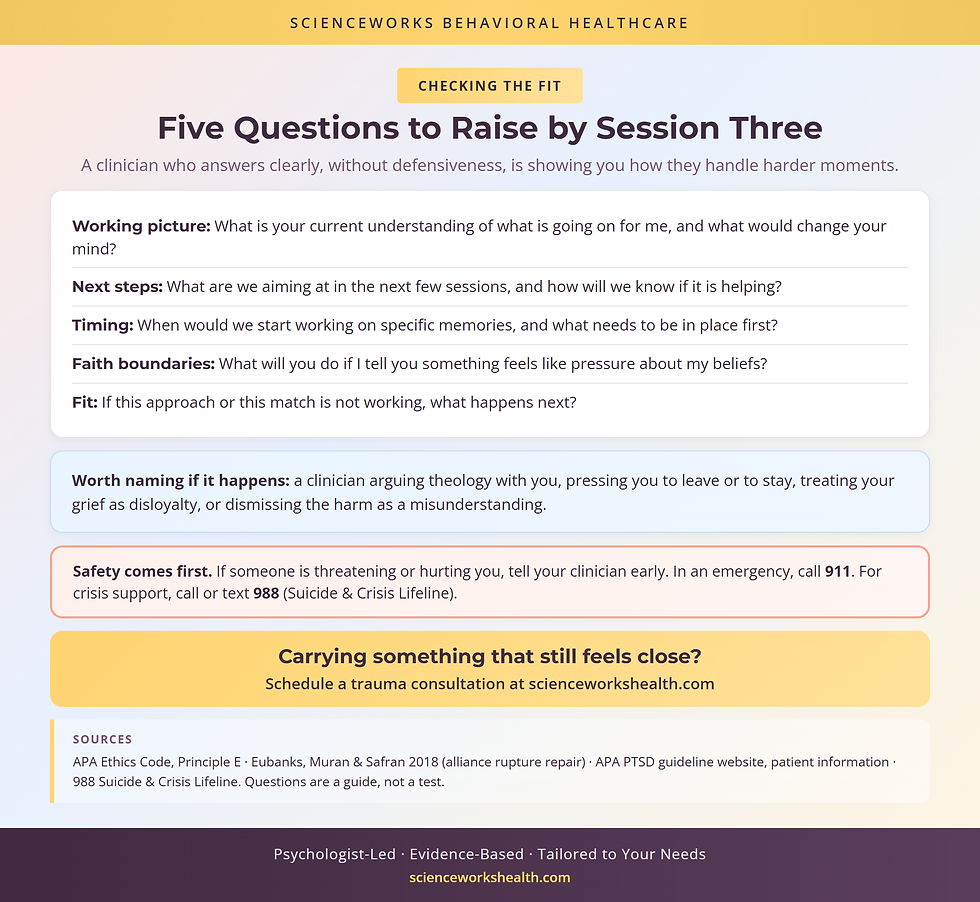
If you are unsure how to start that conversation, these five questions work well by the end of the third session:
Working picture: "What is your current understanding of what is going on for me, and what would change your mind?"
Next steps: "What are we aiming at in the next few sessions, and how will we know if it is helping?"
Timing: "When would we start working on specific memories, and what needs to be in place first?"
Faith boundaries: "What will you do if I tell you something feels like pressure about my beliefs?"
Fit: "If this approach or this match is not working, what happens next?"
A clinician who answers these clearly, without defensiveness, is showing you how they will handle harder moments later.
Key takeaway: 🤝 Naming a problem early is part of the work, and a good clinician will welcome it.
Where to go from here
You came into this wondering whether you could tolerate the start of therapy. The honest answer is that the first sessions are built to be tolerable. They focus on your present life, your safety, and your goals, and they move at a pace that respects how hard trust can be after religious harm. You keep control over what you share, and your beliefs stay yours. If the fit is wrong, you can say so.
When you are ready, a short consultation is a low-pressure way to ask questions before committing to anything.
Carrying something that still feels close?
Trauma-focused care — including approaches like EMDR — can help you process what happened at a pace that feels safe, with a clinician who understands trauma responses.
Frequently Asked Questions
Do I have to talk about my faith in my first therapy session?
No. You decide how much to share, and when. A clinician will usually ask a few questions about your religious background because it helps them understand what happened and what still affects you. You can answer briefly, say you are not ready, or ask why they are asking. Declining a question usually does not stall treatment. It tells your clinician something useful about pacing.
What if my therapist's religious beliefs are different from mine?
It matters less than whether they keep their beliefs out of your decisions. The psychologists' ethics code asks them to respect religious differences and your right to self-determination, and to try to eliminate the effect of their own biases. You can ask a therapist directly how they handle faith in treatment. If you later feel pushed toward staying or leaving, say so. That is a rupture worth raising, and research links working through ruptures with better outcomes.
Can I keep practicing my faith during religious trauma therapy?
Yes. Whether you keep, change, or step away from religious practice is your decision, not a condition of treatment. Some people find prayer, services, or scripture painful for a while, and others find them steadying. In studies of religious clients generally, not religious trauma specifically, therapy that made room for clients' own beliefs reduced distress about as well as standard therapy. What matters is that the choice stays yours.
How can I heal from religious trauma?
Healing is often gradual and uneven rather than a single breakthrough. One review of 10 studies on religious and spiritual abuse found three recurring themes in recovery: recognizing the abuse, telling the story and having it validated, and redefining spirituality on your own terms. Therapy can support each step, especially when reminders still set off your body or shame still runs your decisions. Setbacks along the way are common.
What if I still go to church or live with religious family?
You can still start therapy. Your clinician will want to understand your situation, because the safety and stability of your daily life affect how treatment is paced. Early sessions may focus on practical boundaries, on what you share with family, and on managing reminders you cannot avoid. You do not have to leave your community before you begin. If someone there is threatening or hurting you, tell your clinician early; in an emergency, call 911.
About the Author
Dr. Kiesa Kelly is a licensed clinical psychologist and the owner of ScienceWorks Behavioral Healthcare. She holds a PhD in Clinical Psychology with a concentration in neuropsychology and an M.S. in Clinical Psychology, both from Rosalind Franklin University of Medicine and Science, and an A.B. in Psychology and Neuroscience from Bowdoin College. She completed practica, internship, and an NIH-funded postdoctoral fellowship at the University of Chicago, the University of Wisconsin, the University of Florida, and Vanderbilt University.
Dr. Kelly has more than 20 years of experience with psychological assessment. Her clinical work includes trauma and PTSD, OCD, insomnia, and ADHD and autism, and her preferred approach for treating trauma is EMDR, in which she has completed basic training and further training in EMDR for attachment injuries.
References
1. American Psychological Association, Division 12 (Society of Clinical Psychology). How Long Will It Take for Treatment to Work? PTSD Guideline: For Patients & Families. 2017. https://www.apa.org/ptsd-guideline/patients-and-families/length-treatment
2. National Institute for Health and Care Excellence. Post-traumatic stress disorder. NICE guideline [NG116]. London: NICE; 2018. https://www.nice.org.uk/guidance/ng116/chapter/Recommendations
3. American Psychological Association. Clinical Practice Guideline for the Treatment of Posttraumatic Stress Disorder (PTSD) in Adults: Treatments for PTSD. Last updated April 2025. https://www.apa.org/ptsd-guideline/treatments
4. American Psychological Association. Ethical Principles of Psychologists and Code of Conduct (2002, amended effective June 1, 2010, and January 1, 2017). https://www.apa.org/ethics/code
5. Perry S. Religious/Spiritual Abuse, Meaning-Making, and Posttraumatic Growth. Religions. 2024;15(7):824. https://doi.org/10.3390/rel15070824
6. Dhirachaikulpanich D, Dendumrongsup W, Viyoch T, Srithawatpong N, Angkasirisan T, Huang X, Wainipitapong S. Spirituality and Psychological Well-Being of Adults with a History of Child Abuse by Catholic Clergy: A Systematic Review of Qualitative and Quantitative Studies. J Relig Health. 2025;64(4):2660-2678. https://doi.org/10.1007/s10943-025-02379-3
7. U.S. Department of Veterans Affairs, National Center for PTSD. PTSD Checklist for DSM-5 (PCL-5). https://www.ptsd.va.gov/professional/assessment/adult-sr/ptsd-checklist.asp
8. Blevins CA, Weathers FW, Davis MT, Witte TK, Domino JL. The Posttraumatic Stress Disorder Checklist for DSM-5 (PCL-5): Development and Initial Psychometric Evaluation. J Trauma Stress. 2015;28(6):489-498. https://doi.org/10.1002/jts.22059
9. Janes EE, Cravens JD, Fife ST, D'Aniello C. Maintaining Family Relationships After Religious Disaffiliation: A Grounded Theory. Fam Process. 2026;65(2):e70173. https://doi.org/10.1111/famp.70173
10. Schwartz BK, Cone PH. Discovering the Self: A Grounded Theory of Women's Recovery From Gender-Based Religious Harm. J Adv Nurs. 2026. https://doi.org/10.1111/jan.70599
11. Eubanks CF, Muran JC, Safran JD. Alliance rupture repair: A meta-analysis. Psychotherapy (Chic). 2018;55(4):508-519. https://doi.org/10.1037/pst0000185
12. Flückiger C, Del Re AC, Wampold BE, Horvath AO. The alliance in adult psychotherapy: A meta-analytic synthesis. Psychotherapy (Chic). 2018;55(4):316-340. https://doi.org/10.1037/pst0000172
13. Captari LE, Hook JN, Hoyt W, Davis DE, McElroy-Heltzel SE, Worthington EL Jr. Integrating clients' religion and spirituality within psychotherapy: A comprehensive meta-analysis. J Clin Psychol. 2018;74(11):1938-1951. https://doi.org/10.1002/jclp.22681
Disclaimer
This article is for informational purposes only and is not a substitute for individualized clinical assessment, diagnosis, or treatment. Reading it does not create a client relationship. If you are in crisis or considering harming yourself, call or text 988 (the Suicide and Crisis Lifeline) in the United States, call 911, or go to your nearest emergency department.