
Psychological Testing on a Superbill: What Codes 96130-96139 Mean and What Happens to Your Claim

Last reviewed: 10/07/2026
Reviewed by: Dr. Kiesa Kelly

You finished an ADHD or autism evaluation, paid for it yourself, and received a superbill to send to your insurer. You expected one line. Instead there are five or six, with codes like 96130, 96131, 96136 and 96137, each with a number of "units" beside it. A few weeks later an explanation of benefits arrives, and the amount it allows is not the amount you paid. Some lines may say "denied."
Superbills for psychological testing work the same basic way as superbills for therapy, but the codes, the time rules and the reasons a claim is paid or denied are different. If you are weighing psychological assessments and hoping to use out-of-network benefits, those differences decide how much of your money comes back.
In this article, you'll learn:
What each testing code on your superbill actually describes
Why one evaluation shows up as several codes and many units
What insurers look for before they pay for testing
The questions to ask your plan before you book
How to read the explanation of benefits, and what to do if a claim is denied
The short answer: can you get reimbursed for private-pay testing?
Sometimes, partly, and it depends on three things: whether your plan has out-of-network benefits, whether it treats your testing as medically necessary, and how much of your out-of-network deductible you have met. A superbill gives your insurer the information it needs to process a claim. It does not promise payment. If you are new to superbills, our guide to insurance and twice-exceptional assessments explains what a superbill is and how out-of-network reimbursement works in general. This article picks up where that one leaves off, with the testing codes and what happens to the claim.
Many people paying for testing are in this position because so much behavioral health care is out of network. An RTI International report, which was not peer-reviewed, used 2019 to 2021 commercial claims and found that patients went out of network 10.6 times more often to see a psychologist than to see a medical or surgical clinician [1]. In a 2024 study of 175,083 psychotherapy providers listed in a national online directory, about a third of private-practice psychotherapists did not accept insurance, and Tennessee had one of the lowest insurance-acceptance rates in the country [2]. That study looked at therapy listings, not testing, but the pattern is familiar to anyone shopping for an evaluation. We are one of those practices: we are not in-network with any insurance plan, so every client who uses insurance with us does it through out-of-network benefits. Our page on ADHD and autism testing in Tennessee explains how our evaluations work.
💳 Key takeaway: A superbill is documentation for a claim, not a promise of payment. For testing, whether anything comes back depends on your out-of-network benefits, your deductible, and whether your plan sees the testing as medically necessary.
Three misconceptions about testing superbills
"96136 through 96139 are the neuropsychological testing codes." This one is easy to get wrong. In fact, 96136 through 96139 are test administration and scoring codes used for both psychological and neuropsychological testing. The evaluation codes are the ones that split by type: 96130 and 96131 for psychological testing, and 96132 and 96133 for neuropsychological testing [3][4]. Knowing this helps when you call your plan, because asking about "neuropsychological coverage" may get you an answer about the wrong codes.
"More units on the superbill means a bigger check." Not necessarily. Insurers pay up to their own allowed amount for each code, not your provider's fee [5], and some review whether the time billed was reasonable. Our article on depression therapy and insurance walks through how an allowed amount shrinks a reimbursement check. One major insurer's testing policy requires that the hours or units requested not exceed the reasonable time needed to answer the clinical questions, and that tests not measure the same thing twice [4]. So more units do not guarantee more money back, and a plan may question time it considers longer than needed.
"If my plan reimburses therapy out of network, it will reimburse testing the same way." Testing is judged by its own rules. Plans that pay for out-of-network therapy may still deny testing they consider educational, may limit it to certain clinical questions, or may require approval first [4][5]. Getting a clear answer about testing specifically, before you book, is the most useful thing you can do.
The CPT codes on a testing superbill, in plain English
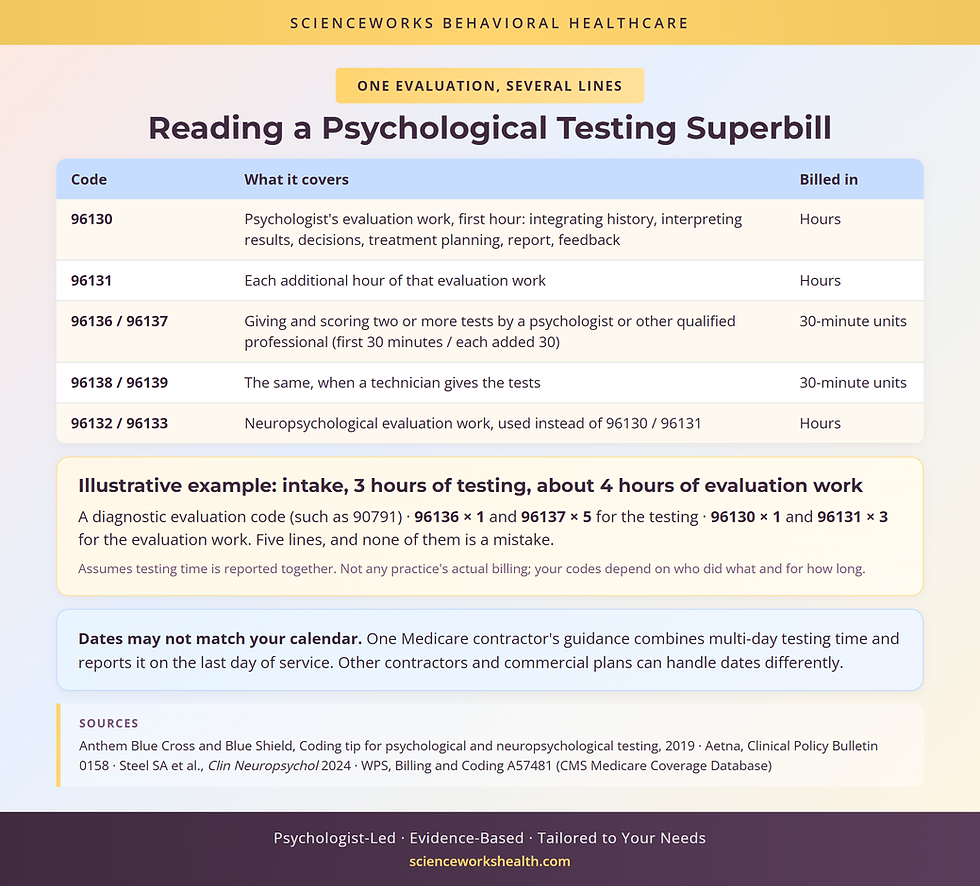
In 2019, the codes for psychological testing were rebuilt. The new set separates giving the tests from the clinician's evaluation work, separates psychological from neuropsychological evaluation, and separates testing done by a professional from testing done by a technician [3]. Here is what each group means.
96130 and 96131: the psychologist's evaluation work
These codes cover what the psychologist does with your results. According to one insurer's coding guidance, evaluation services include choosing the right tests, integrating your history and other information, interpreting standardized test results and clinical data, clinical decision-making, treatment planning, the report, and the feedback conversation with you or your family when it happens [3]. 96130 is the first hour, and 96131 is each additional hour. Much of this work happens when you are not in the room, which is why it can surprise people to see several hours of it on a superbill. If a neuropsychologist does the same work for a neuropsychological evaluation, the codes are 96132 and 96133 instead [3].
96136 to 96139: giving and scoring the tests
These codes cover the time spent actually giving and scoring two or more tests, by any method. 96136 is the first 30 minutes and 96137 is each additional 30 minutes when a psychologist or other qualified professional gives the tests. 96138 and 96139 are the same, but for tests given by a technician [3][4]. Because these are 30-minute codes, three hours of testing by your psychologist can show up as six units across two lines: one unit of 96136 and five units of 96137, or 96138 and 96139 if a technician gave the tests.
Other codes you may see
A single automated test that produces a computer-generated result has its own code, 96146 [3]. A neurobehavioral status exam, a clinical interview focused on thinking, reasoning and judgment, is billed as 96116 for the first hour and 96121 for each additional hour [3]. You may also see 90791, a diagnostic evaluation code. Researchers comparing how these services are valued grouped a psychological evaluation as 90791 plus 96130, 96131, 96136 and 96137 [6].
Here is how this can look in practice. Say your evaluation included an intake interview, three hours of giving and scoring tests by your psychologist over two visits, and about four hours of interpreting the results, integrating them with your history, writing the report and holding a feedback session. Your superbill might show a diagnostic evaluation code, 96136 with 1 unit and 96137 with 5 units for the three hours of testing and scoring, and 96130 with 1 unit and 96131 with 3 units for the four hours of evaluation work. That is five lines for one evaluation, and none of them is a mistake. This example assumes the testing time is reported together; if a practice or plan reports each date separately, the codes are split across dates. It shows how the codes fit together, not any particular practice's billing, and the exact codes on your superbill depend on who did what and for how long.
🧾 Key takeaway: One evaluation usually shows several codes. Hour-based codes cover the psychologist's evaluation work; 30-minute codes cover giving and scoring the tests.
Why testing is often billed as one episode, not session by session
Therapy superbills tend to read like a diary, one session per date. Testing does not, because much of the work is spread across days and happens between your appointments. One Medicare contractor's billing guidance gives a sense of scale: testing typically takes 4 to 8 hours including administration and scoring, and when testing runs over several days, the time is combined and reported on the last day of service [7]. The same guidance says at least 31 minutes must be provided to report an hour code [7]. All of that time is a large part of why an evaluation costs far more than a therapy session, and our guide to adult ADHD testing costs explains what drives the price. Those are one Medicare contractor's rules, and other contractors and commercial plans can handle dates and minimums differently, so the dates on your superbill may not match your calendar, and that can be correct.
Here is a second situation. Say you see that your superbill lists all of your testing on the date of your feedback session, even though you came in on three different days. You call your plan, and the representative says the claim looks odd. Before assuming an error, ask the practice how it reports dates for multi-day testing and ask your plan whether it wants each date listed separately. A short note from the practice explaining the dates can save a round of back and forth. We provide superbills monthly on request, so ask us how your testing will appear before you submit.
What insurers look for before they pay for testing
Medical necessity: will the results change your care?
Plans generally look for testing that answers a medical question. One Medicare contractor's guidance says diagnostic procedures that have no impact on a patient's plan of care are not medically necessary [7], and that for people with psychiatric conditions, testing is not needed when an interview alone can answer the question, such as response to a medication [8]. Commercial plans write their own rules; the major commercial policy we reviewed points the same way. That insurer's policy considers psychological testing medically necessary to help with a differential diagnosis when your history and symptoms do not clearly point to one diagnosis, an interview cannot settle the question, and other conditions about the tests and time are met [4]. The same policy says testing is "rarely considered medically necessary for uncomplicated cases" of ADHD [4]. That is one insurer's position, not a universal rule, but it shows why a claim with a clear clinical question tends to do better than one without.
Common exclusions: educational, workplace and legal testing
Testing done mainly for school, work or legal reasons is a frequent reason for denial. One insurer's policy says testing for educational reasons is not covered, notes that most benefit plans exclude educational testing, and also excludes testing for employment, disability qualification or legal purposes [4]. One Medicare contractor's coverage policy similarly excludes testing for educational or vocational purposes that do not establish medical management [8]. This helps explain why learning-focused testing is often paid out of pocket.
One Medicare contractor's policy also says psychological testing used as a screening test is not covered [8]. A mental health screening questionnaire can help you decide whether testing makes sense, but it is a different service from an evaluation.
Prior authorization: ask first
Your plan may require approval before certain services, and approval is not a promise to pay [5]. Testing is a service where it is worth asking. If your plan requires prior authorization and you skip it, a claim can be denied even when everything else is in order.
🔍 Key takeaway: The clearer the clinical question your testing answers, the better your claim's chances. Testing mainly for school, work or legal reasons is often excluded.
Calling your insurer before you book
A ten-minute call before testing can save weeks of confusion afterward. These questions are worth asking word for word, and writing down the answers along with the representative's name and a reference number:
"Do I have out-of-network benefits for outpatient mental health services, and does psychological testing fall under those benefits or under my medical benefits?" One insurer's policy considers neuropsychological testing for a mental health diagnosis under the mental health benefit, and testing for a medical diagnosis under the medical benefit [4], so the answer matters.
"Is psychological testing, CPT codes 96130 through 96139, covered for my reason for testing, and does it require prior authorization?" Name the reason, such as a possible ADHD or autism diagnosis.
"What is my out-of-network deductible, and how much of it have I met this year?" Reimbursement usually starts only after that deductible is met.
"How do you set the allowed amount for 96130 and 96136, and is there a limit on how many hours or units you will cover?" Plans may base allowed amounts on usual charges in your area [5].
"Do you exclude testing for educational or workplace accommodations?" Ask this if part of your goal is a letter for school or work.
"If some of my testing is done by video from home, do you need anything different on the claim?"
It also helps to ask the practice a few questions. Who will give the tests, a psychologist or a technician? Which codes do you expect to bill, and roughly how many units? How will dates appear on the superbill? You can see who is on our clinical team.
📞 Key takeaway: Ask your plan about testing by code number and by your reason for testing. "Do you cover psychological testing?" is too broad to get a useful answer.
Submitting the claim and reading what comes back
Your superbill gives the plan what it needs to identify the service and the provider, including codes, units, dates, a diagnosis code and the provider's National Provider Identifier, a unique 10-digit number used in standard insurance transactions [9]. Professional claims also carry a place-of-service code from a code set CMS maintains, such as 11 for an office, 10 for telehealth in your home, and 02 for telehealth somewhere else, and each insurer sets its own payment rules for them [10]. You can submit the superbill yourself with your plan's out-of-network claim form, or use a service that does it for you. We partner with Thrizer, which automates out-of-network claims and can check your eligibility.
What comes back is an explanation of benefits, or EOB. An EOB is not a bill [11]. For each line, it typically shows what the provider charged, the plan's allowed amount, what the plan paid, and what you owe, along with remark codes explaining any adjustment [11]. The allowed amount is the most a plan will pay for a service; if you paid more than that, the difference is not reimbursed [5]. Out-of-network coinsurance is a share of that allowed amount, not of what you paid [5]. With testing, that math simply runs across several codes and many units at once. Research on therapy shows why this matters: out-of-network prices and patient cost sharing were substantially higher than in-network, and the gap widened over a decade [12].
Denials, appeals and what is realistic
If a claim is denied, you have rights. HealthCare.gov says your insurer must notify you in writing of a denial within 30 days for services you already received, that you can file an internal appeal within 180 days of the denial notice, and that the plan must decide that appeal within 60 days [13]. After a final denial, you can ask for an independent external review within 4 months, and standard reviews are decided within 45 days [13]. HealthCare.gov lists "not medically necessary" among the denials you can appeal internally, and says any denial that involves medical judgment can go to external review [13].
If your coverage comes through a private employer (most plans other than government and church plans), federal rules also say the plan must give you, free on request, copies of the documents relevant to your claim, and plans that are not grandfathered must explain the denial reason and code and provide the diagnosis and treatment codes on request [14]. Start there. Ask for the specific reason, then send your diagnostic letter or evaluation report, which explains the clinical question the testing answered.
Be realistic about which denials are worth fighting. A denial saying the testing was not medically necessary is a judgment you can challenge with evidence. A denial because your plan has no out-of-network benefit at all is a contract question. It can still be appealed, but an appeal is much less likely to change it. People in one 2024 survey of commercially insured patients went out of network for many reasons, including affordability, location and in-network providers who were not taking new patients [15]. If you could not find an in-network clinician for testing, it is reasonable to say so in your appeal, though it may not change the outcome.
⚖️ Key takeaway: For a medical-necessity denial, appeal with your diagnostic letter or report and ask for the plan's reasons in writing. For a "no out-of-network benefit" denial, budget for testing as a self-pay expense.

A simple way to decide before you book
If your plan has no out-of-network benefits, treat testing as a self-pay cost and focus on what you can control: a written estimate, HSA or FSA funds, and a payment plan if you need one.
If you have out-of-network benefits and a medical question, such as whether ADHD or autism explains years of struggle, ask your plan the questions above, confirm whether prior authorization is needed, and submit the full superbill with your diagnostic letter or report on hand.
If your main goal is a school or workplace accommodation, assume reimbursement is unlikely unless your plan confirms otherwise in writing, and plan the cost accordingly.
If you have not decided whether you need testing at all, a brief screener such as the ASRS for adult ADHD can help you decide whether an evaluation is worth pursuing, though it cannot diagnose anything on its own.
Next step: getting support
The codes on a testing superbill look intimidating, but they follow a simple logic: time spent giving tests, time spent making sense of them, and the interview that framed the question. Once you know what each line means, you can ask your plan better questions, read your EOB with less dread, and decide whether a denial is worth an appeal. The most valuable step comes first, before you book: ask about testing by code and by your reason for testing.
Questions about cost before you book?
If you are deciding whether an evaluation is worth it, our team can talk through what testing would involve, provide a written estimate, and explain how our superbills work.
Frequently Asked Questions
Why are there so many CPT codes on my psychological testing superbill?
Because testing is billed in pieces. One set of codes covers giving and scoring the tests, in 30-minute units, and another covers the psychologist's evaluation work, in hourly units: choosing the tests, interpreting results, writing the report and the feedback session. A diagnostic evaluation code, such as 90791, may appear too. So a single evaluation can show several codes, each with its own number of units.
What is the difference between CPT 96130 and 96136?
96130 covers the first hour of psychological testing evaluation services: the psychologist's work of integrating your history and results, interpreting them, making clinical decisions, planning treatment and giving feedback. 96136 covers the first 30 minutes of actually giving and scoring two or more tests, when a psychologist or other qualified professional does it. Additional time is billed with 96131 and 96137.
Does insurance reimburse testing done for school or work accommodations?
Often it does not. At least one major insurer's policy says testing for educational reasons is not covered and that most benefit plans exclude educational testing, and it also excludes testing for employment, disability qualification or legal purposes. Coverage is more likely when testing answers a medical question that changes diagnosis or treatment. Ask your plan about your specific reason for testing before you book.
Can I appeal if my insurer denies my psychological testing claim?
Yes. Under federal rules you can ask for an internal appeal, usually within 180 days of the denial notice, and many denials that involve medical judgment, such as a finding that testing was not medically necessary, can then go to an independent external review. Ask the plan for the denial reason and code, and include your diagnostic letter or report. A denial because your plan has no out-of-network benefit can still be appealed but is harder to overturn.
Is telehealth psychological testing coded differently on a superbill?
It can be. Professional claims carry a place-of-service code, and in the code set CMS maintains, 10 means telehealth when you are at home, 02 means telehealth somewhere else, and 11 means an office visit. Each insurer sets its own payment rules for these codes and may want other details on telehealth claims, so if part of your testing was by video, ask your plan whether that changes anything about your claim.
About ScienceWorks
ScienceWorks Behavioral Healthcare was founded by Dr. Kiesa Kelly, a licensed clinical psychologist with more than 20 years of experience in psychological assessment and evidence-based treatment. Our clinical team evaluates adults and adolescents for ADHD, autism, anxiety, depression, OCD, trauma and insomnia, and Dr. Kelly's postdoctoral fellowship focused on ADHD in research and clinical practice.
We operate a telehealth-forward model serving Tennessee, with an in-person option at our Nashville office. We are not in-network with any insurance plan, and we provide superbills for clients pursuing out-of-network reimbursement. Every article we publish is reviewed by a licensed clinician for accuracy before it goes live.
References
1. Mark TL, Parish WJ. Behavioral health parity - Pervasive disparities in access to in-network care continue. RTI International; 2024. https://www.rti.org/publication/behavioral-health-parity-pervasive-disparities-access-network-care-continue. Findings as summarized in the RTI International news release, April 17, 2024: https://www.rti.org/news/study-disparities-in-network-access-mental-health-sud-treatment
2. Zhu JM, Huntington A, Haeder S, Wolk C, McConnell KJ. Insurance acceptance and cash pay rates for psychotherapy in the US. Health Aff Sch. 2024;2(9):qxae110. https://doi.org/10.1093/haschl/qxae110
3. Anthem Blue Cross and Blue Shield. Coding tip for psychological and neuropsychological testing. Provider News (Commercial). December 1, 2019. https://providernews.anthem.com/missouri/articles/coding-tip-for-psychological-and-neuropsychological-testing-4-3690
4. Aetna. Neuropsychological and Psychological Testing. Clinical Policy Bulletin Number 0158. Last reviewed March 20, 2026. https://www.aetna.com/cpb/medical/data/100_199/0158.html
5. HealthCare.gov. Glossary of Health Coverage and Medical Terms. https://www.healthcare.gov/sbc-glossary/
6. Steel SA, Rolin SN, Davis JJ. Relatively undervalued: Comparing the work relative value units of neuropsychological evaluation to other services. Clin Neuropsychol. 2024;38(4):907-921. https://doi.org/10.1080/13854046.2023.2272788
7. Wisconsin Physicians Service Insurance Corporation. Billing and Coding: Psychological and Neuropsychological Testing (A57481). Centers for Medicare & Medicaid Services, Medicare Coverage Database. Revision effective October 31, 2024. https://www.cms.gov/medicare-coverage-database/view/article.aspx?articleid=57481
8. Wisconsin Physicians Service Insurance Corporation. Local Coverage Determination: Psychological and Neuropsychological Testing (L34646). Centers for Medicare & Medicaid Services, Medicare Coverage Database. Revision effective October 31, 2024. https://www.cms.gov/medicare-coverage-database/view/lcd.aspx?lcdid=34646
9. Centers for Medicare & Medicaid Services. National Provider Identifier Standard (NPI). https://www.cms.gov/regulations-and-guidance/administrative-simplification/nationalprovidentstand
10. Centers for Medicare & Medicaid Services. Place of Service Code Set. https://www.cms.gov/medicare/coding-billing/place-of-service-codes/code-sets
11. Centers for Medicare & Medicaid Services. How to read a health insurance explanation of benefits. https://www.cms.gov/initiatives/your-patient-rights/medical-bill-rights/get-help/guides-resources/read-explanation-benefits
12. Benson NM, Song Z. Prices and cost sharing for psychotherapy in network versus out of network in the United States. Health Aff (Millwood). 2020;39(7):1210-1218. https://doi.org/10.1377/hlthaff.2019.01468
13. HealthCare.gov. Appealing a health plan decision: Internal appeals; External review. https://www.healthcare.gov/appeal-insurance-company-decision/internal-appeals/ and https://www.healthcare.gov/appeal-insurance-company-decision/external-review/
14. U.S. Department of Labor, Employee Benefits Security Administration. Filing a Claim for Your Health Benefits. https://www.dol.gov/agencies/ebsa/about-ebsa/our-activities/resource-center/publications/filing-a-claim-for-your-health-benefits
15. Busch SH, Kyanko K. Patients' reasons for using out-of-network mental and general medical health providers. Psychiatr Serv. 2024;75(8):812-816. https://doi.org/10.1176/appi.ps.20230212
Disclaimer
This article is for informational purposes only. It is not legal, tax, insurance, or medical advice, and it is not a guarantee of coverage or reimbursement. Insurance benefits, coding rules and appeal rights vary by plan and can change; your plan documents and your insurer are the authoritative source for what your plan covers. The coding example in this article is illustrative and does not describe any specific bill.