
Teen Trauma Therapy or a Residential Program? How to Decide

Last reviewed: 09/12/2026
Reviewed by: Dr. Kiesa Kelly

If you have been searching for help for your teenager after something traumatic, you have probably noticed how fast the results turn into brochures. Residential programs, wilderness therapy, therapeutic boarding schools, "we can pick your child up tonight." Meanwhile the practical question you actually have — does my kid need to leave home, or do we need a good therapist on Tuesdays? — is the one nobody answers directly.
You are also not dealing with a rare situation. In a national survey of more than 6,000 US adolescents, about 62% had experienced at least one potentially traumatic event, and 4.7% met criteria for PTSD [12]. For most of them, outpatient teen trauma therapy is the recommended place to start [3].
That question has a real answer, and it is not a matter of taste. There is a well-established clinical principle for deciding how much care a young person needs, and there are specific things clinicians look at when they apply it. This article walks you through both, so you can walk into any consultation already knowing what should be getting weighed.
In this article, you'll learn:
The principle that governs level-of-care decisions for teenagers
Three things parents are commonly told that do not hold up
What outpatient trauma therapy for teens actually involves
The specific signals that point toward needing more than weekly sessions
What the research does and does not show about residential programs
Concrete questions to ask before agreeing to any placement
The short answer: the least restrictive care that can safely meet the need
Across child and adolescent mental health, the governing principle is consistent: a young person should be treated in the safest and least restrictive setting that can actually meet their needs. The American Academy of Child and Adolescent Psychiatry states it plainly in its principles for residential treatment — the best place for children and adolescents is at home with their families, and residential care becomes appropriate when the severity of the illness means those needs cannot be met in a community-based setting [1]. Federal guidance for youth behavioral health says the same thing: young people and families should receive the most effective, least restrictive services that will meet their needs [2].
This is not a cost-saving rule dressed up as a clinical one. Removing a teenager from home, school and friendships is itself a significant intervention, and it has to earn its place. The question is never "is residential good?" in the abstract. It is "is there something less disruptive that can safely do this job?"
For most teenagers dealing with trauma, there is. Weekly trauma-focused therapy delivered well is the first-line treatment, not the consolation prize.
Key takeaway: 🏠 The default is home. Higher levels of care are answers to a specific question — can this teen be kept safe and make progress in a less restrictive setting? — not a general upgrade.
Three things parents get told that don't quite hold up
Most families arrive at this decision having already absorbed a few claims that shape how they think. It is worth naming them.
"If it were really serious, outpatient wouldn't be enough." In reality, severity and setting are different axes. AACAP's practice parameter is explicit that trauma-focused psychotherapies should be considered first-line treatments for children and adolescents with PTSD [3], and the largest pooled analysis to date found benefit across a broad range of presentations [7]. Severity affects how intensive and how long treatment needs to be, and a structured clinical assessment is what establishes that. It does not automatically mean your teen has to live somewhere else.
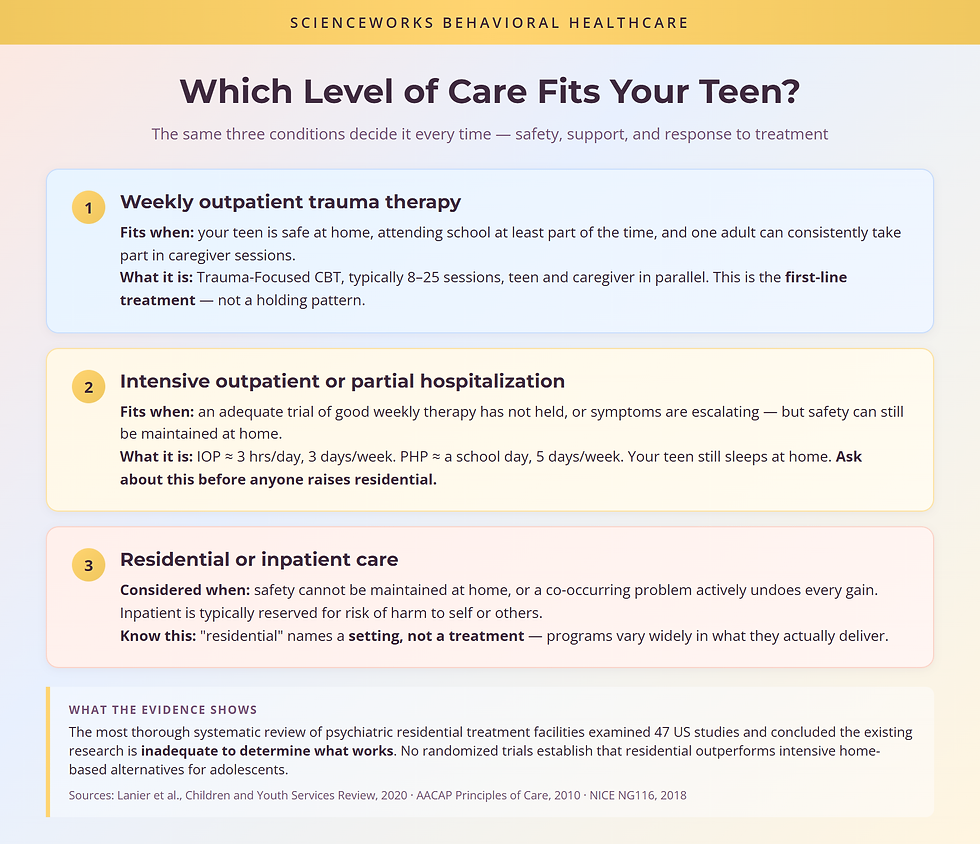
"Residential treatment has better outcomes." This is the claim with the least evidence behind it, and it is worth being direct about that. The most thorough systematic review of behavioral health interventions in psychiatric residential treatment facilities examined 47 U.S. studies and concluded the existing research is inadequate to determine what actually works in these settings [4]. Most studies show improvement, but most are pre-post designs without control groups, which cannot tell you whether a teen would have improved as much or more somewhere less restrictive. That is different from saying residential does not help — but it is also not the settled evidence base parents are usually led to assume.
"All residential programs offer basically the same thing." They do not. A study of youth-serving residential facilities found evidence-based components are far from universal — family therapy in about 76% of facilities, family psychoeducation in about 74% [5]. "Residential treatment" names a setting, not a treatment. Two programs with identical brochures can deliver very different clinical content.
Key takeaway: 🔍 "Residential" describes where your teen sleeps, not what they receive. The treatment model is the thing to ask about.
What outpatient trauma therapy for teens actually involves
The most established approach for adolescents is Trauma-Focused Cognitive Behavioral Therapy. It typically runs 8 to 25 sessions and is delivered to the teen and the caregiver in parallel, with conjoint sessions built in [6]. That caregiver component is not incidental — AACAP's parameter emphasizes including parents or caregivers in the evaluation and treatment wherever possible [3]. The largest synthesis to date, an individual-participant-data meta-analysis pooling 1,686 young people aged 6 to 18 across 25 randomized trials, found significantly lower post-treatment PTSD symptoms for those receiving trauma-focused CBT compared with controls [7].
For teens who do not respond to or engage with trauma-focused CBT, EMDR is the recognized next option — NICE's PTSD guideline positions it specifically as the step after trauma-focused CBT for 7-to-17-year-olds, rather than as an equivalent first choice [8].
If you want a fuller picture of what changes when the client is a teenager rather than an adult — consent, confidentiality, how school and sleep become clinical information — we covered that ground separately in what teen trauma therapy actually looks like.
When outpatient therapy tends to fit well
Your daughter came home different after the accident last spring — here is the shape this often takes. She is sleeping badly, she has stopped driving, and she snaps at everyone in a way that is not like her. But she still goes to school most days, she still has two friends she texts, and when you raised the idea of talking to someone she said "fine, whatever" instead of refusing outright. She is struggling, visibly and significantly, and she is also still standing. This is the profile that weekly trauma-focused therapy is built for.
Or: your son will not talk about what happened at his father's house, and he has become withdrawn and irritable over four months. His grades slipped from Bs to Ds. He is not in danger and he has not hurt himself, but he is clearly carrying something. You can keep him safe at home. There is a parent or guardian who can bring him to appointments and participate in the caregiver sessions. That last part matters more than families expect — the caregiver component is a working part of the treatment, not a courtesy.
The distinguishing pattern: outpatient tends to fit when the teen's safety can be maintained at home and there is at least one adult who can be consistently involved. Those two conditions do most of the work in this decision.
Key takeaway: 🤝 A reliably involved caregiver is one of the strongest arguments for keeping treatment at home — it is a component of the treatment itself, not just transportation.
When your teen may need more than weekly therapy
Sometimes weekly sessions are genuinely not enough, and recognizing that early matters.
Consider: your son has been in weekly therapy for five months with a clinician you like. He goes, he engages, and he is getting worse rather than better. He has stopped going to school entirely, he is not sleeping, and last month he said something that frightened you badly enough that you slept in the hallway. If your teen says something like that, treat it as urgent on the day — call or text 988 rather than waiting on a referral [11]. Past the immediate safety question: you have done the adequate outpatient trial, and it is not holding him.
Or: your daughter's trauma sits alongside escalating substance use, and the two feed each other. Every time she makes progress in therapy, a weekend undoes it. Home cannot interrupt that cycle no matter how good the Tuesday appointment is.
The six things a clinician is actually weighing
Level-of-care decisions are not guesswork. AACAP and the American Association for Community Psychiatry maintain a standardized instrument, CALOCUS-CASII, used to determine service intensity for young people aged 6 to 18. It assesses six dimensions [9]:
Risk of harm — to self or others
Functional status — school, home, relationships, daily functioning
Co-occurrence — developmental, medical, substance use, or additional psychiatric conditions such as depression
Recovery environment — whether home can support and not undermine treatment
Resilience and response to services — how your teen has responded to treatment so far
Engagement in services — whether teen and family are able to participate
Those six are the honest answer to "what signals that a teen needs more than weekly therapy." Notice what is not on the list: how upsetting the original event was, or how worried you are. Both are real; neither determines setting.
The instrument is explicit that it does not provide a diagnosis and does not replace a comprehensive clinical evaluation [9]. It structures judgment; it does not substitute for it.
Two things worth knowing about the top of the continuum. Inpatient care is typically reserved for young people whose illness has reached a point of posing a risk of harm to themselves or others [10]. And there is a great deal of ground between weekly therapy and residential placement — intensive outpatient and partial hospitalization programs add substantial clinical hours while your teen still sleeps at home. Families are often presented with a binary that does not exist.
Key takeaway: ⚖️ Risk, functioning, co-occurring conditions, home environment, response to treatment, and ability to engage. Those six decide it — not the severity of the event itself.
If your teen is in immediate danger, this article is not the right tool. Call or text 988, the Suicide and Crisis Lifeline, or go to your nearest emergency department [11]. Level-of-care planning happens after stabilization, not instead of it.
Questions to ask before agreeing to any program
Whether you are evaluating an outpatient clinician or a residential placement, these get you past the brochure. Ask them verbatim.
Scope: Which specific trauma model do you use with adolescents, and who trained your staff in it? If the answer is a general description of the milieu rather than a named model, that is the answer.
Methodology: How do you involve caregivers, and how many sessions per month would I actually be in? Given that caregiver involvement is a working component of trauma-focused treatment for teens, a program that keeps parents at arm's length is making a clinical choice you should understand.
Assessment: What evaluation happens before admission, and who conducts it? AACAP's principles call for a comprehensive evaluation by a licensed graduate-level provider prior to admission [1]. A program that can admit tonight has not done one.
Output: What does discharge planning look like, and what happens in the first 30 days after my teen comes home? Ask this early, not at the end. Discharge planning should focus on safe transitions to clinically appropriate, less restrictive settings [10].
Alternatives: What less restrictive options did you consider for my teen, and why were they ruled out? Any program that cannot answer this has skipped the step that makes the placement defensible.
A structured symptom measure can also help clarify what is actually present before you are deciding under pressure.
Key takeaway: 📋 A program that can admit your teen tonight has not done a pre-admission evaluation. Speed is not a service here.

How a clinician helps you decide
A good consultation does three things. It establishes what is actually happening — a real assessment, not an intake form, gathering history from you as well as your teen. It maps that onto the continuum honestly, including saying "this is more than we should handle weekly" when that is true. And it tells you what would have to change for the answer to change.
That last part is the one families find most useful: "if he is still refusing school in six weeks, we revisit this" is a decision point rather than an open-ended worry.
Clinicians should also be able to say when they are not the right fit. A practice that treats every teen who walks in as a candidate for its own services is not doing a level-of-care assessment; it is doing intake. Ask directly: is there a level of care you think we need that you don't provide?
If you're not sure where to start
A rule of thumb you can apply before you leave this page:
If your teen is safe at home, attending school at least part of the time, and there is an adult who can consistently participate — start with weekly trauma-focused outpatient therapy. That is the first-line treatment, not a holding pattern.
If your teen has had an adequate trial of good outpatient care and is not improving, or is losing ground — ask specifically about intensive outpatient or partial hospitalization before anyone raises residential. That middle ground is where most escalation should land first.
If safety cannot be maintained at home, or a co-occurring problem is actively undoing every gain — a higher level of care is a reasonable conversation, and the six CALOCUS-CASII dimensions are what should drive it.
If you genuinely cannot tell — that is a clinical question, and it is a reasonable thing to book a consultation to answer. SAMHSA's national helpline is also a free, confidential treatment referral service if you need help finding options [13]. You do not need to arrive with the decision already made.
One thing worth saying plainly: fear is not a clinical indicator. Arriving terrified that your teenager needs to be sent away is understandable, and it is not the same as evidence that they do — for many families, specialized outpatient trauma care turns out to be the right level.
Key takeaway: 🧭 If you cannot tell which level is right, that uncertainty is itself a good reason to book an assessment — not a reason to default to the most intensive option.
Carrying something that still feels close?
Trauma-focused care — including approaches like EMDR — can help you process what happened at a pace that feels safe, with a clinician who understands trauma responses.
Frequently Asked Questions
What type of therapist should a teenager see for trauma?
Look for a licensed clinician with specific training in a trauma-focused model for adolescents — most often Trauma-Focused CBT, sometimes EMDR. The training matters more than the license letters. A useful question is which trauma model they were formally trained in, who supervised that training, and roughly how many teens they have treated with it. General talk therapy is not the same as trauma-focused therapy, and the difference shows up in outcomes.
What is a partial hospitalization or intensive outpatient program?
They are the middle of the care continuum, between weekly therapy and residential placement. Intensive outpatient usually means around three hours a day, three days a week, with your teen living at home. Partial hospitalization is closer to a school day, five days a week, still going home at night. Both keep your teen in their own bed, school and friendships while adding clinical hours — which is often exactly what is needed.
Can we start outpatient therapy while we consider other options?
Yes, and in most situations that is the sensible order. Starting weekly trauma-focused therapy gives you clinical information you do not currently have: how your teen engages, whether symptoms shift, and what gets in the way. If a higher level of care turns out to be needed, that trial is not wasted — it is the evidence a good program will ask for, and it makes the referral more precise.
Does insurance cover residential treatment for teens?
Coverage varies a great deal by plan, and residential is usually the level of care with the most conditions attached. Most plans require documented medical necessity and evidence that less intensive options were tried or ruled out. Before agreeing to a program, ask for the specific billing codes, request a benefits check in writing, and ask what happens financially if your teen's stay runs longer than authorized.
What should we do if our teen is in immediate danger?
Do not work through a referral process. Call or text 988, the Suicide and Crisis Lifeline, or go to your nearest emergency department. Level-of-care decisions like the ones in this article are for planning ongoing treatment, not for managing an acute emergency. Once your teen is safe, the stabilization team can help you think about what the right next step looks like.
About the Author
Dr. Kiesa Kelly is a licensed clinical psychologist and the founder of ScienceWorks Behavioral Health. Her background includes more than 20 years of experience in psychological assessment and evidence-based treatment, with clinical training at the University of Chicago, Vanderbilt University, and the University of Wisconsin, and NIH-funded postdoctoral research training.
Her assessment and treatment work spans trauma and PTSD, OCD, anxiety, and neurodevelopmental evaluation for adolescents and adults. Level-of-care questions — determining what intensity of treatment a young person actually needs — are a routine part of her clinical practice and of the consultations ScienceWorks provides to families across Tennessee.
References
1. American Academy of Child and Adolescent Psychiatry. Principles of Care for Treatment of Children and Adolescents with Mental Illnesses in Residential Treatment Centers. AACAP; 2010. https://www.aacap.org/App_Themes/AACAP/docs/clinical_practice_center/clinical_care/Principles_of_Care_in_RTC_FINAL.pdf
2. Substance Abuse and Mental Health Services Administration. National Guidelines for Child and Youth Behavioral Health Crisis Care. Publication No. PEP22-01-02-001. Rockville, MD: SAMHSA; 2022. https://library.samhsa.gov/product/national-guidelines-child-and-youth-behavioral-health-crisis-care/pep22-01-02-001
3. Cohen JA, Bukstein O, Walter H, et al. Practice Parameter for the Assessment and Treatment of Children and Adolescents With Posttraumatic Stress Disorder. J Am Acad Child Adolesc Psychiatry. 2010;49(4):414-430. https://doi.org/10.1016/j.jaac.2009.12.020
4. Lanier P, Jensen T, Bryant K, et al. A systematic review of the effectiveness of children's behavioral health interventions in psychiatric residential treatment facilities. Child Youth Serv Rev. 2020;113:104951. https://doi.org/10.1016/j.childyouth.2020.104951
5. Herbell K, Breitenstein SM, Ault S, Price M. Variation in Evidence-Based Practices Among Youth-Serving Residential Treatment Facilities. J Am Psychiatr Nurses Assoc. 2024;30(3):503-517 (published online 2022). https://doi.org/10.1177/10783903221120828
6. National Child Traumatic Stress Network. Trauma-Focused Cognitive Behavioral Therapy (TF-CBT). National Center for Child Traumatic Stress. Accessed September 12, 2026. https://www.nctsn.org/interventions/trauma-focused-cognitive-behavioral-therapy
7. de Haan A, Meiser-Stedman R, Landolt MA, et al. Efficacy and moderators of efficacy of cognitive behavioural therapies with a trauma focus in children and adolescents: an individual participant data meta-analysis of randomised trials. Lancet Child Adolesc Health. 2024;8(1):28-39. https://doi.org/10.1016/S2352-4642(23)00253-5
8. National Institute for Health and Care Excellence. Post-traumatic stress disorder. NICE guideline [NG116]. London: NICE; 2018. https://www.nice.org.uk/guidance/ng116/chapter/Recommendations
9. American Academy of Child and Adolescent Psychiatry, American Association for Community Psychiatry. CALOCUS-CASII: Child and Adolescent Level of Care / Service Intensity Utilization System. Accessed September 12, 2026. https://www.aacap.org/aacap/Member_Resources/Practice_Information/CALOCUS_CASII.aspx
10. American Academy of Child and Adolescent Psychiatry. Principles of Care of Inpatient Care of Children and Adolescents. AACAP; January 2026. https://www.aacap.org/App_Themes/AACAP/docs/clinical_practice_center/clinical_care/Principles_Inpatient_Care.pdf
11. Substance Abuse and Mental Health Services Administration. 988 Suicide & Crisis Lifeline. Accessed September 12, 2026. https://www.samhsa.gov/mental-health/988
12. McLaughlin KA, Koenen KC, Hill ED, et al. Trauma exposure and posttraumatic stress disorder in a national sample of adolescents. J Am Acad Child Adolesc Psychiatry. 2013;52(8):815-830.e14. https://doi.org/10.1016/j.jaac.2013.05.011
13. Substance Abuse and Mental Health Services Administration. SAMHSA National Helpline. Accessed September 12, 2026. https://www.samhsa.gov/find-help/helplines/national-helpline
Disclaimer
This article is for informational purposes only and is not a substitute for individualized clinical advice, diagnosis, or treatment. Reading it does not create a clinician-patient relationship. Decisions about level of care for a young person should be made with a qualified clinician who has evaluated that specific teenager. If your teen is in immediate danger, call or text 988 or go to your nearest emergency department.