
Twice-Exceptional Assessment for Adults: What a 2e-Informed Evaluation Looks For

Updated: 4 days ago
Last reviewed: 10/12/2026
Reviewed by: Dr. Kiesa Kelly

If you already suspect you are twice-exceptional, the question that stalls most people is not what is 2e. It is what do I actually book, and what happens if I book the wrong thing.
That worry has a specific answer. A twice-exceptional profile is defined by the distance between measured ability and genuine, disabling difficulty. Measuring the difficulty side is what a standard adult ADHD or autism evaluation already does well. Measuring the ability side takes cognitive testing — and in our adult assessment process, as at many practices, cognitive testing is an optional add-on rather than part of the standard battery. Nobody is cutting corners when it is left out; the evaluation is simply scoped to the question you asked at booking.
In this article, you'll learn:
Why twice-exceptional is not a diagnosis, and what that changes about what you can request
What happens at each step of an adult evaluation, in order, and how the costs are structured
Which instruments are used, by name, including the optional cognitive battery
What the written report contains and what it can realistically be used for
How the process works over telehealth, and where that evidence is thinner
The exact wording to use when asking any provider for a 2e-informed scope
Before you book: 2e is a profile, not a diagnosis code
Here is the one-paragraph orientation, then we move to the machinery. Twice-exceptional describes someone showing high ability alongside a co-occurring disability that creates real functional cost — an operational definition first formalized in the gifted-education literature [2]. For the fuller picture of how that shows up in adult life, and why it goes unrecognized for decades, our guide to twice-exceptional adults covers that ground.
The procedural consequence is easy to miss. Twice-exceptional is not in the DSM-5-TR. ADHD and autism are [1]. There is no such thing as being "diagnosed 2e." What you walk out with is a diagnostic finding, a measured cognitive profile, and a written interpretation of how the two interact — and that interpretation cannot exist unless both halves were measured.
🧭 Key takeaway: You cannot be diagnosed with twice-exceptionality. You can be assessed for a condition and separately measured for ability, and then have a clinician explain how the two interact in writing.

That reframing matters because of a common misconception: a really thorough evaluation will automatically catch a 2e profile. It will not. An evaluation can be rigorous, well-instrumented, and entirely correct while still being unable to answer a question it was never asked.
The one thing to ask for: cognitive testing is usually an add-on
This is the practical center of the whole article. In our process, IQ and cognitive testing is an optional addition at the clinical interview step. It is not part of the standard adult ADHD or autism battery.
So consider what happens when someone books a standard adult ADHD evaluation, does everything right, and never mentions giftedness. The clinician gathers history, administers validated rating scales, runs a structured diagnostic interview, and produces an accurate ADHD finding. The report is competent — and it still cannot say anything about a 2e profile, because the ability side was never measured. There is no failure in that chain, only a scope decision made by default rather than on purpose.
A second misconception is worth naming: asking for cognitive testing implies you think the clinician will miss something. It does not. It means you are adding a question to the evaluation, and scope is a conversation you are entitled to have at the front end — the same call where you would discuss whether to look at one condition or two. If you are still deciding whether a formal evaluation is your next step at all, our mental health screening page is a lower-stakes starting point.
⚖️ Key takeaway: A 2e profile is a comparison. If nobody measures the ability side, the comparison cannot be made — no matter how good the rest of the evaluation is.
What actually happens, step by step
Our adult pathway runs in five stages, for adults 18 and older.
Step 0 — Free phone consultation ($0)
A short call to map what you are trying to answer. This is where the package is designed: one condition or two, cognitive testing or not, which written output you will need. Everything downstream is shaped here, so arrive with your questions written down.
Step 1 — Onboarding and data collection
Intake and validated screeners are completed through our app at your own pace rather than in a rushed appointment. That pacing matters: self-report about lifelong patterns is more accurate when you are not being watched and can revisit a question you answered too quickly.
For a sense of the instrument style, the ASRS is the standard adult ADHD self-report screener, and the AQ-10 plays a similar role on the autism side. Neither is diagnostic. Both are structured ways of putting your experience into a form a clinician can compare against criteria.
Step 2 — Clinical interview, plus optional cognitive testing
The clinical interview establishes broader context, using the PAI for general psychological functioning [16], the BRIEF-A for everyday executive functioning [15], the CAARS 2 for adult ADHD symptoms [14], and the SRS-2 where autism is in scope. These sit alongside the interview rather than replacing it.
Cognitive testing is the optional piece at this step. A current adult battery such as the WAIS-5 produces a full-scale score and, more usefully for a 2e question, separate index scores across verbal comprehension, visual-spatial reasoning, fluid reasoning, working memory, and processing speed [13]. The indexes matter far more here than the headline number.
Step 3 — Diagnostic interview
For ADHD, this is built around the DIVA-5, a semi-structured diagnostic interview mapped to DSM-5 criteria, whose validity has been examined in several independent translations [12]. We also administer a virtual continuous performance test to add objective task data.
For autism, we use the MIGDAS-2, a structured, sensory-based interview framework that organizes observation across sensory interests, language and communication, and social and emotional responses [17]. Worth saying plainly: it is a clinical interview guide, not a normed diagnostic test, and its published evidence base is thinner than that of long-established autism instruments. It supports clinical judgment rather than substituting for it. Both NICE guidelines say the same for their conditions — adult diagnosis rests on clinical assessment and history, not any single instrument [4][5].
If both conditions are genuinely in play, our walkthrough of combined AuDHD assessment in adults covers how that pathway differs.
Step 4 — Feedback and written output
Feedback is a 30-minute session where results are explained conversationally. Written documentation is priced separately, because not everyone needs the same thing: a diagnostic letter of one to two pages, a full report of 15 or more pages, and an accommodation letter.
Adult ADHD or autism assessments start at $1,099. We are self-pay, accept major credit cards, provide a Good Faith Estimate under the No Surprises Act, and offer CareCredit interest-free payment plans for qualifying individuals.
🧾 Key takeaway: The base price answers a diagnostic question. Cognitive testing and the written report are the two decisions that turn that into something you can use as a 2e profile.
How a 2e reading is actually made — and why scatter alone is not it
This is where the third misconception needs correcting: a big gap between my index scores proves I am twice-exceptional. It does not, and a careful clinician will tell you so.
Large discrepancies between a person's best and worst scores are common in healthy adults. In normative samples, once a battery includes enough measures, most people show at least one "abnormal" score and sizeable spread between their highest and lowest results [8]. Uneven profiles are the norm, not the signal. What makes a discrepancy meaningful is whether it lines up with a documented functional cost — the missed deadlines, the exhausting recovery after social days, the projects that stall at 80 percent — sustained across settings and years.
Two things make this skilled work in adults. First, compensation: years of practiced workarounds can flatten the very signs an evaluation looks for, which is a well-documented reason adult ADHD in women goes unrecognized [6] and why a generation of autistic adults reached midlife undiagnosed [7]. Second, ability itself can mask difficulty inside the session, because a strong reasoner can sometimes brute-force a task that would otherwise expose a weakness. Hence the conclusion the twice-exceptional literature keeps reaching — identification requires a comprehensive, individualized approach rather than any single score [3].
Consider a concrete version. Someone completes a battery and comes back with verbal comprehension near the ceiling, processing speed well below their other indexes, and an ADHD finding. On paper that is a spread. What makes it a 2e reading is the rest of the file: a career built on being the person who understands the problem fastest, a decade of being late on documentation, a history of choosing verbal roles over written ones, and exhaustion that lands on exactly the days requiring sustained output rather than insight. The numbers are the evidence; the interpretation is the finding — which is why the clinician doing it matters as much as the instrument. Dr. Kelly's assessment background is oriented around that kind of pattern reading.
🔍 Key takeaway: Score scatter by itself is ordinary. A 2e profile is scatter that matches a documented, long-standing functional cost.
Doing this by telehealth — what the evidence supports and where it thins
Our assessment process is fully virtual over HIPAA-compliant videoconferencing, cognitive testing included. That deserves evidence rather than reassurance, so here is the honest state of it.
The strongest recent support is direct: a randomized, counterbalanced study comparing telehealth and in-person administration of the WAIS-IV in healthy adults found highly concordant results across all subtests and indexes, with excellent agreement coefficients and no systematic bias [10]. Earlier meta-analytic work reached a narrower but consistent conclusion — verbally mediated tasks such as digit span, verbal fluency, and list learning were unaffected by videoconference administration, while pooled data across mixed task types were too heterogeneous to support a single summary effect [9].
Where it thins is predictable. Timed and visual-motor tasks are the most sensitive to video quality, audio lag, and unfamiliar hardware, and professional teleneuropsychology guidance is explicit that the environment, the equipment, and the choice of which measures to administer remotely are part of the validity question rather than logistics [11]. So the setup is not incidental: a quiet room, a stable connection, a real screen rather than a phone, and no one else present unless the protocol calls for it.
💻 Key takeaway: Remote cognitive testing is well supported for verbal reasoning and memory measures, and more setup-dependent for timed and visual-motor tasks. Ask which subtests your evaluator modifies or omits over video.
How to prepare
Preparation is mostly about history, because the developmental record is the part no instrument can generate for you.
Gather anything that documents early ability and early cost side by side: school records, standardized test results, gifted or advanced-placement records, report-card comments, old performance reviews. Comments often beat scores — "capable but inconsistent," "needs to apply himself," "does not work to potential" are the sentences that put a functional cost next to a demonstrated ability in the same paragraph. If a parent or older sibling can speak to your childhood, ask them early rather than the night before.
Then write down what you want the report to do for you. Wanting an explanation, wanting treatment access, and wanting documentation a workplace will accept are three different goals, and they decide which written output to buy at Step 4. Our guide on preparing for an adult assessment intake covers the general version in more detail.
📋 Key takeaway: Bring documents that show ability and cost in the same time period. That pairing is the raw material a 2e interpretation is built from.
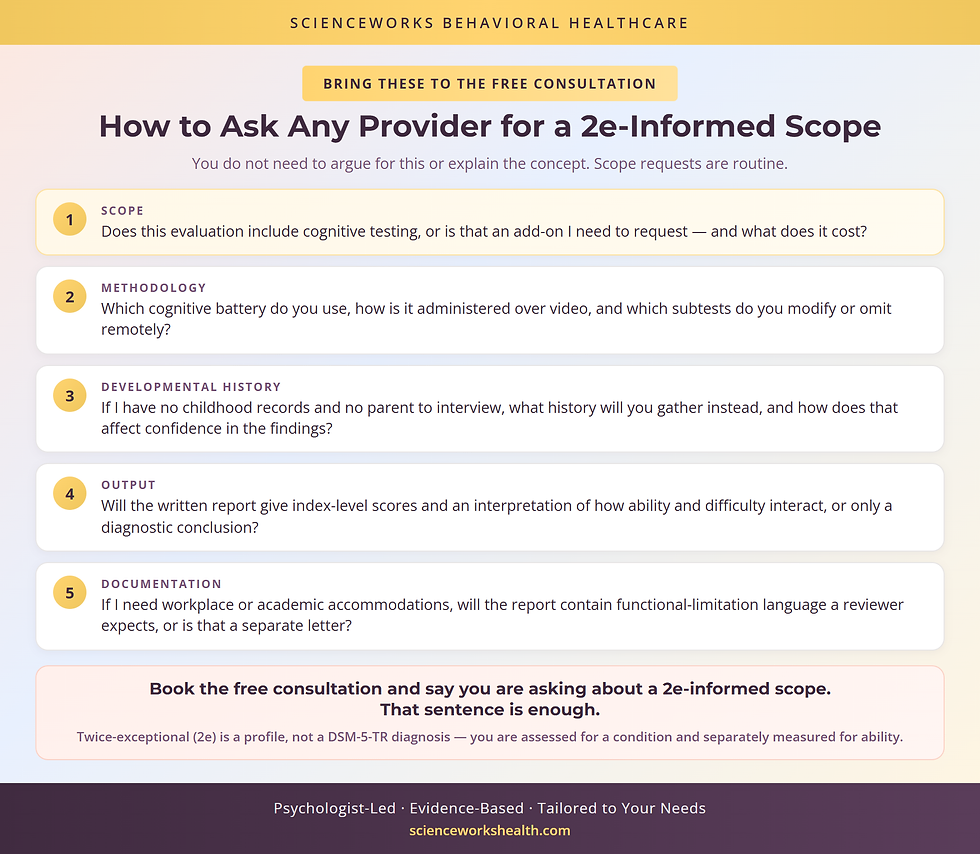
How to request a 2e-informed scope from any provider
You do not need to argue for this or explain the concept. You need to make a scope request, and scope requests are routine.
Start with a decision heuristic. If you already have an ADHD or autism diagnosis and the open question is why capability and daily function do not match, ask about adding cognitive testing to a targeted evaluation rather than repeating the diagnostic workup. If you have no diagnosis and both strong ability and real functional cost are in play, request cognitive testing in the initial package, because adding it later usually means another appointment and another fee. And if your only goal is a diagnosis for treatment access, a standard evaluation is correctly scoped — declining cognitive testing is a reasonable choice, not a shortcut.
Then ask these five questions, more or less verbatim, at the consultation:
Scope: Does this evaluation include cognitive testing, or is that an add-on I need to request — and what does it cost?
Methodology: Which cognitive battery do you use, how is it administered over video, and which subtests do you modify or omit remotely?
Developmental history: If I have no childhood records and no parent to interview, what history will you gather instead, and how does that affect confidence in the findings?
Output: Will the written report give index-level scores and an interpretation of how ability and difficulty interact, or only a diagnostic conclusion?
Documentation: If I need workplace or academic accommodations, will the report contain functional-limitation language a reviewer expects, or is that a separate letter?
That last one is worth understanding before you ask it. Under EEOC guidance, documentation supporting an accommodation request is expected to describe the nature, severity, and duration of the impairment, the activities it limits, the extent of that limitation, and why the specific accommodation is needed [18]. A diagnostic label alone rarely satisfies that, which is why we price an accommodation letter separately — it is written for a different reader than the clinical report.
Where this leaves you
A 2e-informed evaluation is not a different product. It is a standard adult ADHD or autism evaluation with the ability side measured and the interaction interpreted in writing. The steps, instruments, and costs are all knowable in advance, so the one thing genuinely at risk is the scope decision — and that gets made in a short phone call before anything is scheduled.
If what you want next is a plan rather than a label, executive function coaching addresses the follow-through side without requiring a diagnosis first. And if you would rather just ask a person, reach out to our team and say you are asking about a 2e-informed scope. That sentence is enough.
Thinking through what your evaluation should include?
Our adult psychological assessment page lays out every step, instrument, and price so you can decide what belongs in your package before you book the free consultation.
Frequently Asked Questions
Can cognitive testing for a 2e profile be done over telehealth?
Yes, in most cases. Our assessment process is fully virtual over HIPAA-compliant videoconferencing, and a 2025 equivalence study of the WAIS-IV found excellent agreement between remote and in-person scores in healthy adults. Verbally administered subtests hold up best; timed and visual-motor tasks are more sensitive to connection quality and setup. Ask your evaluator which subtests they modify or omit remotely, and what your room and device need to look like.
Is IQ testing included in a standard adult ADHD or autism evaluation?
Usually not. In our process, cognitive testing is an optional add-on at the clinical interview step rather than part of the standard battery, and that structure is common across practices. Because a twice-exceptional profile is defined by the gap between measured ability and real disabling difficulty, an evaluation without cognitive testing cannot describe that gap. If the 2e question matters to you, raise it at the free consultation.
What does a 2e-informed assessment report actually include?
It includes your cognitive index scores and how those indexes compare with each other, the diagnostic findings for ADHD and/or autism, and an interpretation of how strong ability and genuine difficulty interact day to day. Our full report runs 15 or more pages; a shorter diagnostic letter of one to two pages is also available. You own the document and decide who sees it.
Will the report support a workplace or school accommodation request?
Often, but the format matters more than the diagnosis. EEOC guidance describes documentation that covers the nature, severity, and duration of the impairment, what it limits, and why the requested accommodation is needed. A diagnostic label alone rarely covers that. We offer a separate accommodation letter as an add-on written for that purpose, so ask what your reviewer expects before you request one.
What makes a 2e-informed evaluation cost more than a standard one?
Three things drive the difference: how many conditions are assessed, whether cognitive testing is added, and which written output you choose. Adult ADHD or autism evaluations start at $1,099, and cognitive testing, reports, and letters are priced separately. We are self-pay, provide a Good Faith Estimate, and CareCredit plans are available for qualifying individuals.
About ScienceWorks
ScienceWorks Behavioral Healthcare was founded by Dr. Kiesa Kelly, a licensed clinical psychologist with more than 20 years of experience in psychological assessment and evidence-based treatment. Our assessment work centers on adults and adolescents seeking clarity about ADHD, autism, and co-occurring conditions, with particular attention to high-masking adults and working professionals whose difficulties have been obscured by long-standing compensation.
We are a telehealth-forward practice serving Tennessee, with an in-person option at our Nashville office. Our assessment process is neurodiversity-affirming and fully virtual over HIPAA-compliant videoconferencing, and we provide therapy and executive function coaching in-house so that an evaluation can lead directly into support rather than a referral list. Every article we publish is reviewed by a licensed clinician for accuracy before it goes live.
References
1. American Psychiatric Association. Diagnostic and Statistical Manual of Mental Disorders, Fifth Edition, Text Revision (DSM-5-TR). American Psychiatric Association Publishing; 2022. https://doi.org/10.1176/appi.books.9780890425787
2. Reis SM, Baum SM, Burke E. An operational definition of twice-exceptional learners: Implications and applications. Gifted Child Quarterly. 2014;58(3):217-230. https://doi.org/10.1177/0016986214534976
3. Foley Nicpon M, Allmon A, Sieck B, Stinson RD. Empirical investigation of twice-exceptionality: Where have we been and where are we going? Gifted Child Quarterly. 2011;55(1):3-17. https://doi.org/10.1177/0016986210382575
4. National Institute for Health and Care Excellence (NICE). Attention deficit hyperactivity disorder: diagnosis and management. NICE guideline NG87. 2019. https://www.nice.org.uk/guidance/ng87
5. National Institute for Health and Care Excellence (NICE). Autism spectrum disorder in adults: diagnosis and management. Clinical guideline CG142. 2021. https://www.nice.org.uk/guidance/cg142
6. Attoe DE, Climie EA. Miss. Diagnosis: A systematic review of ADHD in adult women. Journal of Attention Disorders. 2023;27(7):645-657. https://doi.org/10.1177/10870547231161533
7. Lai MC, Baron-Cohen S. Identifying the lost generation of adults with autism spectrum conditions. The Lancet Psychiatry. 2015;2(11):1013-1027. https://doi.org/10.1016/S2215-0366(15)00277-1
8. Binder LM, Iverson GL, Brooks BL. To err is human: "Abnormal" neuropsychological scores and variability are common in healthy adults. Archives of Clinical Neuropsychology. 2009;24(1):31-46. https://doi.org/10.1093/arclin/acn001
9. Brearly TW, Shura RD, Martindale SL, et al. Neuropsychological test administration by videoconference: A systematic review and meta-analysis. Neuropsychology Review. 2017;27(2):174-186. https://doi.org/10.1007/s11065-017-9349-1
10. Bartholomaeus V, Chronowski NH, Santiago PHR, et al. Equivalence of telehealth and face-to-face administration of the Wechsler Adult Intelligence Scale Fourth Edition (WAIS-IV). The Clinical Neuropsychologist. 2025;39(5):1073-1096. https://doi.org/10.1080/13854046.2024.2335117
11. Bilder RM, Postal KS, Barisa M, et al. InterOrganizational Practice Committee recommendations/guidance for teleneuropsychology (TeleNP) in response to the COVID-19 pandemic. The Clinical Neuropsychologist. 2020;34(7-8):1314-1334. https://doi.org/10.1080/13854046.2020.1767214
12. Di Lorenzo R, Latella E, Gualtieri F, Adriani A, Ferri P, Filippini T. Validity of the Italian version of DIVA-5: Semi-structured diagnostic interview for adult ADHD based on the DSM-5 criteria. Healthcare (Basel). 2025;13(3):244. https://pmc.ncbi.nlm.nih.gov/articles/PMC11816683/
13. Pearson. Wechsler Adult Intelligence Scale, Fifth Edition (WAIS-5). NCS Pearson; 2024. https://www.pearsonassessments.com/store/en/usd/p/P100071002.html
14. Multi-Health Systems. Conners Adult ADHD Rating Scales, Second Edition (CAARS 2). MHS; 2023. https://storefront.mhs.com/collections/caars-2
15. Psychological Assessment Resources. Behavior Rating Inventory of Executive Function, Adult Version (BRIEF-A). PAR. https://www.parinc.com/products/BRIEF-A
16. Psychological Assessment Resources. Personality Assessment Inventory (PAI). PAR. https://www.parinc.com/products/PAI
17. Western Psychological Services. Monteiro Interview Guidelines for Diagnosing the Autism Spectrum, Second Edition (MIGDAS-2). WPS. https://www.wpspublish.com/migdas-2-monteiro-interview-guidelines-for-diagnosing-the-autism-spectrum-second-edition.html
18. U.S. Equal Employment Opportunity Commission. Enforcement guidance on reasonable accommodation and undue hardship under the ADA. EEOC. https://www.eeoc.gov/laws/guidance/enforcement-guidance-reasonable-accommodation-and-undue-hardship-under-ada
Disclaimer
This article is for informational purposes only and is not a substitute for individualized clinical advice, diagnosis, or treatment. Reading it does not create a clinician-patient relationship. Assessment pricing and process details reflect our adult (18+) pathway as of the review date above and may change; confirm current details at your free consultation. If you are in crisis, call or text 988 in the United States to reach the Suicide and Crisis Lifeline.