
ADHD Medication and Executive Function: What It Doesn't Fix

Updated: Oct 1
Last reviewed: 09/24/2026
Reviewed by: Dr. Kiesa Kelly

The first weeks on ADHD medication can feel like someone turned the lights up. You can sit through a meeting and follow it. You read a page once instead of three times. And then, a month or two in, you notice what did not change: the unopened mail, the project with no plan, the dentist appointment you still have not booked.
That gap is common, and it is not a sign that the medication failed or that you did. Medication changes how well some mental skills work in the moment. It does not build the plans, habits and systems that turn good focus into finished tasks. Our overview of executive dysfunction in adults covers the skills themselves. This article is about the gap between taking medication and getting things done.
In this article, you'll learn:
What ADHD medication has been shown to improve, and what the studies did not measure
Three common beliefs about medication and executive function that do not hold up
Why many adults still struggle while taking medication that is working
What helps alongside medication, and how strong that evidence is
A rule of thumb for when to go back to your prescriber, a therapist, or a fresh assessment
The short answer: medication changes capacity, not skills or systems
Think of executive function as two layers. One is capacity: how well you can hold attention, hold back an impulse, or keep information in mind. The other is the set of skills and systems built on top of it: planning a project, breaking it into steps, starting on time, and having a routine that catches what you would otherwise forget.
This two-layer picture is a clinical framework rather than a research finding, but it matches where the research sits: almost entirely in the first layer. A 2024 meta-analysis of longer-term treatment in people with ADHD (the pooled studies were not limited to adults) found that methylphenidate improved reaction time, attention, inhibition and working memory compared with placebo, with small to medium effects [1]. Those are real gains. But planning, organizing and following through were not among the domains that meta-analysis pooled, so there is little direct evidence either way. Clinically, a skill that was never learned rarely appears just because attention improved. If you want the mirror image of this article, our piece on what therapy can and cannot do without medication covers the other direction.
🧠 Key takeaway: Medication can make the engine run more smoothly. It does not draw the map or build the habits that get you where you are going.
Three things people get wrong about medication and executive function
"If the medication were working, I would be organized by now." Medication and organization are measured differently. The trials above tested focus and self-control on lab tasks over weeks [1], and a large 2025 review of adult treatments found that stimulants and atomoxetine reduced core ADHD symptoms in the short term [2]. The same review found that ADHD medications were not shown to improve broader outcomes such as quality of life [2]. Getting organized is arguably closer to those broader outcomes than to a focus test.
"Pills don't teach skills, so medication does not really help executive function." This saying overstates the case. Medication does not teach skills, but it does improve several of the capacities that skills depend on. In the 2024 meta-analysis, both methylphenidate and atomoxetine improved attention and inhibition over placebo [1]. The accurate version is narrower: medication helps some of the raw ingredients, and the rest still has to be built.
"If I still struggle, I need a stronger dose." Sometimes that is the right question for your prescriber, but it is not the only explanation. Adult ADHD commonly comes with other conditions, including anxiety and mood disorders such as depression [3]. Those conditions can bring their own problems with starting and finishing. Poor sleep, a missing planning system, or low mood can all look like "the medication stopped working." If your mood has been low, a PHQ-9 depression screener is one quick way to check whether that deserves its own conversation [4].
🔎 Key takeaway: Still struggling on medication often means something besides focus needs attention too. It is not a sign that you failed, and it is worth reviewing with your prescriber and, where relevant, a therapist.

What medication typically improves
Attention, inhibition and working memory: what the trials actually measure
When researchers test ADHD medication and executive function, they mostly use standardized tasks, often timed and computerized: responding to one kind of target and holding back on another, holding a string of items in mind, or keeping attention on a dull task. On these measures, methylphenidate showed small to medium improvements over placebo in the 2024 meta-analysis [1].
The details matter. An earlier analysis of placebo-controlled methylphenidate studies found improvements in response inhibition and sustained attention that did not depend on age, in children or adults [5]. Its estimate for working memory was smaller and fell just short of statistical significance [5]. And atomoxetine, a non-stimulant, did not show a significant effect on working memory in the 2024 analysis while improving the other domains [1]. So "medication improves working memory" is less settled than "medication improves attention and self-control."
How that shows up day to day
Here is what the capacity gains often look like in real life.
You used to lose the thread in team meetings, and now you follow the whole discussion and remember what you were asked to do. You can read a long email without rereading it. When a coworker interrupts you, you get back to what you were doing instead of drifting into three other tabs. Your partner notices you are less likely to blurt out the first thing you think. These are the everyday versions of what the studies test on standardized tasks: holding attention, holding back a response, keeping information in mind. The studies measured the lab versions, not these situations, but many people describe changes like these.
Or: you sit down to pay the bills and, for the first time in a while, you can stay with the task for twenty minutes without getting up. But the reason you sat down at all is that a late notice arrived. The medication helped you do the task once you were in the chair. It did not create the system that would have put the bills in front of you before they were late.
What medication doesn't install
Planning, sequencing and task-initiation habits
A plan has to be made before it can be followed. Breaking a vague goal like "sort out the taxes" into steps, deciding what comes first, and choosing a time to start are skills. For adults who were never taught them, or who learned to get by on last-minute pressure, there is little evidence that medication on its own teaches them.
Picture a Sunday afternoon with no deadlines. You have taken your medication and you feel clear-headed. You open your laptop to work on the side project you care about, and an hour later you have reorganized your music, answered two old messages, and read about project-management apps. Nothing was wrong with your focus. There was simply no defined first step, so your attention went wherever it was pulled. The missing piece was a plan small enough to start, not more concentration.
Systems, routines and environment
The other missing layer is outside your head: calendars that actually get checked, a single place where tasks live, reminders that fire at the right moment, and routines that do not depend on remembering them. A system keeps working at any hour and on any day, whatever your focus is doing.
Or: every morning you take your medication, and every morning you still leave the house without the thing you needed. Your focus at work is better than it has been in years. But the permission slip, the prescription refill and the library book all depend on remembering them at the right moment, and there is nothing in your routine that puts them in front of you. A hook by the door and a phone reminder would do more for that problem than any change in focus.
In the UK's national guideline, medication for adults is recommended when symptoms still cause significant problems after environmental changes have been made and reviewed [6].
⏱️ Key takeaway: Plans and systems are built, not prescribed. Good focus makes them easier to build and use, not unnecessary.
Why "still struggling on meds" happens
When an adult is taking ADHD medication and still stuck, the explanation usually falls into one of four groups.
A skills or systems gap. The capacity is there during the day, but there is no plan, calendar or routine for it to act on.
Something else is also going on. Adult ADHD is highly comorbid with other conditions [3]. Anxiety can make starting feel risky, and low mood can sap motivation. The GAD-7 is a brief anxiety screener that can help you notice whether worry is part of the picture [7].
Sleep. Poor sleep can make executive skills harder, and ADHD medication can affect sleep. UK guidance asks prescribers to monitor changes in sleep, for example with a sleep diary, and to adjust medication accordingly [6].
Coverage and fit. How long medication lasts, when you take it, and whether the dose fits are questions for your prescriber, not for trial and error at home.
In practice these overlap. A useful first step is to write down when the struggle happens and what it looks like before you talk to anyone about it.
What actually helps alongside medication
Evidence-based options
UK guidance is specific here. For adults who have benefited from medication but whose symptoms still cause significant problems, it recommends considering non-drug treatment in combination with medication, including a structured supportive psychological intervention focused on ADHD with regular follow-up, which may involve cognitive behavioral therapy (CBT) [6].
The trial evidence points the same way. In a randomized trial of 86 adults who were already on medication and still had significant symptoms, 12 sessions of CBT led to greater improvement in ADHD symptoms than a relaxation program with educational support, and the gains held at 12 months [8]. A group therapy built specifically around time management, organization and planning also reduced inattention symptoms more than supportive therapy, in adults with ADHD some of whom were taking medication [9]. Across studies, CBT for adult ADHD has improved symptoms and self-reported day-to-day functioning, and whether participants were taking medication did not change how much they improved from the start to the end of treatment [10].
The evidence has limits. In the large 2025 review of adult treatments, psychological therapies such as CBT beat placebo on clinician ratings but not on patients' own ratings [2], and CBT's advantage has been smaller in studies that compared it with another active treatment rather than a waitlist [10]. That is one reason guidance treats therapy as something to consider alongside medication, not as a replacement for it.
Executive function coaching is another option for building plans and routines. Its research base is still early: a 2026 study of individual coaching found improvements in symptoms and executive function, but it had no comparison group [11]. Our executive function coaching is delivered by an executive coach who holds an ADHD-CCSP certification and is not a licensed clinician, so it is not a treatment for anxiety, depression or trauma. Our article on choosing between an executive function coach or a therapist walks through how to tell which fits.
When the struggle is tied to anxiety, low mood or burnout, specialized therapy is usually the better starting point, because those conditions need treatment of their own.
What to be cautious of
Never change your dose or schedule on your own. Bring what you are noticing to your prescriber instead.
Be wary of anyone who treats the choice as all-or-nothing. "Pills don't teach skills" and "medication is all you need" both miss what the evidence shows.
Ask about training. In a US survey of 481 ADHD coaches (conducted 2024 to 2025, published 2026, and recruited through coaching networks rather than at random), 85% of those who answered had no professional license and nearly 9 in 10 had no professional background in mental health, and the authors called for randomized trials of coaching [12]. That does not make coaching unhelpful, but it is worth knowing who you are working with.
When to get re-evaluated
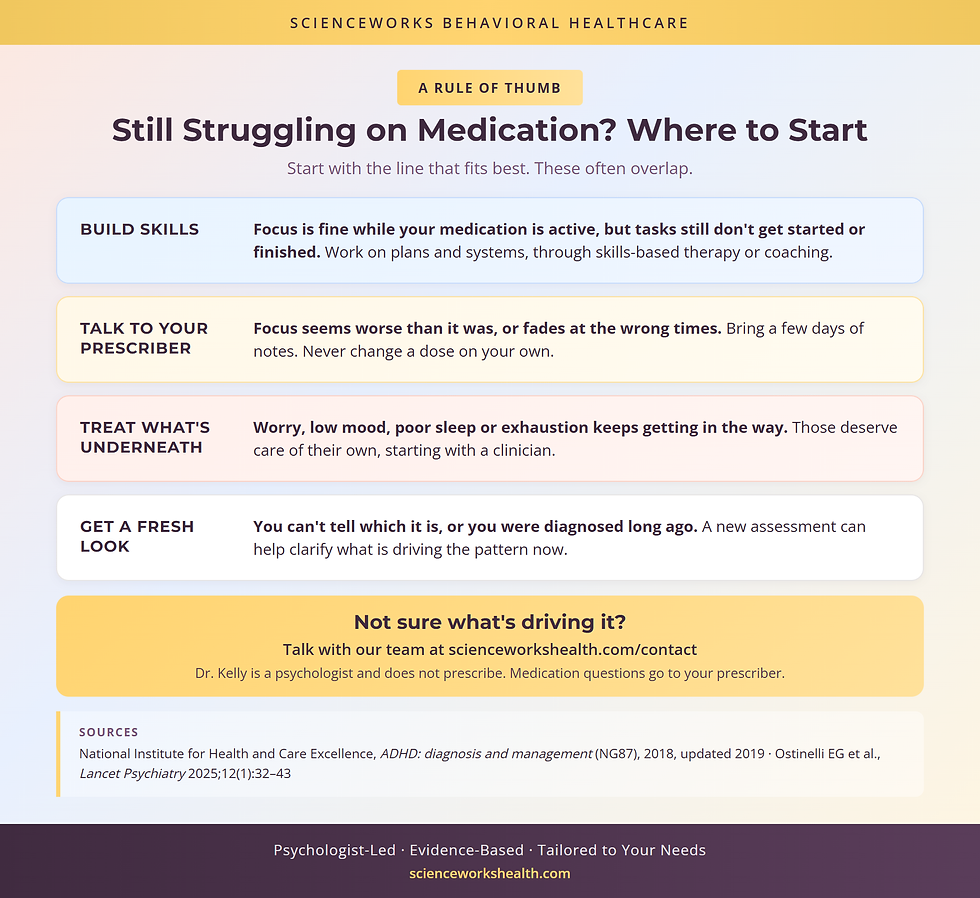
A rule of thumb you can use today:
If focus is fine while your medication is active but tasks still do not get started or finished, work on plans and systems, through therapy that teaches those skills or coaching.
If focus itself seems worse than it was, or wears off at the wrong times, talk with your prescriber, and bring a few days of notes.
If worry, low mood, poor sleep or exhaustion keeps getting in the way, treat that directly, starting with a conversation with a clinician.
If you cannot tell which of these it is, or you were diagnosed long ago, a fresh psychological assessment can help clarify what is driving the pattern now.
If you are choosing a therapist or coach for this, these questions help you judge fit:
How do you work with adults who are already taking ADHD medication?
Which skills do you teach directly, such as planning, prioritizing or starting tasks, and how?
How will we measure whether this is helping?
When would you suggest I talk to my prescriber, or get evaluated for something else?
When you are ready, you can reach our team to talk through which kind of support fits.
Next step - getting support
If medication helped and life still feels harder than it should, you are not back at square one. The capacity gains are real, and they make it easier to build what medication cannot provide: plans that are small enough to start, systems that work after the medication wears off, and treatment for anything else that is getting in the way.
Good ideas, hard to follow through?
Executive-function coaching builds the practical systems — time, task initiation, working memory — that make follow-through possible, without pathologizing how your brain works.
Frequently Asked Questions
Why do I still procrastinate even though my ADHD medication is working?
Because medication and follow-through are not the same thing. Trials of ADHD medication have mainly tested attention, self-control, reaction time and working memory, and found improvements there; they have not tested whether medication helps people start tasks they dread. Starting also depends on a clear first step and a routine, and can be affected by sleep and mood. Questions about timing or dose belong with your prescriber.
Can CBT help if I am already taking ADHD medication?
Yes, for many adults. In a randomized trial of 86 adults who were already on ADHD medication but still had significant symptoms, 12 sessions of cognitive behavioral therapy led to greater improvement in ADHD symptoms than an attention-matched relaxation program, and the gains held at 12 months. UK guidance likewise suggests considering non-drug treatment alongside medication when symptoms still cause real problems.
Should I ask my prescriber for a higher dose if I am still disorganized?
That is a decision to make with your prescriber, and it helps to bring specifics. Note whether the problem is focus during the hours the medication covers, or something medication does not target, such as having no planning system, poor sleep, or anxiety. Never change a dose on your own. If the pattern is unclear, a fresh assessment can help clarify what is driving it.
About the Author
Dr. Kiesa Kelly is a licensed clinical psychologist and the founder of ScienceWorks Behavioral Healthcare. She earned her PhD in Clinical Psychology with a concentration in Neuropsychology from Rosalind Franklin University of Medicine and Science, and completed practica, internship, and an NIH-funded National Research Service Award postdoctoral fellowship at the University of Chicago, the University of Wisconsin, the University of Florida, and Vanderbilt University. A neuropsychologist by training, she has more than 20 years of experience with psychological assessment, and her NIH postdoctoral fellowship included an original study of cognitive-control processes in children with ADHD.
Her clinical training also included adult psychotherapy at the University of Wisconsin-Madison Psychiatric Institute and Clinics and cognitive-behavioral therapy at The Chicago Medical School Anxiety Disorders Clinic. Dr. Kelly is a PhD clinical psychologist, not a physician. She does not prescribe medication, and questions about ADHD medication belong with your prescribing clinician.
References
1. Isfandnia F, El Masri S, Radua J, Rubia K. The effects of chronic administration of stimulant and non-stimulant medications on executive functions in ADHD: a systematic review and meta-analysis. Neurosci Biobehav Rev. 2024;162:105703. https://doi.org/10.1016/j.neubiorev.2024.105703
2. Ostinelli EG, Schulze M, Zangani C, Farhat LC, Tomlinson A, Del Giovane C, Chamberlain SR, Philipsen A, Young S, Cowen PJ, Bilbow A, Cipriani A, Cortese S. Comparative efficacy and acceptability of pharmacological, psychological, and neurostimulatory interventions for ADHD in adults: a systematic review and component network meta-analysis. Lancet Psychiatry. 2025;12(1):32-43. https://doi.org/10.1016/s2215-0366(24)00360-2
3. Kessler RC, Adler L, Barkley R, Biederman J, Conners CK, Demler O, Faraone SV, Greenhill LL, Howes MJ, Secnik K, Spencer T, Ustun TB, Walters EE, Zaslavsky AM. The prevalence and correlates of adult ADHD in the United States: results from the National Comorbidity Survey Replication. Am J Psychiatry. 2006;163(4):716-723. https://doi.org/10.1176/ajp.2006.163.4.716
4. Kroenke K, Spitzer RL, Williams JB. The PHQ-9: validity of a brief depression severity measure. J Gen Intern Med. 2001;16(9):606-613. https://doi.org/10.1046/j.1525-1497.2001.016009606.x
5. Tamminga HG, Reneman L, Huizenga HM, Geurts HM. Effects of methylphenidate on executive functioning in attention-deficit/hyperactivity disorder across the lifespan: a meta-regression analysis. Psychol Med. 2016;46(9):1791-1807. https://doi.org/10.1017/s0033291716000350
6. National Institute for Health and Care Excellence. Attention deficit hyperactivity disorder: diagnosis and management (NG87). Published March 14, 2018; updated September 13, 2019. https://www.nice.org.uk/guidance/ng87/chapter/Recommendations
7. Spitzer RL, Kroenke K, Williams JB, Löwe B. A brief measure for assessing generalized anxiety disorder: the GAD-7. Arch Intern Med. 2006;166(10):1092-1097. https://doi.org/10.1001/archinte.166.10.1092
8. Safren SA, Sprich S, Mimiaga MJ, Surman C, Knouse L, Groves M, Otto MW. Cognitive behavioral therapy vs relaxation with educational support for medication-treated adults with ADHD and persistent symptoms: a randomized controlled trial. JAMA. 2010;304(8):875-880. https://doi.org/10.1001/jama.2010.1192
9. Solanto MV, Marks DJ, Wasserstein J, Mitchell K, Abikoff H, Alvir JM, Kofman MD. Efficacy of meta-cognitive therapy for adult ADHD. Am J Psychiatry. 2010;167(8):958-968. https://doi.org/10.1176/appi.ajp.2009.09081123
10. Knouse LE, Teller J, Brooks MA. Meta-analysis of cognitive-behavioral treatments for adult ADHD. J Consult Clin Psychol. 2017;85(7):737-750 (correction: 2017;85(9):882). https://doi.org/10.1037/ccp0000216
11. Ahmann E, Saviet M, Otto M. Coaching for adults with ADHD: a prospective study. Am J Lifestyle Med. Published online March 27, 2026. https://doi.org/10.1177/15598276261432960
12. Sibley MH, Graham ED, Holbrook JK, Dvorsky MR, Yeguez CE, Rosier T, Coghill D, Page TF, Fouche R, Demuth J. Demographics, services, and practices in attention-deficit/hyperactivity disorder coaching in the US. JAMA Netw Open. 2026;9(1):e2552407. https://doi.org/10.1001/jamanetworkopen.2025.52407
Disclaimer
This article is for informational purposes only and is not a substitute for professional medical or mental health advice, diagnosis, or treatment. Do not start, stop or change any medication without talking to your prescribing clinician.