
What to Expect From an Adult ADHD Evaluation

Last reviewed: 07/23/2026
Reviewed by: Dr. Kiesa Kelly

If you have been wondering whether ADHD explains a lifetime of near-misses — the missed deadlines, the half-finished projects, the sense that everything takes more effort for you than it seems to for other people — deciding to get evaluated can feel like a big step into the unknown. Knowing what to expect from an adult ADHD evaluation takes some of the mystery out of it. An evaluation is not a pop quiz you can fail, and it is not a single test that spits out a yes-or-no answer. It is a structured conversation, backed by validated tools, designed to figure out what is actually driving the pattern you are living with.
This article walks through the whole process so you can arrive prepared and know what each step is for.
In this article, you'll learn:
What an adult ADHD evaluation actually is — and what it is not
Who tends to benefit from one, and who it may not be the right fit for
What happens step by step, from intake to the feedback session
How the evaluation rules out look-alike conditions such as anxiety, depression, and sleep problems
How to prepare, including questions worth asking your provider
What you receive at the end, and what your next steps might be
What an adult ADHD evaluation is — the one-paragraph answer
An adult ADHD evaluation is a clinical assessment that combines a detailed interview, validated rating scales, a developmental history, and a review of how symptoms affect you across different parts of your life. There is no single blood test or brain scan that diagnoses ADHD; the diagnosis is made clinically, by a trained professional weighing several sources of information together [2]. In our psychological assessment process, the goal is not just a label. It is a clear picture of how your attention, activity, and self-regulation work — and whether that pattern meets the criteria for ADHD, points to something else, or reflects more than one thing at once.
Common misconceptions worth clearing up first
A few myths keep people from getting evaluated, or leave them confused about what the process involves. It helps to name them directly.
"If I did well in school or hold down a job, it can't be ADHD." In reality, many adults — especially women and people who are bright or highly conscientious — spend years compensating. They overwork, rely on last-minute pressure, or build elaborate systems to stay afloat. That effort can hide impairment from everyone but the person paying the cost. ADHD is diagnosed on the pattern and the toll it takes, not on whether you have ever succeeded at anything.
"There is a brain scan or blood test that can diagnose ADHD." There is not. Marketing for scans and computer tests can imply otherwise, but no biological test confirms ADHD in routine care. Diagnosis rests on a clinical assessment that pulls together your history, standardized rating scales, and evidence of real-world impairment [2].
"An online quiz can tell me if I have ADHD." A screener such as the ASRS is genuinely useful — it is a validated self-report tool that flags whether a fuller look is warranted [6]. But a screener is a starting point, not a diagnosis. It cannot account for the other conditions that mimic ADHD, and it cannot see how symptoms play out across your life.
Who it is for
ADHD is more common in adults than many people assume. Global reviews put adult prevalence at roughly 3 percent, with broader "symptomatic" estimates higher [3][4], and recent U.S. survey data estimate that about 6 percent of adults — around 15.5 million people — currently have an ADHD diagnosis, with roughly half diagnosed as adults rather than in childhood [5]. If you were missed as a kid, you are far from alone.
Signs it is worth doing
The clearest signal is a long-standing, cross-situational pattern that keeps costing you — not a bad week. Two quick self-check scenarios may help you recognize yourself.
You do fine in fast-moving meetings because the pressure keeps you locked in, but the quiet administrative work is where you drown. You miss forms, forget follow-up emails, and cannot reliably start a boring task until the deadline is close enough to feel like an emergency. Your inbox has hundreds of unread messages, your desk holds three half-finished projects, and you know exactly what each one needs — you just cannot make yourself sit down and do it. People describe you as capable but scattered, and you have learned to overfunction in bursts to make up for long stretches of inertia.
Or: you kept it together for years with rigid routines and a lot of quiet effort, and then something shifted — a new baby, a demanding role, a hormonal transition — and the systems that used to save you stopped working. Now you lose your keys and your train of thought in the same afternoon, you reread the same paragraph four times, and the mental load feels heavier than the tasks themselves. It is not that you stopped trying. It is that the coping strategies finally hit their limit.
This second pattern is especially common in women, who are underdiagnosed in childhood and often identified far later — the childhood boy-to-girl ratio of roughly three to one narrows to closer to one to one by adulthood, and women are frequently diagnosed years after their symptoms first caused problems [11]. Hormonal shifts appear to play a role here: an emerging body of research suggests that the estrogen changes of perimenopause and menopause can unmask or worsen ADHD symptoms such as inattention and emotional dysregulation, though this area is still being actively studied and defined [9][10]. If that describes you, ADHD testing in Chattanooga for women navigating perimenopause and menopause is one place to start a conversation that holds those pieces together.
⏱️ Key takeaway: ADHD is diagnosed on a lifelong, cross-setting pattern of impairment — not a single hard week and not a single test result.
Who it is not the right fit for
An evaluation may not be the most useful first step if your difficulties are recent and clearly tied to a specific stressor — a bereavement, an acute depressive episode, a period of poor sleep, or a medical issue. ADHD is, by definition, a lifelong pattern with roots before age 12, so a sudden change in a previously steady adult points somewhere else first [1]. That does not mean you should not seek help; it means a different assessment or a medical check-up may come before, or alongside, an ADHD evaluation. A good clinician will help you sort out which door to walk through first.
What actually happens, step by step
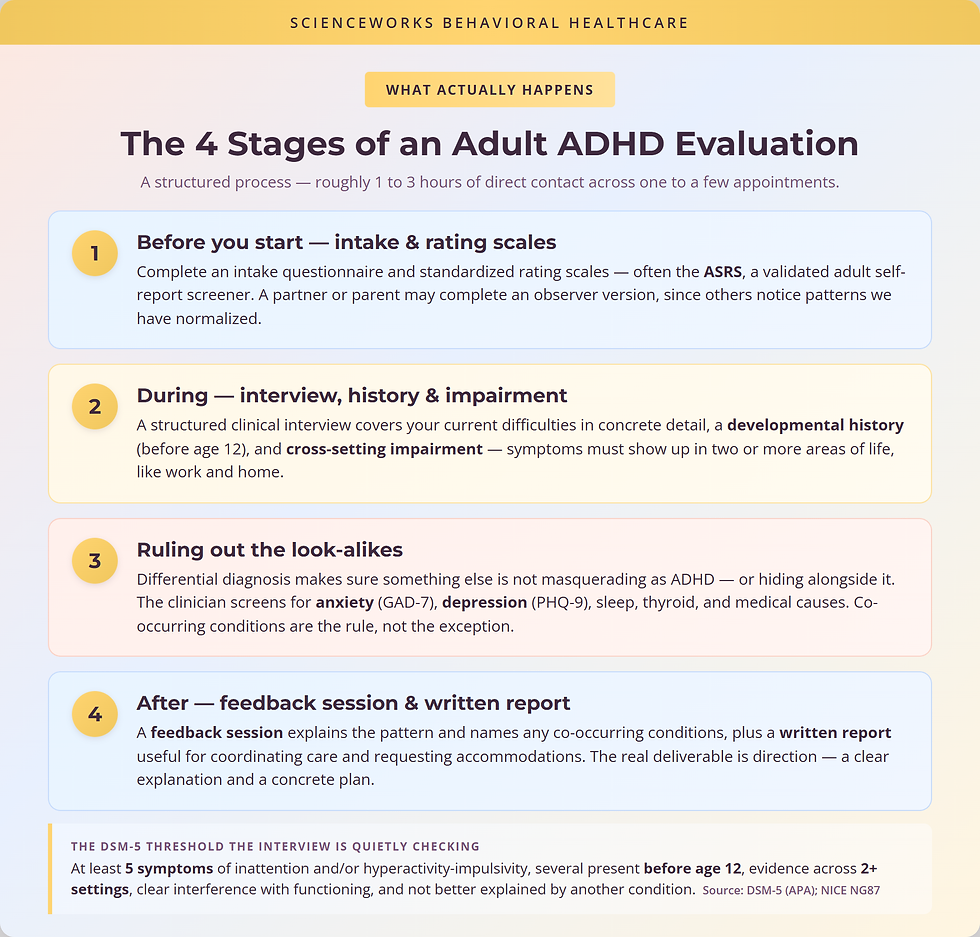
Before you start — intake and rating scales
Most evaluations begin before you ever sit down with the clinician. You will usually complete an intake questionnaire and one or more standardized rating scales, often including the ASRS, a validated adult self-report screener [6]. You may also be asked to complete a broader mental health screening so the clinician has a wide-angle view going in. Sometimes an evaluator will ask whether a partner, parent, or close friend can complete an observer version, because other people often notice patterns we have normalized in ourselves.
During the evaluation — interview, scales, history, and impairment
The heart of the evaluation is a structured clinical interview. Expect to talk through your current difficulties in concrete detail — not just "I can't focus," but when, where, and at what cost. The clinician will review your rating scales with you, ask about a developmental history (what you were like as a child, how you did in school, what your parents or teachers noticed), and probe for cross-setting impairment, because the criteria require that symptoms show up in more than one area of life, such as work and home [1].
Under current diagnostic criteria, an adult needs at least five symptoms of inattention and/or hyperactivity-impulsivity, several of them present before age 12, evidence that symptoms occur in two or more settings, clear interference with functioning, and confirmation that the picture is not better explained by another condition [1]. Much of the interview is quietly checking each of those boxes.
What it covers — ruling out the look-alikes
A large part of a good evaluation is differential diagnosis: making sure something else is not masquerading as ADHD, or hiding alongside it. This matters because co-occurring conditions are the rule, not the exception. Reviews find that a substantial share of adults with ADHD also experience anxiety — with estimates commonly reaching around half in clinical samples — and depression estimates ranging widely from roughly 19 to 53 percent [7][8].
That is why the clinician will screen for conditions that can look like ADHD or travel with it. Anxiety can fragment attention and mimic restlessness, so a tool like the GAD-7 helps map that terrain. Depression can flatten motivation and slow thinking in ways that resemble inattention, which is where a screener such as the PHQ-9 is useful. Poor sleep, thyroid problems, and other medical issues can also drive concentration complaints, so expect questions about your sleep, your health, and any medications you take. None of this is the clinician doubting you — it is how a careful assessment earns the accuracy that makes the result trustworthy.
🧩 Key takeaway: Ruling out anxiety, depression, sleep problems, and medical causes is not a detour from the ADHD question — it is part of answering it correctly.

How to prepare
You do not need to study, but a little preparation makes the evaluation sharper and faster.
Gather any history you can. Old report cards, past testing, or a parent's memories of your childhood all help establish the age-of-onset piece. If you do not have records, that is common and workable — clinicians are used to reconstructing developmental history from memory and family accounts.
Jot down concrete examples. Specific moments ("I missed my rent three times last year," "I redo tasks because I lose the thread") are more useful than general labels.
Note your other health context. Current medications, sleep patterns, and any anxiety, mood, or thyroid issues are all relevant.
Bring your real questions. The evaluation is also for you.
A few questions worth asking any provider before or during your evaluation:
Scope: Does this evaluation also screen for the conditions that commonly overlap with ADHD, like anxiety and depression, and can you diagnose those or would I need a referral?
Methodology: How do you account for masking and years of compensation in adults, especially if I have functioned well on the surface?
Developmental history: What do you do if I do not have childhood records or a parent to interview?
Output: What exactly will I receive at the end — a written report, specific recommendations, and guidance on next steps, or just a diagnosis?
📋 Key takeaway: The four questions above — scope, masking, developmental history, and output — quickly tell you whether an evaluation is thorough enough to trust.
After — results and next steps
Once the evaluation is complete, you will typically have a feedback session where the clinician explains what they found and why. This is the part many people find most valuable. A good feedback conversation does not just hand you a label; it explains the pattern, names any co-occurring conditions, and connects the findings to concrete recommendations.
Most evaluations also include a written report summarizing your history, the measures used, the diagnostic reasoning, and recommendations. That document is useful for coordinating care, requesting workplace or academic accommodations, and guiding treatment.
From there, next steps depend on what the evaluation found. If ADHD is diagnosed, options often include a combination of approaches — practical, skills-based support and, for many people, a conversation about medication with a prescriber. Executive-function coaching can build the day-to-day systems for time, task initiation, and follow-through that ADHD makes hard, while specialized therapy can address the anxiety, low self-worth, or depression that so often accumulate after years of unexplained struggle. If the evaluation points somewhere else, you leave with a clearer target than you walked in with — which is its own kind of relief.
🔑 Key takeaway: The real deliverable is direction — a clear explanation, a written record, and a concrete plan you can act on, whatever the diagnosis turns out to be.
A quick decision heuristic if you are still on the fence: if the pattern has been lifelong, shows up in more than one area of your life, and keeps costing you despite genuine effort, an evaluation is a reasonable next step. If your difficulties are new and clearly tied to a recent event, start with your primary care provider or a general mental health assessment first — and mention ADHD so it stays on the table.
Wondering if ADHD explains the pattern?
A structured ADHD evaluation can tell you whether what you're noticing is ADHD, something else, or both — and what would actually help.
Frequently Asked Questions
How long does an adult ADHD assessment take?
Most adult ADHD assessments involve one to a few appointments, with roughly one to three hours of direct contact. The clinician gathers your history, walks through validated rating scales, and reviews evidence of impairment across settings. Timelines vary by clinic and by how much collateral information (like old report cards or a partner's input) needs to be gathered, so ask about the expected schedule when you book.
Does insurance cover ADHD testing for adults?
It depends on your plan. Some plans cover part or all of an adult ADHD evaluation, others apply a deductible or treat it as a separate benefit, and some do not cover it at all. Coverage can also differ between a diagnostic evaluation and ongoing therapy. Before you book, call the number on your insurance card and ask what is covered, and ask the clinic for the billing codes so you can check.
What is the 24-hour rule for ADHD?
The 24-hour rule is an informal coping strategy, not a clinical or diagnostic term, and it is not part of an ADHD evaluation. People use it in different ways — most often, waiting 24 hours before acting on an impulsive purchase or decision to reduce impulsivity. It can be a useful habit, but it does not diagnose or rule out ADHD, and you will not encounter it as a formal step in an assessment.
What type of clinician is best for an ADHD evaluation?
An adult ADHD evaluation should be done by a licensed clinician trained in adult ADHD assessment — commonly a clinical psychologist or a psychiatrist, and in some settings other qualified mental health professionals. What matters most is training in adult presentations, differential diagnosis, and how ADHD is masked or compensated for in adulthood. A screener alone, from any source, is not a diagnosis.
Can an online ADHD screener give me a diagnosis?
No. Online screeners such as the ASRS are useful starting points that flag whether a full evaluation may be worthwhile, but they cannot diagnose ADHD on their own. A diagnosis requires a clinical assessment that weighs your history, rating scales, evidence of impairment in more than one setting, and other conditions that can look like ADHD. Treat a high screener score as a reason to ask, not an answer.
About the Author
Dr. Kiesa Kelly is a licensed clinical psychologist and the founder of ScienceWorks Behavioral Healthcare, with more than 20 years of experience in psychological assessment and evidence-based treatment. Her work centers on adult neurodevelopmental evaluation — including ADHD and autism — with particular attention to how these conditions present in adults who were missed earlier in life, and in women whose symptoms have been masked or misread for years.
Dr. Kelly's background spans clinical training, teaching, and assessment across neurodevelopmental and mental health conditions. At ScienceWorks, she leads a telehealth-forward practice serving Tennessee, with an in-person option in Nashville, and reviews clinical content for accuracy. She is a PhD-level clinical psychologist, not a physician, and works alongside prescribers and other clinicians when medical management is part of a person's care.
References
1. American Psychiatric Association. Diagnostic and Statistical Manual of Mental Disorders (DSM-5) — Attention-Deficit/Hyperactivity Disorder diagnostic criteria. https://www.psychiatry.org/File%20Library/Psychiatrists/Practice/DSM/APA_DSM-5-ADHD.pdf
2. National Institute for Health and Care Excellence (NICE). Attention deficit hyperactivity disorder: diagnosis and management. NICE guideline NG87. https://www.nice.org.uk/guidance/ng87
3. Song P, Zha M, Yang Q, et al. The prevalence of adult attention-deficit hyperactivity disorder: A global systematic review and meta-analysis. J Glob Health. 2021. https://pmc.ncbi.nlm.nih.gov/articles/PMC7916320/
4. Prevalence of ADHD in Adults: An Umbrella Review of International Studies. 2025. https://www.ncbi.nlm.nih.gov/pmc/articles/PMC11859750/
5. Staley BS, Robinson LR, Claussen AH, et al. Attention-Deficit/Hyperactivity Disorder Diagnosis, Treatment, and Telehealth Use in Adults — National Center for Health Statistics Rapid Surveys System, United States, October–November 2023. MMWR Morb Mortal Wkly Rep. 2024;73(40):890–895. https://pmc.ncbi.nlm.nih.gov/articles/PMC11466376/
6. Kessler RC, Adler LA, Gruber MJ, et al. Validity of the World Health Organization Adult ADHD Self-Report Scale (ASRS) Screener in a representative sample of health plan members. Int J Methods Psychiatr Res. 2007;16(2):52–65. https://onlinelibrary.wiley.com/doi/10.1002/mpr.208
7. The prevalence of psychiatric comorbidities in adult ADHD compared with non-ADHD populations: A systematic literature review. PLoS One. 2022. https://www.ncbi.nlm.nih.gov/pmc/articles/PMC9635752/
8. Adult ADHD and comorbid anxiety and depressive disorders: a review of etiology and treatment. Front Psychiatry. 2025. https://www.ncbi.nlm.nih.gov/pmc/articles/PMC12179154/
9. Chapman L, Gupta K, Hunter MS, Dommett EJ. Examining the Link Between ADHD Symptoms and Menopausal Experiences. J Atten Disord. 2025. https://journals.sagepub.com/doi/10.1177/10870547251355006
10. Research advances and future directions in female ADHD: the lifelong interplay of hormonal fluctuations with mood, cognition, and disease. Front Glob Womens Health. 2025. https://www.frontiersin.org/journals/global-womens-health/articles/10.3389/fgwh.2025.1613628/full
11. Attoe DE, Climie EA. Miss. Diagnosis: A Systematic Review of ADHD in Adult Women. J Atten Disord. 2023. https://journals.sagepub.com/doi/10.1177/10870547231161533
Disclaimer
This article is for informational and educational purposes only and is not a substitute for professional medical or psychological advice, diagnosis, or treatment. Reading it does not create a clinician-patient relationship. Screeners referenced here are not diagnostic tests. If you have concerns about ADHD or another health condition, consult a qualified healthcare provider. If you are in crisis or may be in danger, call or text 988 (the Suicide and Crisis Lifeline) or dial 911.