
Adult ADHD Screening: What the ASRS v1.1 Measures & Misses

Updated: Sep 2
Last reviewed: 09/02/2026
Reviewed by: Dr. Kiesa Kelly
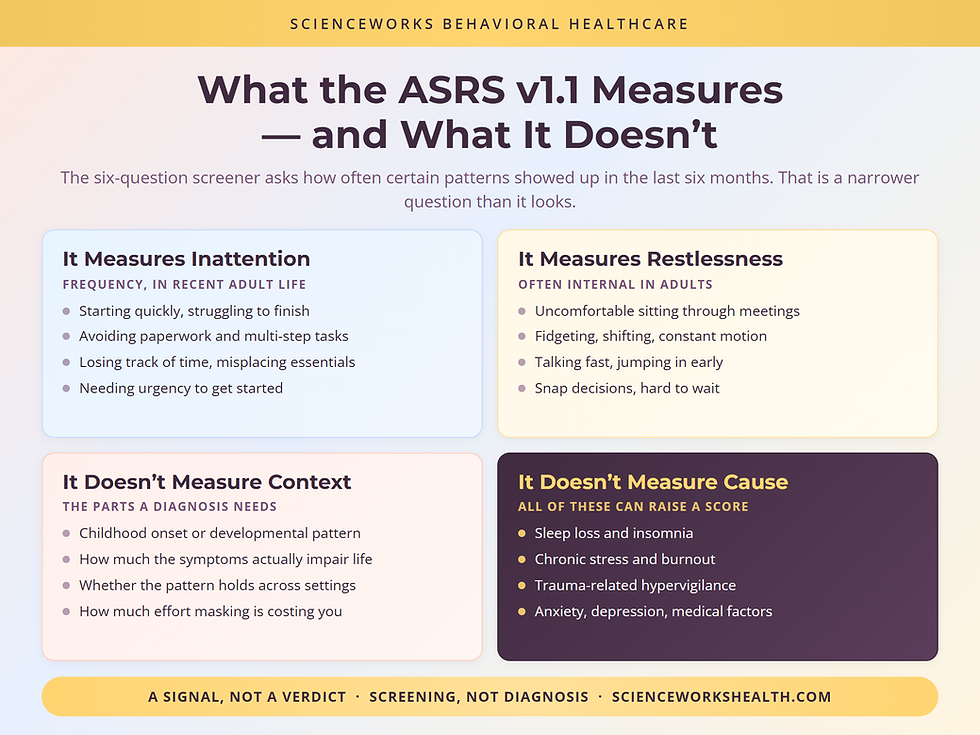
If you came here after taking the checklist and seeing a score, the main ASRS scoring guide is the better page for score meaning. This page has a different job. It explains what the ASRS v1.1 is designed to measure, what it does not measure, and why a screening result is useful only when you place it in context.[1,2]
In this article, you’ll learn:
what the ASRS v1.1 is designed to capture
what kinds of adult ADHD patterns it tends to pick up
what the checklist does not measure on its own
why history and context matter more than a score alone
what common overlap a screener cannot sort out for you
🔎 Key takeaway: The ASRS v1.1 is best understood as a signal, not a verdict. It helps identify patterns worth exploring, but it does not decide the diagnosis by itself.[1,4-6]
What the ASRS v1.1 is designed to measure
The ASRS v1.1 was developed with the World Health Organization as a practical adult ADHD screening tool. Its purpose is straightforward: to flag whether your recent symptom pattern looks enough like ADHD that a fuller evaluation may be worth considering.[1]
The version most people see is the 6-question screener, sometimes called Part A. There is also an 18-item version. Both focus on how often certain ADHD-related behaviors show up in everyday adult life, and the screener asks about the last 6 months rather than your whole life.[1,2]
That design is part of why the ASRS is so common. It is brief, easy to complete, and useful for case-finding. If you want to compare it with other self-check tools, our mental health screening library can help you see how different screeners are built for different questions.
🧭 Key takeaway: The ASRS is trying to capture symptom frequency in recent adult life. It is not trying to map your whole developmental history in six questions.[1,2]
What the ASRS v1.1 measures in adult life
At its core, the ASRS focuses on the two symptom clusters most associated with ADHD:
inattention
hyperactivity and impulsivity[1,2]
It measures how often those patterns happen. It does not directly measure why they happen.
Inattention in adults
In adult life, inattention often looks less like “I cannot pay attention at all” and more like difficulty regulating attention, organization, follow-through, and effort.
Common examples include:
starting tasks quickly but struggling to finish
avoiding paperwork, scheduling, or multi-step tasks
losing track of time
misplacing essentials
needing urgency to get started
A practical example: you may be able to focus intensely on something interesting, then feel unusually stuck with routine tasks like email, forms, planning, or follow-up. The ASRS is built to notice that kind of uneven attention pattern.[1,2]
Hyperactivity and impulsivity that may look quieter in adults
Adult hyperactivity is often more internal than people expect. Instead of obvious childhood-style movement, it may show up as restlessness, fidgeting, impatience, interrupting, or acting before thinking.[4,6]
In adults, that can look like:
feeling physically uncomfortable sitting through meetings
shifting position or fidgeting constantly
talking quickly or jumping in before others finish
making snap spending or texting decisions
struggling to wait in lines, traffic, or slow conversations
This matters because many adults do not relate to the stereotype of a visibly “hyper” child. The ASRS is trying to capture adult presentation, not just childhood imagery.[4,6]
Why masking can make the checklist look flatter than real life
Some adults have learned to compensate so well that their day-to-day effort is not obvious on paper. They may overprepare, rely on rigid systems, stay up late catching up, or appear organized while feeling chronically overwhelmed underneath.
A checklist can miss some of that hidden labor. It records the endorsed symptom, but not always the amount of energy, stress, or compensation required to keep things looking manageable. That is one reason some adults, especially those who mask heavily, may seem less obvious on a screener than they do in real life.[4-6]
🧠 Key takeaway: The ASRS can capture adult ADHD traits, but it may understate how hard you are working to compensate for them. Real-life effort and burnout still matter clinically.[4-6]

What the ASRS v1.1 does not measure
The ASRS is useful partly because it is narrow. But that narrowness is also its main limitation.
On its own, the ASRS does not establish:
childhood onset or a developmental pattern over time
how much the symptoms impair work, school, home life, or relationships
whether the pattern is consistent across settings
whether another condition, life stressor, or medical factor better explains the symptoms[4-6]
That distinction is important. A person can endorse many ADHD-like experiences and still need a broader evaluation before ADHD is the best explanation.
📋 Key takeaway: The ASRS measures symptom pattern, not diagnostic completeness. It does not prove onset, impairment, or cause.[4-6]
Why context and history matter more than a checklist alone
A good adult ADHD evaluation looks beyond whether the boxes were checked. It asks when the pattern began, how long it has been present, how much it interferes with life, and whether it shows up across different settings.[4-6]
That history matters because ADHD is a neurodevelopmental condition. Clinicians usually want to know whether the pattern can be traced back to earlier life, even if it was not recognized at the time. They also want concrete examples of impairment, not just the presence of symptoms on paper.[4-6]
A practical example: someone may score high during a period of severe stress, poor sleep, and overloaded caregiving demands. Another person may describe the same pattern going back to school years, work history, relationships, and daily routines. Those are not the same clinical story, even if the checklist scores look similar.[5-8]
This is part of what a fuller psychological assessment adds. It places the checklist inside a timeline, functional picture, and differential diagnosis process instead of treating it like a stand-alone answer.
What a screener cannot sort out on its own
Many experiences that raise an ADHD screener score are not unique to ADHD. Difficulty concentrating, forgetfulness, task avoidance, and mental fog can show up for different reasons.[5-9]
Common overlap includes:
sleep loss or insomnia, which can reduce attention and efficiency[7]
chronic stress or burnout, which can affect cognitive performance[8]
trauma-related hypervigilance and sleep disruption, which can interfere with concentration[9]
anxiety or depression, which can affect motivation, initiation, and focus[5,6]
substance use, medication effects, or medical issues that affect energy and cognition[5,6]
That is why it helps to look at the broader picture. For example, if sleep is a major driver, support around insomnia and sleep problems may matter. If the picture is more tied to threat responses and intrusive memories, a trauma-focused page like our trauma therapy overview may fit the question better.
⏳ Key takeaway: A positive screen does not tell you which mechanism is causing the symptoms. Overlap is common, and the timeline often matters as much as the checklist itself.[5-9]
What a screener can and can’t tell you
What the ASRS can tell you is limited but still valuable. It can tell you whether your recent pattern resembles common adult ADHD symptoms closely enough that further discussion may be worth having.[1,4]
What it cannot tell you is whether ADHD is the best explanation, whether the pattern began in childhood, how much impairment is present across settings, or what treatment plan makes the most sense. Those questions need more than a rating scale.[4-6]
A low score also does not automatically settle the question. Some adults underreport, mask, or show symptoms in ways that are more situational than a brief screener can easily capture.[1,5,6]
🌿 Key takeaway: A screener can help reduce guesswork, but it cannot replace clinical judgment. Its job is to guide the next question, not answer every one.[4-6]
A practical way to use this page
If your main question is what your ASRS result means, read the ASRS scoring guide. If your question is what a fuller evaluation adds beyond a checklist, our psychological assessments page explains that process in more detail.
Summary
The ASRS v1.1 is designed to measure recent adult ADHD symptom frequency, especially inattention and hyperactivity/impulsivity. It does not measure the full context needed for diagnosis, including developmental history, impairment, consistency across settings, and overlap with sleep, stress, trauma, mood, or medical factors.[1,4-9]
That is why the screener is helpful but incomplete. Used well, it can point you toward the right next question. It just cannot answer the whole question by itself.
Frequently Asked Questions
What does the ASRS v1.1 actually measure in adults?
The ASRS v1.1 measures how often inattention and hyperactivity/impulsivity symptoms appear in recent adult life — specifically the past 6 months. Inattention in adults often looks like difficulty with follow-through, avoiding multi-step tasks, losing track of time, and needing urgency to start. Hyperactivity may show up as restlessness, fidgeting, talking quickly, or making impulsive decisions rather than visible childhood-style movement. The ASRS captures frequency, not cause or impairment.
Can the ASRS v1.1 diagnose ADHD on its own?
No. The ASRS is designed as a screening tool, not a diagnostic instrument. On its own, it doesn't establish childhood onset, how much impairment symptoms cause, whether the pattern is consistent across settings, or whether another condition better explains the picture. Sleep deprivation, chronic stress, trauma, burnout, anxiety, and mood disorders can all produce ASRS-like symptoms. A positive screen means the pattern is worth exploring with a full evaluation — not that ADHD is confirmed.
Why might the ASRS underestimate ADHD in adults who mask?
Adults who compensate heavily for ADHD often look less obvious on a screener than in real life. They may overprepare, rely on rigid systems, stay up late catching up, or appear organized while feeling chronically overwhelmed underneath. The ASRS records endorsed symptoms but not the amount of energy, stress, or compensation required to keep things looking manageable. Some adults, especially those who mask heavily, may seem less impaired on paper than they are in practice.
About ScienceWorks
Dr. Kiesa Kelly is a clinical psychologist and founder of ScienceWorks Behavioral Healthcare. Her work includes supporting adults and teens with concerns related to ADHD, autism, OCD, trauma, and insomnia.
Her approach emphasizes evidence-based, neurodiversity-affirming care and practical next steps that fit daily life.
References
Kessler RC, Adler L, Ames M, et al. The World Health Organization Adult ADHD Self-Report Scale (ASRS): a short screening scale for use in the general population. Psychol Med. 2005;35(2):245-256. https://doi.org/10.1017/S0033291704002892
Harvard Medical School, Health Care Policy (NCS). Adult ADHD Self-Report Scale (ASRS) v1.1 Screener (6 questions), English (PDF). https://www.hcp.med.harvard.edu/ncs/ftpdir/adhd/6Q_ASRS_English.pdf
Hines JL, King TS, Curry WJ. The adult ADHD self-report scale for screening for adult attention deficit-hyperactivity disorder (ADHD). J Am Board Fam Med. 2012;25(6):847-853. https://doi.org/10.3122/jabfm.2012.06.120065
National Institute for Health and Care Excellence (NICE). Attention deficit hyperactivity disorder: diagnosis and management (NG87). 2018, updated May 7, 2025. https://www.nice.org.uk/guidance/ng87
Canadian ADHD Resource Alliance (CADDRA). Canadian ADHD Practice Guidelines, 4.1 Edition. 2021. https://www.caddra.ca/wp-content/uploads/Canadian-ADHD-Practice-Guidelines-4.1-January-6-2021.pdf
Centre for Addiction and Mental Health (CAMH). Adult ADHD: Screening and Assessment. https://www.camh.ca/en/professionals/treating-conditions-and-disorders/adult-adhd/adult-adhd---screening-and-assessment
García A, Crego A, Peralbo-Rubio MJ. Sleep deprivation effects on basic cognitive processes. Psychol Res Behav Manag. 2021;14:1897-1914. https://pmc.ncbi.nlm.nih.gov/articles/PMC8340886/
Koutsimani P, Montgomery A, Georganta K. Burnout and cognitive performance: a systematic review. Front Psychol. 2021;12:682363. https://pmc.ncbi.nlm.nih.gov/articles/PMC7926785/
National Institute of Mental Health (NIMH). Post-Traumatic Stress Disorder (PTSD). Revised 2023. https://www.nimh.nih.gov/health/publications/post-traumatic-stress-disorder-ptsd
Disclaimer
This article is for informational purposes only and is not a substitute for diagnosis, medical advice, or treatment. If you have concerns about ADHD or related symptoms, seek evaluation from a qualified healthcare professional.