
ERP Homework Between Sessions: Why Practice Stalls and How to Restart After a Missed Week

Last reviewed: 10/07/2026
Reviewed by: Dr. Kiesa Kelly
It is Sunday night and your practice log is mostly blank. On Tuesday you meant to do the exposure you planned with your therapist, then work ran late. On Thursday you started, felt the familiar pull to check, and stopped. By the weekend, doing it felt harder than it had on Monday. Now your session is tomorrow, and part of you wants to cancel rather than explain.
If you are in exposure and response prevention (ERP) for OCD, you probably already know that between-session practice matters. Our overview of OCD treatment covers the approaches we use, including ERP. This article is about what to do when that practice stalls: why it happens, what the research says, and how to bring a missed week back to your therapist so treatment can keep moving. It is written for people who are already working with a therapist, not as a guide to designing exposures on your own.
In this article, you'll learn:
Why between-session ERP practice is so often the hardest part
Three misconceptions that make a stalled week feel worse than it is
The most common reasons homework slips, and what each one points to
What to say to your therapist after a week that did not happen
What restarting usually looks like, and what to avoid doing alone
The short answer: a stalled week is common and workable
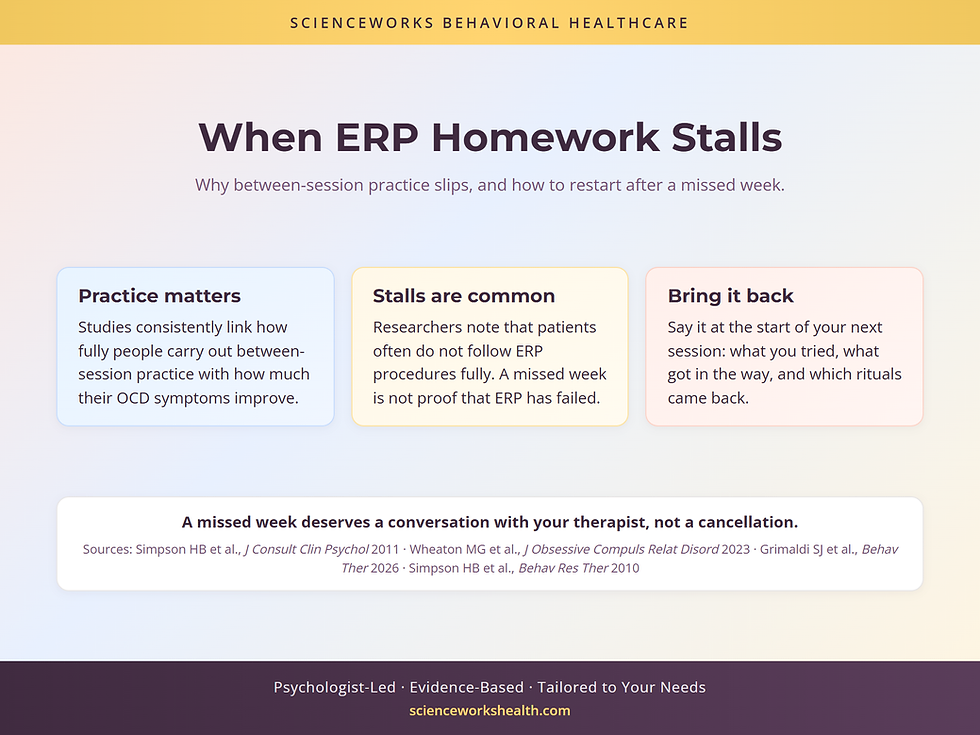
ERP is a recommended first-line treatment for OCD [1][2], and much of the work happens between sessions. Our guide to how ERP works at home and online describes what that practice usually looks like. Studies consistently link how fully people carry out that practice with how much their symptoms improve [3][4][5]. That link is real, and it is also why a missed week can feel like a failure. It is not one. Researchers testing a way to improve ERP practice noted that patients often do not adhere fully to its procedures [6], and in research studies, therapists rate between-session practice at every exposure session [3][5].
What matters most is what happens next. A missed week that gets talked about, understood and planned around is part of normal treatment. A missed week that turns into a canceled session, then two, is how ERP quietly stalls. Our article on how long OCD treatment takes covers how practice affects the overall timeline.
🔁 Key takeaway: Between-session practice is linked to better outcomes, and that is exactly why a missed week deserves a conversation, not a cancellation.
Three misconceptions about ERP homework
"If I skipped my homework, ERP isn't working for me." A stall is not proof the treatment has failed. In studies of adults in ERP, factors like how severe symptoms were at the start, quality of life, and the relationship with the therapist were linked to outcome largely through how fully people carried out their practice, although these studies cannot show cause and effect [3][4]. Researchers concluded that severe OCD does not, on its own, rule out benefiting from ERP and that therapists should watch practice closely instead [3][7]. That points to the practice, which can be adjusted, rather than to something fixed about you. Repeating a structured measure such as the DOCS, which asks about the past month, can help you and your therapist see whether symptoms are shifting over time, even when one week felt like a stall.
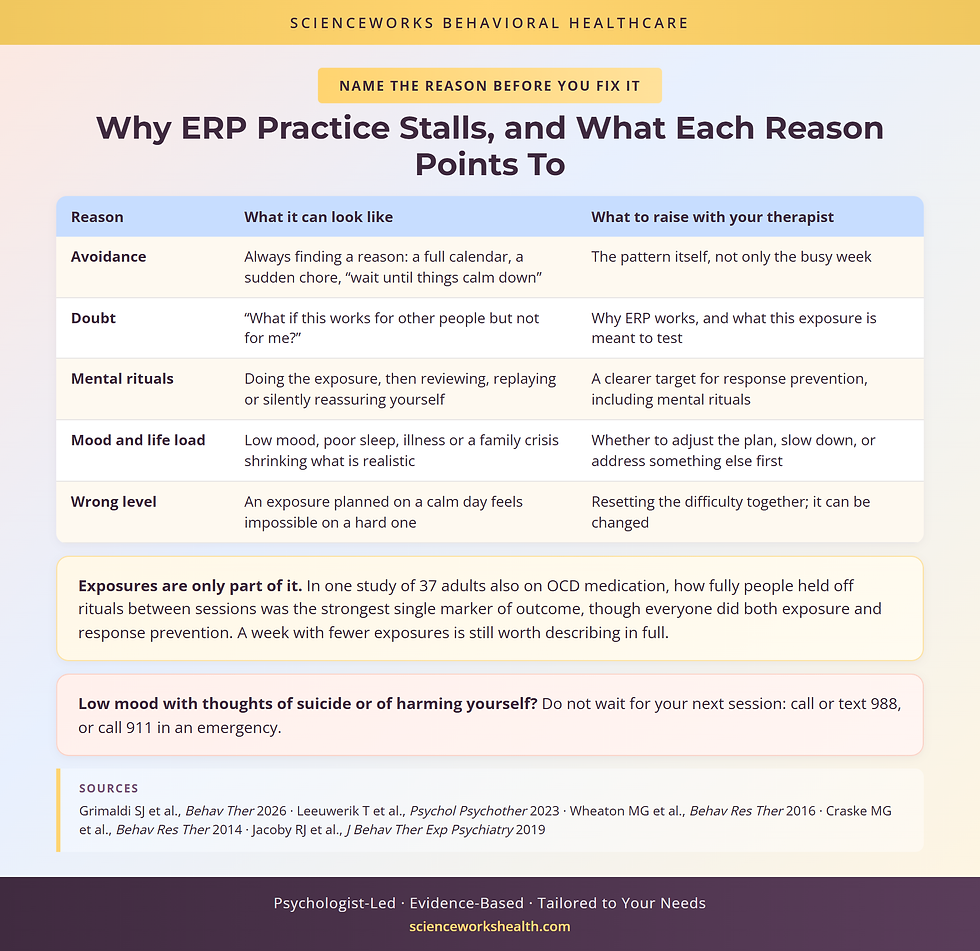
"The only thing that counts is how many exposures I did." Practice has more than one part. In one study of 37 adults who were also taking OCD medication, therapists rated how many homework exposures people attempted, how well those exposures went, and how fully people held off their rituals. All three were linked to outcome, and success with holding off rituals was the strongest single marker [7]. The authors were careful to say this does not mean response prevention matters more than exposure, since everyone did both [7]. The practical point is that practice has several parts, so a week with fewer exposures is still worth describing in full to your therapist, including how you did at resisting rituals.
"An exposure only counts if my anxiety comes down." Older explanations of exposure focused on anxiety fading during each practice. Newer models put more weight on what you learn, especially the gap between what you feared would happen and what actually did [8]. Applying this to OCD is still developing [9], and your therapist may frame it slightly differently. But an exposure where anxiety stayed high and you still did not perform the ritual can be a useful practice, not a failed one.
💡 Key takeaway: A stalled week usually says something about the plan or about what is getting in the way, not about whether you can benefit from ERP.
Why between-session practice stalls
Avoidance that looks like being busy
Avoidance rarely announces itself. It shows up as a full calendar, a sudden need to clean the kitchen, or a decision to "wait until things calm down." In a 2026 study of 121 adults receiving ERP alongside medication, people who avoided more at the start of treatment did less between-session practice, and, statistically, that lower practice explained the link to poorer outcomes [5]. People interviewed after group ERP also described real life commitments and stressful events, like moving to a new home, that made practice hard to prioritize [10].
Consider how this can play out. Dana and her therapist had planned three short exposures for the week, all tied to her contamination fears at work. Monday's meeting ran long, so she skipped the first. On Tuesday she reorganized her inbox instead, telling herself she would do two on Wednesday. By Friday she noticed she had found a reason to skip them every single day. Her schedule was genuinely busy, but the pattern of always finding a reason is worth naming to her therapist, because it is the avoidance itself speaking.
Doubting that it will help
In the same 2026 study, people who expected treatment to help did more practice, and, statistically, that practice explained the link to better outcomes [5]. Doubt is common, and it is often an OCD-flavored doubt: "What if this works for other people but not for me?" People in one interview study said that understanding how and why ERP works was what motivated them to keep going, and that revisiting the rationale during treatment helped [10]. If you have stopped believing the plan makes sense, that is worth saying out loud in session.
Rituals that move inside your head
Response prevention includes mental rituals and neutralizing, not only visible compulsions [1][2]. That can make practice harder to judge. You might do the exposure and then spend twenty minutes reviewing whether you did it "right," replaying a memory, or silently reassuring yourself. In one published case, a man with OCD would bring to mind a reassuring image when his intrusive thoughts came up, and his therapist explained that safety behaviors like this can get in the way of the learning exposure is meant to produce [8]. In one interview study of 15 people after group ERP, those whose obsessions came without visible compulsions described finding it harder to make ERP tasks fit their symptoms [10].
Here is a common version. Sam's exposure, which he had planned with his therapist, involved writing down an intrusive thought. He did it every day and logged it as done. What he did not log was the half hour afterward spent mentally checking that he had not meant the thought. In session, his therapist asked how the practice went, and Sam realized the exposure had been happening while a ritual ran right alongside it. That does not mean the whole week was wasted, but it does matter: in one study, how fully people held off their rituals between sessions was the strongest single marker of how they did [7]. It means the plan needs a clearer target for response prevention.
Mood, stress and life load
Practice takes energy. In the same interview study of people after group ERP, some said their OCD, depression or anxiety did not stop them from attending sessions but did make it hard to do the work between them [10]. Low mood, poor sleep, illness or a family crisis can all shrink what is realistic in a given week. Telling your therapist about these is not making excuses. It is giving them what they need to decide whether to adjust the plan, slow down, or address something else first. In specialized therapy for OCD, that kind of adjustment is part of the work, not a detour from it. If low mood comes with thoughts of suicide or of harming yourself, do not wait for your next session: call or text 988, or call 911 in an emergency.
Exposures set at the wrong level
Sometimes the task itself is the problem. An exposure that was planned on a calm day can feel impossible on a hard one. Some exposure experts describe starting with moderately difficult exposures because early success helps people stay engaged, and they do not always move up a ranked list in strict order [8]. A small preliminary study of 40 adults with distressing unwanted thoughts, not a clinical OCD sample, found no significant difference after four sessions between a gradual approach and one that varied difficulty [11]. The takeaway is not that one approach is right. It is that difficulty is something you and your therapist set together, and it can be changed.
🧭 Key takeaway: Each reason for a stall points somewhere different: avoidance, doubt, hidden rituals, low capacity, or a task set at the wrong level. Naming which one it was is the first step to fixing it.
After a week that did not happen: how to talk to your therapist
The most useful thing you can do is go to the session and say it early, before the conversation moves on. In research on ERP, therapists rate practice at every exposure session [3][5], and researchers recommend monitoring and reinforcing practice, addressing avoidance early, and strengthening patients' belief that treatment can help [5]. A missed week is exactly the kind of information a good ERP therapist is looking for.
You do not need a perfect explanation. It helps to bring:
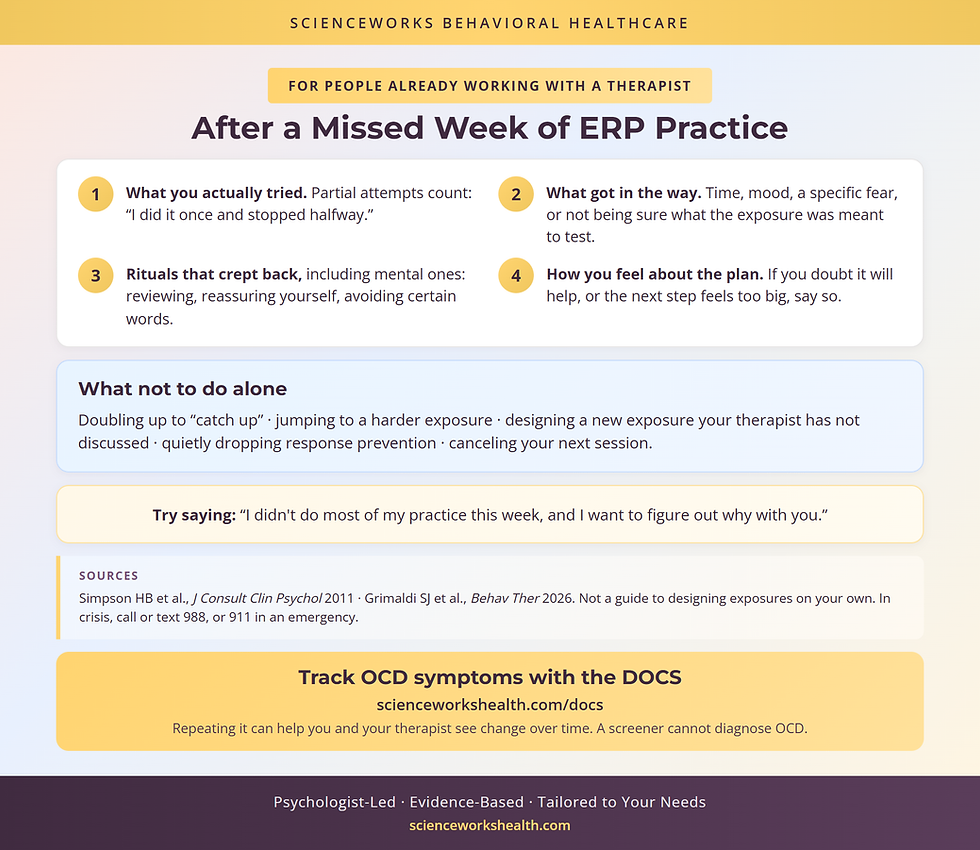
What you actually tried. Even partial attempts count. "I did it once and stopped halfway" is useful.
What got in the way. Time, mood, a specific fear, or not being sure what the exposure was meant to test.
Any rituals that crept back. Include mental ones: reviewing, reassuring yourself, avoiding certain words.
How you feel about the plan right now. If you doubt it will help, or the next step feels too big, say that.
Some people find a simple opener helps: "I want to be honest that I didn't do most of my practice this week, and I want to figure out why with you." For example, Priya missed two exposures and spent the week dreading her session. When she said this at the start, her therapist asked which part felt hardest. Priya realized the exposure had felt pointless because she no longer remembered what it was meant to test. They spent ten minutes revisiting the reason for it and chose a version she could do the next day. Nothing about that conversation was a failure. It was the treatment working as designed.
🗣️ Key takeaway: Say it at the start of the session: what you tried, what got in the way, which rituals came back, and how you feel about the plan.
What restarting usually looks like
What happens next is a decision you make with your therapist, but a few patterns are common.
A step back, then forward. After a gap, your therapist may suggest repeating an exposure you have already managed before moving on. This rebuilds momentum without treating the gap as a disaster.
A clearer target. If mental rituals were the issue, the plan may name exactly what counts as a ritual, including mental ones, and how you will respond when the urge comes.
A refresher on the reason. Revisiting why a particular exposure matters can make it feel worth doing again [10].
Planning around real life. Fewer, shorter practices on predictable days can beat an ambitious plan that falls apart by Wednesday.
Bringing in support, carefully. UK guidance (NICE, 2005) says that, for adults living with family, involving a family member in ERP should be considered when this is appropriate and acceptable to everyone, while treatment also helps family members step back from rituals and reassurance [2]. Whether a reminder to practice helps or slides into accommodation is something to agree with your therapist, and our article on family accommodation in OCD explains how accommodation works.
There are also tools for when practice keeps stalling. Clinicians have tried adding other approaches to ERP, such as acceptance-based or mindfulness strategies, to fit treatment to the person, though how well these add-ons work is still being studied [12]. In one small trial, adding motivational interviewing to ERP did not improve how much homework people did [6]. If stalls keep happening over many weeks, it is reasonable to ask for a broader review of the plan. UK guidance recommends a review when a full course of treatment has not produced an adequate response [2], and repeating a structured symptom measure can help you and your therapist see whether symptoms are actually shifting.
What not to do alone
A missed week often brings the urge to fix it fast. A few common instincts tend to backfire:
Doubling up on exposures the next week to "catch up."
Jumping to a harder exposure to prove to yourself that you can.
Designing a new exposure your therapist has not discussed with you.
Quietly dropping response prevention while still logging exposures as done.
Canceling the next session because you feel you have nothing to report.
Therapists usually set guardrails for practice between sessions: how long, how often, and what to do if it becomes too much. Within those guardrails, the safest response to a stall is the least dramatic one: bring it to the next session and restart from the plan you agree on.
A simple way to decide your next step
If you missed one week and you know why, tell your therapist at the start of the next session and restart from the step you agree on.
If you have missed two or more weeks, or the dread is growing, ask directly for the plan to be reviewed, including whether the steps are the right size.
If your rituals are mostly mental and you are not sure what counts, ask your therapist to spell out what response prevention looks like for those rituals.
If low mood, sleep problems or a life crisis are taking up most of your energy, tell your therapist, because the plan may need to change or something else may need attention first. If you are having thoughts of suicide or of harming yourself, do not wait for your next session: call or text 988, or call 911 in an emergency.
If you are thinking about quitting ERP, say that before canceling. Medication is also a recommended treatment for OCD [2], and there may be other ways to adjust your care. If you are not currently in treatment and want ERP, our ERP therapy for OCD in Tennessee page explains how to start.
Next step: getting support
A stalled week of ERP homework feels heavier than it is. The research links practice to progress, which is why a gap matters, and it shows that therapists can monitor practice session by session. In our experience, what helps most is bringing the missed week back into the room rather than avoiding the session. If you are working with an ERP therapist, the next session is the right place to start again. If you are looking for one, clinicians on our team, such as Dr. Brittany Lippert, provide ERP for OCD.
Think it might be OCD?
OCD responds well to the right approach — a clinician trained in ERP and I-CBT can help you tell OCD apart from anxiety and build a plan that fits.
Frequently Asked Questions
What should I do if I skipped my ERP homework this week?
Go to your next session anyway and say so at the start. Tell your therapist what you did and did not try, what got in the way, and whether any rituals crept back, including mental ones. In ERP, reviewing between-session practice is a normal part of each session, and a week that slipped is something your therapist can help you plan around. A missed week is information for planning the next step, not a reason to cancel or to quietly pretend it went fine.
Is it normal to struggle with ERP homework?
Yes. Researchers who study ERP note that patients often do not complete all of their between-session practice, and people in treatment describe low mood, busy lives, stressful events and doubts about the approach as getting in the way. Struggling with homework does not mean ERP cannot work for you. It means the plan may need adjusting, which is a normal part of treatment.
Do mental rituals during an exposure undo the practice?
They can work against it. Response prevention in ERP includes mental rituals and neutralizing, such as reviewing, praying a thought away or reassuring yourself, not only visible compulsions. One slip does not erase a week of practice, but holding off rituals matters, so tell your therapist what you noticed and decide together what to change.
Should I do extra exposures to make up for a missed week?
Not on your own. Doubling up, or jumping to a harder exposure to make up for lost time, means changing the plan without your therapist. The pace and difficulty of exposures are decided together, and after a gap your therapist may choose to repeat a step you have already managed. Bring the missed week to your session and restart from the plan you agree on.
Is ERP the hardest kind of therapy for OCD?
It can feel demanding, because it asks you to face what OCD tells you to avoid without doing the ritual. Reviewers note that its distress can be too much for some people, which can lower engagement. Good ERP is planned with a therapist and paced so it is challenging but doable. Medication is also a recommended treatment for OCD, and some therapists offer other approaches, so you have choices if ERP feels out of reach.
About the Author
Dr. Kiesa Kelly is a licensed clinical psychologist and the founder of ScienceWorks Behavioral Healthcare. Her graduate therapy training focused on obsessive-compulsive disorder, including a cognitive behavioral therapy practicum at The Chicago Medical School Anxiety Disorders Clinic, where she delivered exposure and response prevention to adult and pediatric patients and developed and facilitated exposure hierarchies. Her more recent training includes inference-based CBT through the OCD Training School and group consultation on OCD and anxiety with Michael Heady.
Dr. Kelly earned her PhD in Clinical Psychology, with a concentration in Neuropsychology, from Rosalind Franklin University of Medicine and Science. She completed practica, internship, and an NIH-funded postdoctoral fellowship at the University of Chicago, the University of Wisconsin, the University of Florida, and Vanderbilt University, and has more than 20 years of experience in psychological assessment. She is a psychologist, not a physician, and does not prescribe medication.
References
1. Abramowitz JS, Abramovitch A, McKay D, Draffin A. Management of obsessive-compulsive disorder in adults. BMJ. 2026;392:e083443. https://doi.org/10.1136/bmj-2024-083443
2. National Institute for Health and Care Excellence. Obsessive-compulsive disorder and body dysmorphic disorder: treatment. Clinical guideline CG31. 2005. https://www.nice.org.uk/guidance/cg31/chapter/Recommendations
3. Simpson HB, Maher MJ, Wang Y, Bao Y, Foa EB, Franklin M. Patient adherence predicts outcome from cognitive behavioral therapy in obsessive-compulsive disorder. J Consult Clin Psychol. 2011;79(2):247-252. https://doi.org/10.1037/a0022659
4. Wheaton MG, Rosenfield B, Rosenfield D, Marsh R, Foa EB, Simpson HB. Predictors of EX/RP alone versus EX/RP with medication for adults with OCD: does medication status moderate outcomes? J Obsessive Compuls Relat Disord. 2023;39:100850. https://doi.org/10.1016/j.jocrd.2023.100850
5. Grimaldi SJ, McManus H, Alschuler DM, Mackey B, Tyler J, Galfalvy H, Foa E, Simpson HB. Patient Adherence as a Mediator of Cognitive Behavioral Therapy Outcome in Adults With Obsessive-Compulsive Disorder. Behav Ther. 2026;57(5):917-926. https://doi.org/10.1016/j.beth.2026.04.001
6. Simpson HB, Zuckoff AM, Maher MJ, Page JR, Franklin ME, Foa EB, Schmidt AB, Wang Y. Challenges using motivational interviewing as an adjunct to exposure therapy for obsessive-compulsive disorder. Behav Res Ther. 2010;48(10):941-948. https://doi.org/10.1016/j.brat.2010.05.026
7. Wheaton MG, Galfalvy H, Steinman SA, Wall MM, Foa EB, Simpson HB. Patient adherence and treatment outcome with exposure and response prevention for OCD: Which components of adherence matter and who becomes well? Behav Res Ther. 2016;85:6-12. https://doi.org/10.1016/j.brat.2016.07.010
8. Craske MG, Treanor M, Conway CC, Zbozinek T, Vervliet B. Maximizing exposure therapy: an inhibitory learning approach. Behav Res Ther. 2014;58:10-23. https://doi.org/10.1016/j.brat.2014.04.006
9. Jacoby RJ, Abramowitz JS. Inhibitory learning approaches to exposure therapy: A critical review and translation to obsessive-compulsive disorder. Clin Psychol Rev. 2016;49:28-40. https://doi.org/10.1016/j.cpr.2016.07.001
10. Leeuwerik T, Caradonna G, Cavanagh K, Forrester E, Jones AM, Lea L, Rosten C, Strauss C. A thematic analysis of barriers and facilitators to participant engagement in group exposure and response prevention therapy for obsessive-compulsive disorder. Psychol Psychother. 2023;96(1):129-147. https://doi.org/10.1111/papt.12430
11. Jacoby RJ, Abramowitz JS, Blakey SM, Reuman L. Is the hierarchy necessary? Gradual versus variable exposure intensity in the treatment of unacceptable obsessional thoughts. J Behav Ther Exp Psychiatry. 2019;64:54-63. https://doi.org/10.1016/j.jbtep.2019.02.008
12. Faustino D, Braga R, Faria MJ, Gonçalves MM, Oliveira JT. A systematic review on how to combine exposure and response prevention with add-ons for the treatment of obsessive-compulsive disorder. Psychotherapy (Chic). 2025;62(2):132-143. https://doi.org/10.1037/pst0000560
Disclaimer
This article is for informational and educational purposes only and is not a substitute for professional medical or mental health advice, diagnosis, or treatment. It is not a guide to designing or running exposures on your own; ERP should be planned with a qualified clinician. If you are in crisis or thinking about harming yourself, call or text 988, or call 911 in an emergency.