
Family Accommodation in OCD: What Loved Ones Do That Can Keep It Going, and How to Step Back

Last reviewed: 09/30/2026
Reviewed by: Dr. Kiesa Kelly
It is 7:40 in the morning and you are already late. Your partner asks, for the third time, whether you are sure the back door is locked. You say yes. They ask you to go and look, just once, so they can stop thinking about it. You go. You come back, you describe the lock turning, and for a few minutes the house is quiet. Tomorrow the question will be back, and you both know it.
If that sounds familiar, you are doing something so common in OCD that researchers have a name for it: family accommodation. It usually starts as love. Over time it can become part of the loop that keeps the OCD going. This article is written for you, the partner, spouse, or adult family member. If you are trying to understand what your loved one is dealing with, our OCD treatment page explains how OCD is treated.
In this article, you'll learn:
What family accommodation is, and what it looks like in adult households
Why helping can keep OCD going, and what the research does and does not show
How clinicians measure accommodation
How to step back without pulling away, and what to be careful about
When to join treatment, and where to find support for yourself
What family accommodation is: the one-paragraph answer
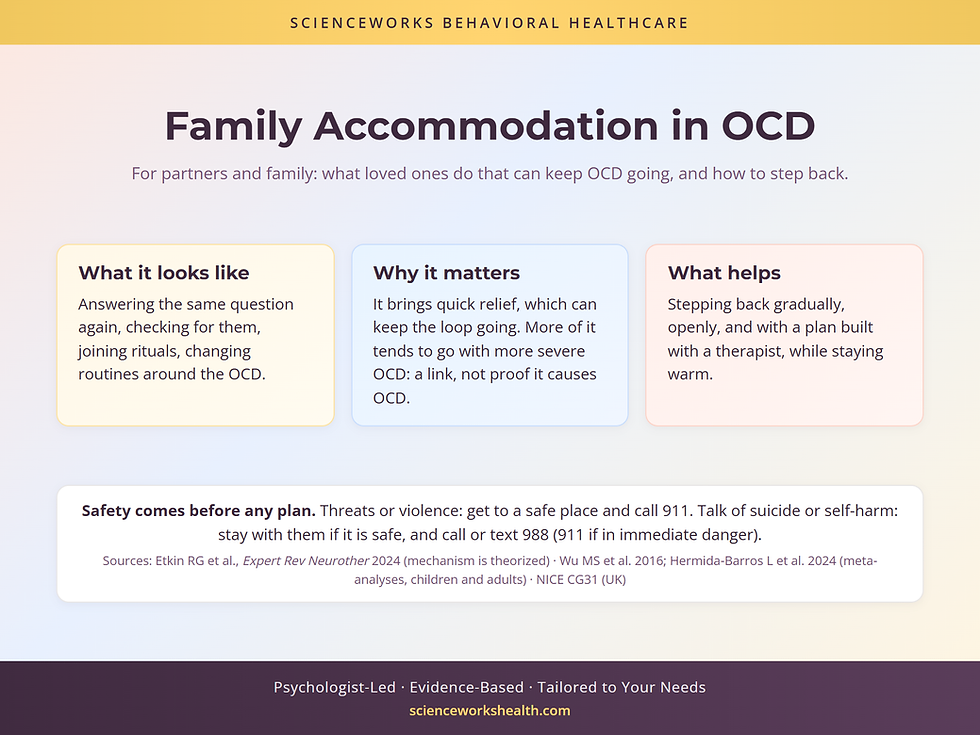
Family accommodation refers to "the changes that family members make to their own behavior to help a relative avoid or alleviate distress related to their symptoms" [1]. In OCD, that includes taking part in rituals, answering the same reassurance questions, helping your loved one avoid triggers, and rearranging routines around the OCD [1][2]. The idea was first described in a study of adults with OCD and their relatives, not children [1][3]. Partners are often closely involved: in one study that enrolled each adult's closest relative, more than half of those relatives were spouses or partners [2].
🧩 Key takeaway: Accommodation is anything you do, or stop doing, to spare your loved one OCD-related distress. It is common, it usually comes from care, and it is a treatment target rather than a flaw in you.
If you are the parent of a child or teenager with OCD, much of this applies, but treatment is organized differently. Our guide to what teen OCD therapy involves covers the family side for parents.
Four misconceptions that keep families stuck
"If I love them, I should make the distress stop." Your instinct makes sense. Reassurance and help bring fast relief. But in OCD, relief is also what keeps rituals going: when a ritual lowers anxiety, that relief strengthens it for next time [4]. Answering the question for them can work the same way.
"If I have been accommodating, I caused this or made it worse." Accommodation is not a verdict on you. Researchers who work with families present it to them as a common and understandable response [5], and an early study suggested families may accommodate to reduce their loved one's anxiety, or anger directed at them [3]. The research shows accommodation and severity tend to travel together. It does not show that accommodation causes OCD [6][7].
"The fix is to stop helping, starting today." Stopping suddenly, without explaining the change, can backfire. A review of accommodation in adult OCD notes that stopping is usually associated with greater distress and sometimes aggressive reactions, and advises reducing it progressively and openly [8]. Family guidance from the International OCD Foundation makes the same point: plans made without talking to the person with OCD tend to backfire [9]. If your loved one has not started treatment yet, our guide to what families can do while waiting for ERP covers small, agreed first steps.
"If we accommodate at all, or every day, their OCD must be unusually severe." Not necessarily. Accommodation is extremely common. A 2025 pooled analysis of 39 studies found it on a monthly and weekly basis in over 90 percent of OCD cases, and daily in close to half [10]. How often it happened was not significantly linked to OCD severity or treatment outcome [10]. Across studies, families who accommodate more do tend to be living with more severe OCD [6][7], but simply having accommodation in your home is not a sign that your loved one's OCD is unusually severe or hard to treat.
What accommodation looks like at home
Joining rituals and answering the same question again
Reassurance is the most common form. In a study of 41 adults' closest relatives, more than half of them spouses or partners, the most frequent accommodations in the past week were reassuring the person that there were no grounds for their OCD worry (63 percent), avoiding talking about triggers (56 percent), and waiting for rituals to finish (49 percent) [2]. That was a small study, but its list will be familiar to many partners.
Joining in can look like checking that doors are locked for them, listening to a repeated confession, or promising they did nothing wrong [1][8]. In contamination OCD, it can mean washing your own hands on request, buying extra soap, or checking for contaminants [1]. None of these feel dramatic on their own. The pattern is what matters.
Or: your spouse has a fear of harming someone by mistake. Before bed, you have started going through the day with them: yes, you both locked the car; no, they did not say anything hurtful at dinner; yes, you would have noticed. It takes twenty minutes now, where it used to take two. You do it because it is the only way either of you can sleep, and you have quietly stopped mentioning how tired you are.
Changing routines, avoiding triggers, taking over tasks
Accommodation also changes how the household runs. The self-rated Family Accommodation Scale asks relatives about taking over household responsibilities, helping with personal tasks and food preparation, avoiding things that could trigger OCD, making excuses or covering for the OCD, cutting back on leisure time, and changing work schedules [2]. One adult-focused review gives examples such as cleaning the bathroom before your partner uses it, or escorting them in social situations [8].
These changes can take a toll on the helper, too. In a study of 20 couples, more accommodation by the partner was linked to lower relationship satisfaction for the partner, though not for the person with OCD [11]. In one family guideline example, a husband let his wife's contamination fear keep their children's friends out of the house "to keep the peace" [9]. Caring for someone with OCD can bring frustration, anger, guilt, and a shrinking social life [8]. If you notice your own mood or anxiety slipping, our mental health screening tools can be a place to start.
🏠 Key takeaway: Accommodation is not only what you do during a ritual. It is also what the household has quietly stopped doing, and those changes cost you, too.
Why helping can keep OCD going
OCD runs on a loop. An intrusive thought brings anxiety, a ritual brings relief, and the relief teaches the brain to reach for the ritual again next time [4]. Accommodation can slot into that loop. It spares your loved one the anxious moment, but it can also take away the chance to learn that the anxiety passes and the feared outcome does not happen [1][4]. Researchers describe this as a theorized mechanism, not a proven one [1]. The same authors suggest accommodation may also send an implicit message that the fear is valid, or that your loved one cannot cope without help [1].
People on the helping side often sense this. In the study that developed the original Family Accommodation Scale, most relatives accommodated, but many did not believe it improved their loved one's condition [12].
What the research shows is more nuanced than "accommodation makes OCD worse." Two meta-analyses, including a 2024 review of 108 studies and 8,928 children and adults, found a moderate link: families who accommodate more tend to be living with more severe OCD [6][7]. The same 2024 review found that how much accommodation there was at the start of treatment did not predict how much symptoms improved, and that accommodation fell during cognitive behavioral therapy in those studies [7]. And because accommodation is so common, its presence alone is not a sign that your loved one's OCD is unusually hard to treat [10].
Timing evidence in adults is limited. In one study of adults leaving intensive or residential OCD treatment, symptom changes during treatment were followed by changes in accommodation, and a rise in accommodation after discharge, as reported by the patients, came before a later rise in symptoms [13]. That was an observational study of a more severe group, so it shows sequence in both directions, not proof of cause.
🔄 Key takeaway: More accommodation tends to go with more severe OCD, and in studies of children and adults it dropped during cognitive behavioral therapy. How much there was at the start of treatment did not predict who improved, so it is a lever worth working on, not a verdict on how treatment will go.

How clinicians measure it (the Family Accommodation Scale)
The Family Accommodation Scale was developed with adults with OCD and their primary caregivers [12]. The clinician-rated version asks about a dozen kinds of accommodation over the past week, such as reassurance, waiting for rituals, and changing personal routines, each rated from 0 to 4 [2]. A self-rated version lets the relative fill it out. In its first study, with the relatives of 41 adults with OCD, the self-rated version agreed strongly with the interview version among relatives who completed both, though its authors call the results preliminary [2].
UK clinical guidance recommends that assessment, where appropriate, include how much family members or caregivers are involved in supporting or carrying out OCD-related behaviors [14]. This is not a test to score yourself on at home. It is a way for a clinician to see the whole system around the OCD, so the plan fits your household.
How to step back without pulling away
Supportive statements instead of reassurance
The goal is to stay close while declining the ritual. In a trial of a brief intervention for the families of adults with OCD, clinicians suggested alternatives to verbal reassurance such as "I can see this is really hard for you" and "I just want to support all of your hard work in treatment" [5]. International OCD Foundation guidance adds that long explanations rarely help, because "there is always that lingering 'What if?'" [9].
A supportive statement does two things at once. It names the distress, and it signals confidence that your loved one can get through it without the ritual. Something like: "I love you, and I'm not going to check it again. I'll sit with you while this feels hard." It will not feel as good in the moment as a reassuring answer. That is expected.
A gradual plan built with the therapist
UK guidance recommends that when family members have become involved in compulsions, avoidance, or reassurance seeking, treatment should help them reduce that involvement "in a sensitive and supportive manner" [14]. In practice, that tends to look like this:
Agree first. Talk about the plan at a calm moment, not in the middle of a ritual, and ideally with the therapist's help [9].
Pick one accommodation. Start with something specific and manageable, not everything at once.
Script your response. Decide together what you will say instead of answering or joining in.
Stay consistent. Make sure everyone in the household is on the same plan. In one family example, a mother stopped doing laundry for her adult son, but his father did it instead, because they had no agreed plan [15].
Expect some distress when things change [8], and keep the therapist involved as you go.
If your loved one has not started treatment yet, keep changes small and agreed. For parents of children, a parent-based program called SPACE teaches parents to reduce accommodation and use supportive statements [16]; it is designed for children and teens, not adult partners.
What to be cautious of: abrupt withdrawal, conflict, and when safety comes first
Sudden changes in how you respond can create anger and stress at home [17], and one adult-focused review warns that stopping suddenly, without making the change explicit, may even give rise to abusive behavior [8]. The International OCD Foundation's family guidelines also suggest that on especially bad days, family members may need to "back off," unless there is a risk of violence or danger to life, while aiming for firmer limits on better days, and to set limits ahead of time rather than in the middle of a conflict [9].
Here is an honest limit of the evidence: we found no study that measured how often adults react with anger or aggression when a partner stops accommodating. The studies we found on that question were in children and adolescents, and the adult guidance comes from clinical reviews and expert opinion [8][9]. So take strong reactions seriously, slow down, and bring in the therapist.
Safety comes before any plan. If you are being threatened or anyone is being hurt, get yourself to a safe place and call 911. If your loved one talks about suicide or harming themselves, stay with them if it is safe to do so and call or text 988, or call 911 if they are in immediate danger. If you feel afraid of your partner, or threats or intimidation are becoming a pattern, the National Domestic Violence Hotline offers free, confidential support around the clock: call 1-800-799-7233 or text START to 88788 [22].
🛟 Key takeaway: Step back from the rituals, not from the person, and do it gradually, openly, and with the therapist. If safety is ever in question, safety comes first.

When family members should join treatment
For adults with OCD who live with family, UK guidance says clinicians should consider involving a family member as a co-therapist in exposure and response prevention (ERP), where that is appropriate and acceptable to everyone [14]. A 2020 meta-analysis of 15 studies found that family and couple-integrated treatment for adult OCD improved OCD symptoms, depression, anxiety, and functioning, along with relationship satisfaction and accommodation [18]. The authors called the evidence that it beats individual treatment "preliminary" [18].
Even a small amount of family involvement may help. In a pilot trial with 18 adults in ERP, family members, most of them partners, were randomized to two extra sessions on reducing accommodation, attended without the patient [5]. Accommodation fell further in that group, and their loved ones' symptoms improved faster than in the ERP-only group [5]. It was a small, preliminary study, but the idea is practical. A couple-based program for OCD has also been piloted, with partner-assisted ERP and work on accommodation built in [19].
A simple way to decide your next step:
If anyone is unsafe: stop any plan and get help first: 911 in an emergency, or 988 if your loved one talks about suicide or self-harm.
If your loved one is already in OCD treatment: ask whether you can join a session to plan how to respond at home.
If they are not in treatment yet: focus on small, agreed changes and on getting them to an OCD-informed evaluation.
If the OCD has become the center of your relationship: couples work that understands OCD may help. Our overview of couples therapy for ADHD, autism, and OCD explains how that works.
If you are running on empty: get support for yourself, whatever your loved one decides.
If you are looking for a therapist for your loved one, or for the two of you, these questions help:
Do you use ERP, and how do you involve partners or family members?
Can I have a session to learn how to respond when I am asked for reassurance?
How will we decide which accommodation to reduce first?
What should I do if my loved one gets angry or distressed when I step back?
Do you see couples when OCD is affecting the relationship?
Some of our clinicians, such as Dr. Brittany Lippert, work with OCD as well as couples and families, and our specialized therapy team can help match you with the right fit.
🤝 Key takeaway: You do not have to figure this out alone. Asking to join a session is one of the most useful things a partner can do.
Where family members can find support
You need support too. The International OCD Foundation's resource directory lists more than 300 support and treatment groups around the world for OCD and related disorders, including groups for family members, loved ones, and caregivers [20]. Support groups are not a substitute for therapy, but they can be a helpful step or addition [20]. NAMI Family-to-Family is a free, eight-session education program for the families and friends of people with mental health conditions in general; NAMI describes it as evidence-based [21].
It also helps to protect time that is not organized around OCD. Family guidance is direct about this: you need and deserve time to pursue your own interests [9]. Taking care of yourself is part of helping, not a break from it [17].
Next step: getting support
Stepping back from accommodation is hard, because it can feel like withholding love. It is not. It is choosing to support the person over the OCD, and it works best as a plan you build together with a clinician who understands OCD. Whether your loved one is ready for treatment or not, you can start by learning, by getting support for yourself, and by asking for help when the plan gets hard.
Think it might be OCD?
OCD responds well to the right approach — a clinician trained in ERP and I-CBT can help you tell OCD apart from anxiety and build a plan that fits.
Frequently Asked Questions
What are some tips for living with a partner who has OCD?
Treat the OCD as the problem, not your partner. Agree on a plan at a calm moment rather than in the middle of a ritual, and change one accommodation at a time instead of everything at once. When you are asked for reassurance, respond briefly and warmly, ideally with a supportive line you agreed on in advance, rather than a long, logical answer, since explanations rarely settle the doubt. Protect some time that is not organized around OCD, and get support for yourself. If your partner is in treatment, ask whether you can join a session.
How can I help a partner with contamination OCD without making it worse?
Stay warm, and step back from the rituals themselves rather than from your partner. Common accommodations in contamination OCD include washing your own hands on request, buying extra cleaning supplies, cleaning surfaces before they use them, and promising that nothing is contaminated. With their therapist, pick one of these to reduce first and agree on what you will say instead. Avoid debating whether something is really dirty; long debates about the fear are themselves a common form of accommodation.
Where can family members of someone with OCD find support?
The International OCD Foundation's resource directory lists support and treatment groups for OCD, including groups for family members and loved ones. NAMI Family-to-Family is a free, eight-session education program for the families and friends of people with mental health conditions in general, not OCD specifically. Many partners also benefit from their own therapy, or from a session with their loved one's OCD therapist to align on a plan.
What if my partner gets angry when I stop helping with rituals?
Distress, and sometimes anger, is a known reaction when accommodation stops, which is why clinicians recommend reducing it gradually and explaining the plan in advance. Anger is a reason to slow down and bring in the therapist, not to give up. If you are threatened or anyone is being hurt, get to a safe place and call 911. If your loved one talks about suicide or self-harm, stay with them if it is safe and call or text 988, or call 911 if they are in immediate danger.
Is accommodating my partner's OCD the same as enabling it?
The clinical term is accommodation, and it is not a verdict on you. It usually starts as care, and it is extremely common: in a 2025 pooled analysis it showed up weekly or monthly in over 90 percent of OCD cases. The concern is not that you did something wrong. It is that each accommodation gives the OCD a short-term win, which can keep the cycle going. Stepping back, with a plan and with support, is how you help without feeding it.
About the Author
Dr. Kiesa Kelly is a licensed clinical psychologist and the founder of ScienceWorks Behavioral Healthcare, with more than 20 years of experience in psychological assessment. She provides evidence-based treatment for OCD, anxiety, and related conditions, and her clinical work centers on exposure and response prevention and inference-based approaches across the obsessive-compulsive spectrum.
She earned her PhD in Clinical Psychology with a concentration in Neuropsychology from Rosalind Franklin University of Medicine and Science, and completed practica, internship, and an NIH-funded National Research Service Award postdoctoral fellowship at the University of Chicago, the University of Wisconsin, the University of Florida, and Vanderbilt University. Dr. Kelly is a psychologist, not a physician, and does not prescribe medication.
References
1. Etkin RG, Bloch MH, Lebowitz ER. Family accommodation: a diagnostic feature of obsessive-compulsive disorder? Expert Rev Neurother. 2024;24(2):129-131. https://doi.org/10.1080/14737175.2024.2309239
2. Pinto A, Van Noppen B, Calvocoressi L. Development and preliminary psychometric evaluation of a self-rated version of the Family Accommodation Scale for Obsessive-Compulsive Disorder. J Obsessive Compuls Relat Disord. 2013;2(4):457-465. https://doi.org/10.1016/j.jocrd.2012.06.001
3. Calvocoressi L, Lewis B, Harris M, Trufan SJ, Goodman WK, McDougle CJ, et al. Family accommodation in obsessive-compulsive disorder. Am J Psychiatry. 1995;152(3):441-443. https://doi.org/10.1176/ajp.152.3.441
4. Hezel DM, Simpson HB. Exposure and response prevention for obsessive-compulsive disorder: a review and new directions. Indian J Psychiatry. 2019;61(Suppl 1):S85-S92. https://doi.org/10.4103/psychiatry.IndianJPsychiatry_516_18
5. Thompson-Hollands J, Abramovitch A, Tompson MC, Barlow DH. A randomized clinical trial of a brief family intervention to reduce accommodation in obsessive-compulsive disorder: a preliminary study. Behav Ther. 2015;46(2):218-229. https://doi.org/10.1016/j.beth.2014.11.001
6. Wu MS, McGuire JF, Martino C, Phares V, Selles RR, Storch EA. A meta-analysis of family accommodation and OCD symptom severity. Clin Psychol Rev. 2016;45:34-44. https://doi.org/10.1016/j.cpr.2016.03.003
7. Hermida-Barros L, Primé-Tous M, García-Delgar B, Forcadell E, Lera-Miguel S, Fernández de la Cruz L, et al. Family accommodation in obsessive-compulsive disorder: an updated systematic review and meta-analysis. Neurosci Biobehav Rev. 2024;161:105678. https://doi.org/10.1016/j.neubiorev.2024.105678
8. Albert U, Baffa A, Maina G. Family accommodation in adult obsessive-compulsive disorder: clinical perspectives. Psychol Res Behav Manag. 2017;10:293-304. https://doi.org/10.2147/PRBM.S124359
9. Van Noppen B, Pato M. Living with someone who has OCD: guidelines for family members. International OCD Foundation. https://iocdf.org/expert-opinions/expert-opinion-family-guidelines/
10. Pellegrini L, Tardivo G, Callegher RZ, Strani F, Fineberg NA, Albert U. Pooled frequency meta-analysis of family-accommodation (FA) in obsessive-compulsive disorder (OCD): a pervasive phenomenon. Asian J Psychiatr. 2025;114:104744. https://doi.org/10.1016/j.ajp.2025.104744
11. Boeding SE, Paprocki CM, Baucom DH, Abramowitz JS, Wheaton MG, Fabricant LE, et al. Let me check that for you: symptom accommodation in romantic partners of adults with obsessive-compulsive disorder. Behav Res Ther. 2013;51(6):316-322. https://doi.org/10.1016/j.brat.2013.03.002
12. Calvocoressi L, Mazure CM, Kasl SV, Skolnick J, Fisk D, Vegso SJ, et al. Family accommodation of obsessive-compulsive symptoms: instrument development and assessment of family behavior. J Nerv Ment Dis. 1999;187(10):636-642. https://doi.org/10.1097/00005053-199910000-00008
13. Kelley KN, Caporino NE, Falkenstein MJ. Family accommodation in intensive/residential treatment for adults with OCD: a cross-lagged panel analysis. Behav Ther. 2024;55(2):391-400. https://doi.org/10.1016/j.beth.2023.07.012
14. National Institute for Health and Care Excellence. Obsessive-compulsive disorder and body dysmorphic disorder: treatment (CG31). London: NICE; 2005. Recommendations 1.1.4.1, 1.5.2.4, and 1.5.2.9. https://www.nice.org.uk/guidance/cg31/chapter/Recommendations
15. Van Noppen B, Pato M. Families: "What can I do to help?" International OCD Foundation. https://iocdf.org/expert-opinions/expert-opinion-families-what-you-can-do-to-help/
16. Lebowitz E. SPACE: Supportive Parenting for Anxious Childhood Emotions. International OCD Foundation OCD Treatment Guide. https://iocdf.org/about-ocd/ocd-treatment-guide/space/
17. Beyond OCD. Stop accommodating OCD. https://beyondocd.org/information-for-friends-and-family/stop-accommodating-ocd
18. Stewart KE, Sumantry D, Malivoire BL. Family and couple integrated cognitive-behavioural therapy for adults with OCD: a meta-analysis. J Affect Disord. 2020;277:159-168. https://doi.org/10.1016/j.jad.2020.07.140
19. Abramowitz JS, Baucom DH, Boeding S, Wheaton MG, Pukay-Martin ND, Fabricant LE, et al. Treating obsessive-compulsive disorder in intimate relationships: a pilot study of couple-based cognitive-behavior therapy. Behav Ther. 2013;44(3):395-407. https://doi.org/10.1016/j.beth.2013.02.005
20. International OCD Foundation. Support groups and treatment groups. https://iocdf.org/ocd-finding-help/supportgroups/
21. National Alliance on Mental Illness. NAMI Family-to-Family. https://www.nami.org/programs/nami-family-to-family/
22. National Domestic Violence Hotline. Get help. https://www.thehotline.org/
Disclaimer
This article is for informational and educational purposes only and is not a substitute for professional medical or mental health advice, diagnosis, or treatment. Every household is different, and changes to how you respond to a loved one's OCD work best when planned with a qualified clinician. If you or someone you love is in danger, call 911. If you are in crisis or thinking about harming yourself, call or text 988.