
The "Interest-Based Nervous System" in ADHD: What the Research Supports and What It Doesn't

Last reviewed: 10/10/2026
Reviewed by: Dr. Kiesa Kelly
It is 11 p.m. and you have spent four hours rebuilding a spreadsheet for your fantasy league, completely absorbed, barely noticing the time. The insurance appeal that is due Friday, the one that actually matters, has been sitting in a tab for two weeks. You know it is important. You want to do it. You open it, read the first line, and somehow end up back in the spreadsheet. Then, on Thursday night, with the deadline breathing down your neck, you finish the appeal in forty minutes.
If that pattern is familiar, you may have come across the phrase "interest-based nervous system" in ADHD, often with the acronym INCUP: interest, novelty, challenge, urgency and passion. In our clinical experience, for many people it is the first explanation that fits, and it lands with real relief. It also raises a fair question: is this neuroscience, or a description? This article separates the two. If the pattern has been costing you for years, a structured psychological assessment is where an answer about ADHD actually comes from, and we will come back to what that involves.
In this article, you'll learn:
Where the "interest-based nervous system" idea comes from, and what kind of claim it is
Three common misconceptions about ADHD motivation, rewards and dopamine
What research on reward, delay and motivation in ADHD does support
What the label leaves out, including other conditions that can look similar
What actually helps, and when the pattern points to an evaluation
The short answer: a useful description, not a research finding
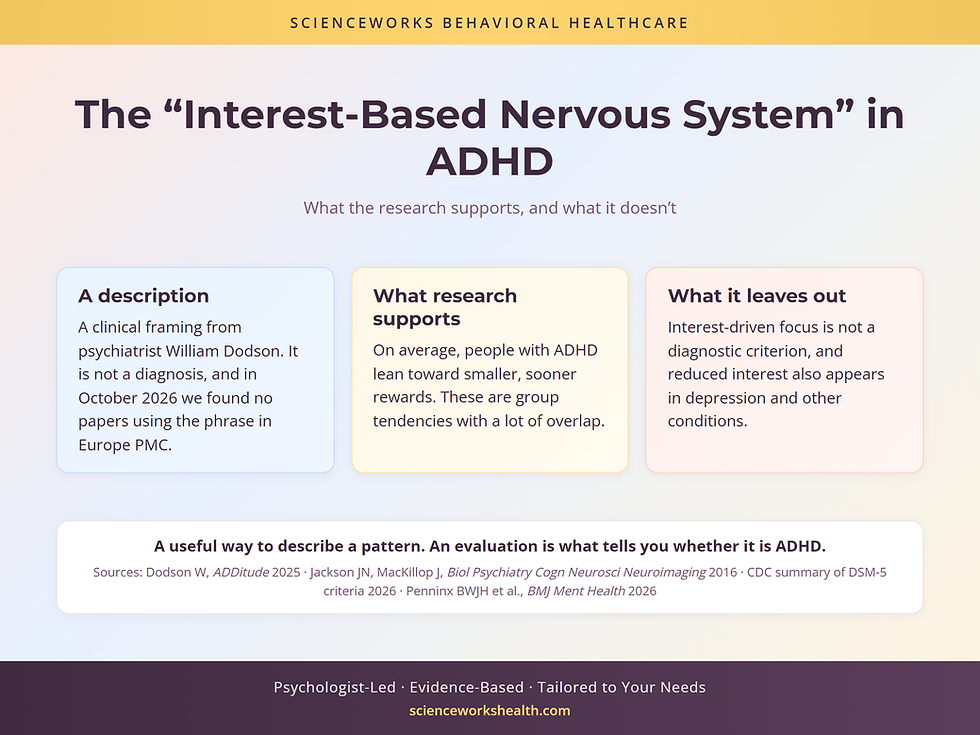
"Interest-based nervous system" is a phrase used by psychiatrist William Dodson. In his words, "The ADHD nervous system is interest-based, rather than importance- or priority-based" [1]. He writes that people with ADHD describe engaging through "interest, challenge, novelty, urgency, or passion" [1], and that his clinical work led him to a hypothesis, which he checked by going back to "the hundreds of people and their families I worked with" [2]. That is a clinical observation from one clinician's practice. It is not the name of a tested model, and it is not a diagnosis.
When we searched Europe PMC, a large database of biomedical research, in October 2026, we found no papers using the phrase "interest-based nervous system" and none on INCUP and ADHD, while a search on a related research term, "delay aversion" and ADHD, returned 589. INCUP appears to be a coaching acronym built on Dodson's list. That does not make the experience it describes less real. It means the label should be read as a description of a pattern, and the science has to be checked separately.
Clinicians who work with ADHD describe the pattern often. Thomas Brown, a psychologist known for his work on executive function in ADHD, has called "the situational variability of the symptoms" the central mystery about the condition, as reported from his 2022 talk at the American Psychiatric Association meeting [3]. Our article on why starting tasks is so hard looks at the same inconsistency from the executive-function side.
🧭 Key takeaway: The "interest-based nervous system" is a clinician's description of a pattern many people with ADHD report. It is not a research construct or a diagnosis, so its claims about the brain need to be checked against the evidence.
Three misconceptions about ADHD motivation
"If interest drives your focus, that proves you have ADHD." Interest-driven focus is not a diagnostic criterion, and related patterns are found in other conditions too. The DSM-5 criteria, as summarized by the CDC, require symptoms before age 12, in two or more settings, that clearly interfere with daily life and are not better explained by another condition [4]. A screener like the ASRS, which was validated against clinical diagnosis [5], is a reasonable first step, not a conclusion. Reduced interest or pleasure appears across many conditions, including depression [6]. A preference for smaller, sooner rewards has also been found in depression, bipolar disorder and several other conditions [7].
"People with ADHD can't be motivated by rewards or consequences." Dodson writes that people with ADHD have "never been able to use the idea of importance or rewards to start and do a task" [2]. Research on children points the other way, at least for rewards actually delivered during a task. A review of 22 studies, covering 1,181 children, found that rewards and other reinforcement had a positive effect on task performance and motivation in children with ADHD and in children without it, and reported evidence that the effect on performance was "somewhat more prominent" in ADHD [8]. It also reported "some evidence" that high-intensity reinforcement is highly effective in ADHD, and that children with ADHD prefer immediate over delayed rewards [8]. These were children, so the adult picture is less clear. The review also does not directly test Dodson's narrower point about using the idea of a future reward to get started, and the delay research below fits the sense that distant rewards carry less pull.
"It's all about low dopamine." Dopamine is part of the story. In a brain-imaging study of 45 adults with ADHD and 41 without, lower scores on a measure of achievement motivation went with lower dopamine markers in reward-related brain areas [9]. The authors hypothesized that the dopamine differences could underlie the motivation problems, but the links were moderate and the study was correlational, so it shows an association rather than a cause [9]. A 2025 review of adult ADHD notes that genetic findings implicate dopaminergic and GABAergic systems and glial cells, and that amphetamine-type medications raise both dopamine and noradrenaline, while noting that the genetic studies are heavily focused on children [10]. Even in research on lost interest and pleasure more broadly, experts suggest that "mechanisms beyond dopamine likely contribute" [6].
🧩 Key takeaway: Being interest-driven does not by itself point to ADHD. In studies of children, rewards helped those with ADHD too. And dopamine is not a full explanation.
What the research does support
Rewards, delay and the pull of "now"
The research that comes closest to the lived experience is on how people with ADHD respond to rewards and to waiting. A meta-analysis of 25 comparisons involving 3,913 people found that, on average, people with ADHD discounted delayed money more steeply than people without ADHD, meaning a reward later was worth less to them than a reward now [11]. The difference was medium-sized and did not differ significantly between samples under and over age 18 [11]. A second meta-analysis found small-to-medium effects across two kinds of choice tasks, and that, in one of the two task types, using real rather than hypothetical rewards almost doubled the difference between participants with and without ADHD [12].
Brain-imaging research points the same way. A meta-analysis of imaging studies found that, on average, a reward-related area called the ventral striatum responded less when people with ADHD were anticipating a reward [13]. The authors also said there were too few studies for "a final answer" [13]. A 2026 review of childhood ADHD describes "a strong preference for smaller immediate rewards over larger delayed ones" as one of the well-supported findings [14].
These findings fit the experience of finishing the appeal on Thursday night. A deadline turns a distant, abstract payoff into an immediate one. That is a reasonable way to connect the evidence to everyday life, but it is our interpretation, not something these studies tested directly.
Two pathways, not one nervous system
ADHD researchers have long described two broad explanations: problems with regulation, such as inhibition and executive function, and differences in motivation, such as an aversion to waiting [15]. Psychologist Edmund Sonuga-Barke's dual pathway model treats these as complementary accounts that may describe different groups of people, rather than as rival theories [16]. His later study of 71 children and teens with ADHD found that timing, inhibition and delay-related difficulties did not cluster together more than chance would predict, with substantial groups showing only one problem; the authors noted it needs replication in larger samples [17].
That is the most important limit on any single explanation, including the interest-based one. Group averages hide a lot of overlap. A review of adult ADHD notes "much heterogeneity" in how people with ADHD perform on lab tasks, and that differences may be minimal in many individuals [10]. So the reward and delay findings describe a tendency in groups, not a rule that applies to everyone with ADHD.
Here is a composite illustration of what that can look like. One person works as a nurse and is sharp and fast on a busy shift. Off shift, she cannot start anything without a deadline, and her laundry, bills and emails pile up until something forces them. Another person with ADHD has no trouble waiting for a reward and enjoys long projects. His difficulty is impulsive speech and losing track of what he was asked a minute ago. Both meet criteria, but only the first fits the "interest-based" story well.
📊 Key takeaway: On average, people with ADHD prefer sooner rewards and show less activity in one reward area while anticipating a reward, though that imaging evidence is still thin. These are group tendencies with a lot of overlap, and they do not describe every person with ADHD.

What the label leaves out
The interest-based framing can be a relief, and in our clinical experience it often reduces shame. But it leaves out several things a reader needs.
It is not how ADHD is diagnosed. NICE guidance says a diagnosis "should not be made solely on the basis of rating scale or observational data," and requires at least moderate impairment across two or more important settings [18]. A 2025 review notes that no neuropsychological test, the kind of task used in reward and delay research, can tell ADHD apart from other conditions [10].
It overlaps with other conditions. The CDC notes that sleep disorders, anxiety, depression and certain learning disabilities can have symptoms similar to ADHD [19]. Consider a third, composite pattern. For most of your life you were organized and driven, and you could do boring work when it mattered. Over the past six months, though, you have stopped caring about things you used to enjoy, you sleep badly, and even your hobbies feel flat. That is not the lifelong, situational pattern described above. In our clinical experience, a loss of interest across the board points first toward mood, and the PHQ-9, a validated depression screener [20], is a quick way to check whether depression deserves a closer look.
It can overstate what it explains. Dodson presents the interest-based nervous system as one of three features that "explain every aspect" of ADHD [1]. Since the mid-2000s, researchers have proposed models built around multiple developmental pathways rather than one simple core deficit [21], a 2025 review still describes "much heterogeneity" across people with ADHD [10], and even the executive-function account is listed as an open question in the adult literature [10].
When the pattern points to an evaluation
Use this as a rough guide, not a verdict:
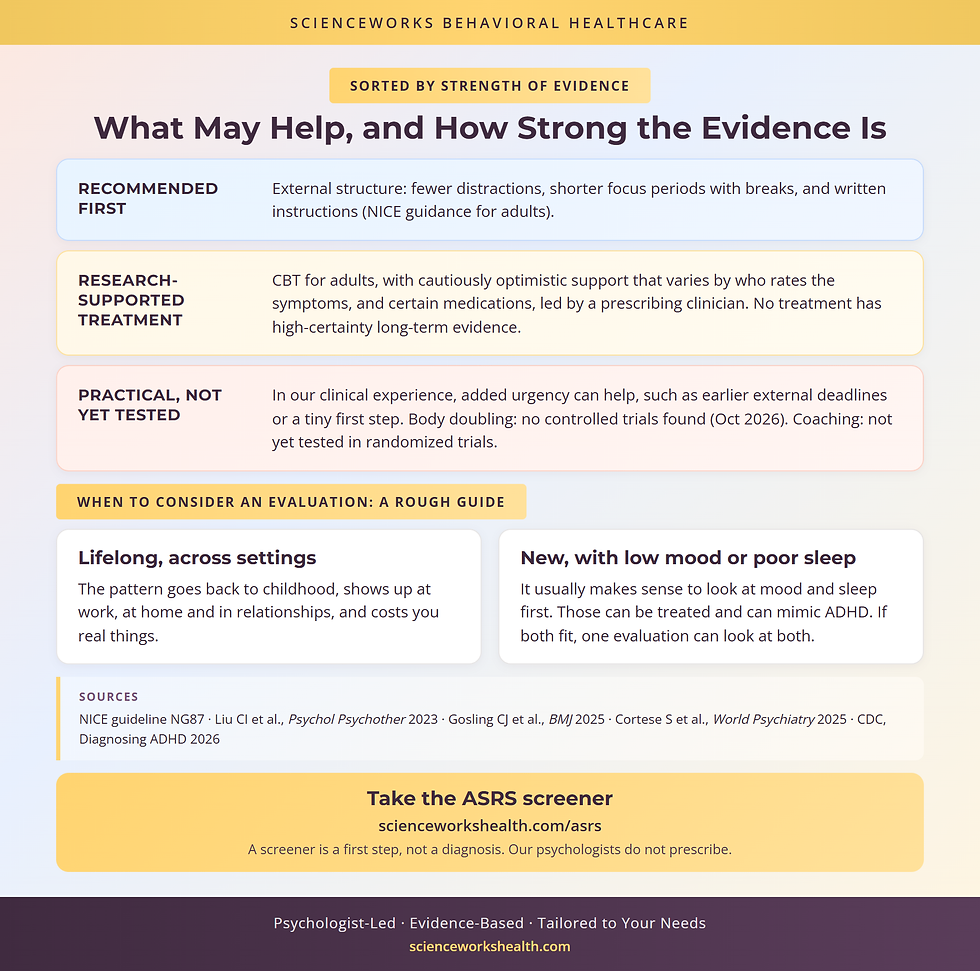
If the interest-and-urgency pattern goes back to childhood, shows up at work, at home and in relationships, and is costing you real things, an ADHD evaluation is a sensible next step.
If the pattern is new, or comes with low mood, poor sleep or loss of interest in everything, it usually makes sense to look at mood and sleep first. Those can be treated and can mimic ADHD.
If both seem true, say so. An evaluation can look at ADHD and mood together rather than forcing a choice.
Our page on ADHD and autism testing in Tennessee explains how our evaluations are structured.
🔎 Key takeaway: Interest-driven focus is common, so it cannot settle whether you have ADHD. A lifelong pattern across settings with real impairment can, through a proper evaluation.
What actually helps
Borrowing structure, and urgency, on purpose
The most practical part of the interest-based idea overlaps with what guidelines do recommend: put structure outside your head rather than relying on willpower. NICE recommends environmental changes for adults with ADHD first, with examples that include reducing distractions, shorter periods of focus with movement breaks, and backing up spoken requests with written instructions [18]. CBT for adult ADHD includes the same kind of external scaffolding: problem-solving, organization, time management and planning supports [10].
In our clinical experience, adding urgency on purpose can help too: setting earlier, external deadlines with someone else, breaking a large task into a first step small enough to start, or making progress visible. Those tactics have not been tested in trials. Our guide to prioritizing with ADHD covers related strategies in detail. When we searched Europe PMC in October 2026, the studies mentioning body doubling and ADHD were qualitative or descriptive, and none was a controlled trial. These strategies are low-risk to try, but they are practical suggestions rather than proven treatments.
Treatment and coaching options
Several treatments have research behind them. A 2023 meta-analysis of 28 randomized trials offers what its authors call "cautiously optimistic" support for CBT in adults with ADHD, with improvements in core symptoms, emotional symptoms, self-esteem and quality of life [22]. A 2025 umbrella review found at least moderate-certainty evidence that CBT and certain medications reduce ADHD symptoms in adults, but no high-certainty long-term evidence for any treatment [23]. A 2025 review adds a caution: in one large analysis, short-term CBT benefits showed up in clinicians' ratings but not in patients' own ratings, and long-term data come from very few trials [10]. NICE recommends that adults be offered medication if symptoms still cause significant impairment after environmental changes [18]. Medication decisions belong with a prescribing clinician, and our psychologists do not prescribe.
Executive function coaching focuses on the practical systems that make follow-through easier. It is worth being clear about the evidence: a 2025 review notes that ADHD coaching has yet to be tested in randomized trials [10]. We see coaching as skills support that sits alongside an evaluation and evidence-based care, not as a replacement for them. Our specialized therapy page describes the therapy options we offer when a structured therapy approach fits better.
What to be cautious of
Explanations that claim to account for "every aspect" of ADHD. The research describes several pathways, not one.
"Dopamine-boosting" hacks presented as treatment. The dopamine findings are real but partial and correlational.
Concluding that you do or do not have ADHD from an online description, including this one. If you can lose yourself in a hobby for hours, our article on hyperfocus at work explains why that does not settle the question either way.
🛠️ Key takeaway: External structure, such as fewer distractions, shorter focus periods and planning supports, is what guidelines recommend first. Added urgency is a practical idea that has not been tested. CBT and medication have the strongest evidence; coaching and body doubling have not yet been tested in trials.
Questions to ask before an ADHD evaluation
If you decide to look into an evaluation, these questions help you choose well:
"How will you tell ADHD apart from depression, anxiety or sleep problems that can look similar?"
"What developmental history will you gather if I don't have school records?"
"How will you account for the ways I've learned to compensate, such as working only to deadlines or relying on a partner or calendar to keep me on track?"
"Will the evaluation use rating scales alone, or also a clinical interview and input from someone who knows me?"
"What will I receive at the end: a diagnosis only, or specific recommendations for work, home and treatment?"
"If medication might help, how will you coordinate with a prescriber?"
Next step: getting support
The "interest-based nervous system" names something many people with ADHD describe: interest and urgency, not importance, decide what gets done. The research supports part of that picture, including a stronger pull toward immediate rewards and differences in how the brain responds to rewards. But those are group tendencies, not universal rules or a diagnosis, and the same struggle can come from mood, sleep or other conditions. The most useful next step is the one that tells you which explanation fits you.
Wondering if ADHD explains the pattern?
A structured ADHD evaluation can tell you whether what you're noticing is ADHD, something else, or both — and what would actually help.
Frequently Asked Questions
Is the interest-based nervous system a real ADHD diagnosis?
No. It is a description, not a diagnosis or a research term. Psychiatrist William Dodson uses the phrase to describe how many of his patients engage with tasks, and we could not find it in the peer-reviewed literature indexed by Europe PMC. ADHD is diagnosed from DSM-5 criteria: symptoms before age 12, in two or more settings, that clearly interfere with daily life and are not better explained by another condition.
Is INCUP an evidence-based framework for ADHD motivation?
Not in the research sense. INCUP (interest, novelty, challenge, urgency, passion) appears to be a coaching acronym that echoes Dodson's list, and we found no studies that test it. Some nearby findings have research behind them, such as a stronger pull toward immediate rewards in ADHD. The acronym itself has not been studied as a tool or a model, and the idea that deadlines help is a reasonable reading of that research rather than something it tested.
Does low dopamine explain ADHD motivation problems?
Only partly, and less neatly than online explanations suggest. A brain-imaging study of adults found that lower motivation scores went with lower dopamine markers in reward areas, but the link was moderate and correlational. Genetic research, mostly in children so far, also points to other brain systems, and ADHD stimulants act on noradrenaline as well as dopamine. Dopamine is part of the story, not the whole explanation.
Do rewards and deadlines actually work for people with ADHD?
Often, yes, at least in children. A review of 22 studies of children found that rewards and other reinforcement improved task performance and motivation in children with and without ADHD, with some evidence of a larger effect on performance in ADHD. Children with ADHD also preferred immediate rewards. Adult research is thinner. For adults, standard guidance starts with structure: fewer distractions, shorter focus periods with breaks, and written instructions.
Can depression look like an interest-driven attention problem?
Yes. Losing interest or pleasure in things you used to enjoy is common in depression and shows up across many other conditions too. ADHD requires symptoms that began in childhood and appear across settings. In our clinical experience, a newer, across-the-board loss of interest points more toward mood. A screener such as the PHQ-9 can help you decide whether mood deserves a closer look.
About the Author
Dr. Kiesa Kelly is a licensed clinical psychologist and the founder of ScienceWorks Behavioral Healthcare. A neuropsychologist by training with more than 20 years of experience in psychological assessment, she completed an NIH National Research Service Award postdoctoral fellowship researching dual pathway models of ADHD, the line of research discussed in this article. Her practice focuses on ADHD and autism evaluations, alongside OCD, trauma and insomnia.
Dr. Kelly earned her PhD in Clinical Psychology, with a concentration in Neuropsychology, from Rosalind Franklin University of Medicine and Science. She completed practica, internship, and postdoctoral training at the University of Chicago, the University of Wisconsin, the University of Florida, and Vanderbilt University. She is a psychologist, not a physician, and does not prescribe medication.
References
1. Dodson W. 3 Defining Features of ADHD That Everyone Overlooks. ADDitude. Updated August 11, 2025. Accessed October 10, 2026. https://www.additudemag.com/symptoms-of-add-hyperarousal-rejection-sensitivity/
2. Dodson W. Secrets of Your ADHD Brain. ADDitude. Updated November 3, 2025. Accessed October 10, 2026. https://www.additudemag.com/secrets-of-the-adhd-brain/
3. O'Brien E. Willpower and ADHD. Psychiatric Times. June 9, 2022. Accessed October 10, 2026. https://www.psychiatrictimes.com/view/willpower-and-adhd
4. Centers for Disease Control and Prevention. Clinical Care of ADHD in Children. Updated July 30, 2026. Accessed October 10, 2026. https://www.cdc.gov/adhd/hcp/clinical-care/index.html
5. Kessler RC, Adler L, Ames M, et al. The World Health Organization Adult ADHD Self-Report Scale (ASRS): a short screening scale for use in the general population. Psychol Med. 2005;35(2):245-256. https://doi.org/10.1017/s0033291704002892
6. Penninx BWJH, Kas MJH, Dawson GR, et al. Research agenda to advance anhedonia assessment, understanding and treatment: an ECNP-GALENOS expert meeting report. BMJ Ment Health. 2026;29(1):e302843. https://doi.org/10.1136/bmjment-2026-302843
7. Amlung M, Marsden E, Holshausen K, et al. Delay Discounting as a Transdiagnostic Process in Psychiatric Disorders: A Meta-analysis. JAMA Psychiatry. 2019;76(11):1176-1186. https://doi.org/10.1001/jamapsychiatry.2019.2102
8. Luman M, Oosterlaan J, Sergeant JA. The impact of reinforcement contingencies on AD/HD: a review and theoretical appraisal. Clin Psychol Rev. 2005;25(2):183-213. https://doi.org/10.1016/j.cpr.2004.11.001
9. Volkow ND, Wang GJ, Newcorn JH, et al. Motivation deficit in ADHD is associated with dysfunction of the dopamine reward pathway. Mol Psychiatry. 2011;16(11):1147-1154. https://doi.org/10.1038/mp.2010.97
10. Cortese S, Bellgrove MA, Brikell I, et al. Attention-deficit/hyperactivity disorder (ADHD) in adults: evidence base, uncertainties and controversies. World Psychiatry. 2025;24(3):347-371. https://doi.org/10.1002/wps.21374
11. Jackson JN, MacKillop J. Attention-Deficit/Hyperactivity Disorder and Monetary Delay Discounting: A Meta-Analysis of Case-Control Studies. Biol Psychiatry Cogn Neurosci Neuroimaging. 2016;1(4):316-325. https://doi.org/10.1016/j.bpsc.2016.01.007
12. Marx I, Hacker T, Yu X, Cortese S, Sonuga-Barke E. ADHD and the Choice of Small Immediate Over Larger Delayed Rewards: A Comparative Meta-Analysis of Performance on Simple Choice-Delay and Temporal Discounting Paradigms. J Atten Disord. 2021;25(2):171-187. https://doi.org/10.1177/1087054718772138
13. Plichta MM, Scheres A. Ventral-striatal responsiveness during reward anticipation in ADHD and its relation to trait impulsivity in the healthy population: a meta-analytic review of the fMRI literature. Neurosci Biobehav Rev. 2014;38:125-134. https://doi.org/10.1016/j.neubiorev.2013.07.012
14. Cai W, Mizuno Y. Dynamic modeling in neurocognitive frameworks of childhood ADHD: a review of inhibitory control and reward systems. Transl Psychiatry. 2026;16(1):198. https://doi.org/10.1038/s41398-026-03972-0
15. Sonuga-Barke EJ. Psychological heterogeneity in AD/HD--a dual pathway model of behaviour and cognition. Behav Brain Res. 2002;130(1-2):29-36. https://doi.org/10.1016/s0166-4328(01)00432-6
16. Sonuga-Barke EJ. The dual pathway model of AD/HD: an elaboration of neuro-developmental characteristics. Neurosci Biobehav Rev. 2003;27(7):593-604. https://doi.org/10.1016/j.neubiorev.2003.08.005
17. Sonuga-Barke E, Bitsakou P, Thompson M. Beyond the dual pathway model: evidence for the dissociation of timing, inhibitory, and delay-related impairments in attention-deficit/hyperactivity disorder. J Am Acad Child Adolesc Psychiatry. 2010;49(4):345-355. https://doi.org/10.1016/j.jaac.2009.12.018
18. National Institute for Health and Care Excellence. Attention deficit hyperactivity disorder: diagnosis and management. NICE guideline NG87. 2018, updated 2019. https://www.nice.org.uk/guidance/ng87/chapter/Recommendations
19. Centers for Disease Control and Prevention. Diagnosing ADHD. Updated July 30, 2026. Accessed October 10, 2026. https://www.cdc.gov/adhd/diagnosis/index.html
20. Kroenke K, Spitzer RL, Williams JB. The PHQ-9: validity of a brief depression severity measure. J Gen Intern Med. 2001;16(9):606-613. https://doi.org/10.1046/j.1525-1497.2001.016009606.x
21. Sonuga-Barke EJ. Causal models of attention-deficit/hyperactivity disorder: from common simple deficits to multiple developmental pathways. Biol Psychiatry. 2005;57(11):1231-1238. https://doi.org/10.1016/j.biopsych.2004.09.008
22. Liu CI, Hua MH, Lu ML, Goh KK. Effectiveness of cognitive behavioural-based interventions for adults with attention-deficit/hyperactivity disorder extends beyond core symptoms: A meta-analysis of randomized controlled trials. Psychol Psychother. 2023;96(3):543-559. https://doi.org/10.1111/papt.12455
23. Gosling CJ, Garcia-Argibay M, De Prisco M, et al. Benefits and harms of ADHD interventions: umbrella review and platform for shared decision making. BMJ. 2025;391:e085875. https://doi.org/10.1136/bmj-2025-085875
Disclaimer
This article is for informational and educational purposes only and is not a substitute for professional medical or mental health advice, diagnosis, or treatment. Online descriptions and screeners cannot diagnose ADHD or any other condition. Do not start, stop or change any medication without talking to your prescriber. If you are in crisis or thinking about harming yourself, call or text 988, or call 911 in an emergency.