
Moral Injury vs. PTSD: How They Differ and What Helps

Updated: 1 day ago
Last reviewed: 10/11/2026
Reviewed by: Dr. Kiesa Kelly

You are a nurse on a unit that has run short for months. One night two patients crash and you have time for one. You make the call, and you would probably make it again. The patient you could not reach does not survive. Nobody blames you. A year later you are not afraid at work. It is harder to name than fear: you cannot stop judging yourself, you no longer trust the people above you, and a job that felt like who you are now feels like something you did wrong.
If that is close to your experience, you may have wondered whether it is PTSD. Sometimes it is, or partly is. But there is a name for a wound that lands on your sense of right and wrong rather than your sense of safety: moral injury. This article explains moral injury vs. PTSD, where the two overlap, and why the difference changes what helps. If you are carrying something like this, our trauma services can help with this kind of sorting.
In this article, you'll learn:
What moral injury is, and why it is not a diagnosis
Three common misconceptions about moral injury and PTSD
How the two differ, and what it means when both are present
Who it affects beyond the military, including healthcare workers and first responders
How clinicians assess it, and what the evidence on treatment does and does not show yet
Moral injury vs. PTSD: the one-paragraph answer
Moral injury is lasting psychological, behavioral, social and sometimes spiritual distress after you take part in, fail to prevent, or witness an event that goes against your deeply held moral beliefs [1][2]. PTSD is a diagnosis that follows exposure to actual or threatened death, serious injury or sexual violence, and it requires symptoms in four areas: re-experiencing, avoidance, negative thoughts or feelings, and arousal [3]. The two overlap heavily, and the VA's National Center for PTSD notes that "it is possible to have either in the absence of the other" [4]. Moral injury is not a diagnosis [1]. When both are present, PTSD and depression tend to be more severe and suicidal thinking is more likely [1][4].
🧭 Key takeaway: PTSD centers on a threat that the body keeps reacting to. Moral injury centers on a violation of what you believe is right. One person can carry either, or both.
Three misconceptions about moral injury and PTSD
"Moral injury is just PTSD by another name." It is not. The VA describes "significant overlap" between the two, but PTSD includes symptoms such as hyperarousal that are "not central to moral injury" [4]. A 2025 paper proposing new definitions notes that PTSD must involve re-experiencing and avoidance, "whereas moral injury may or may not" [5]. You can have moral injury without meeting criteria for PTSD [4]. Treating the two as identical can mean treating only the part that fits the familiar diagnosis. Our guide to complex PTSD vs. PTSD covers another way a trauma picture can extend past the classic diagnosis.
"If what I feel is guilt or shame, not fear, it can't be PTSD." Also not true. Guilt and shame are "core features of moral injury and are also symptoms of PTSD" [4]. The PCL-5, the checklist used to screen for the diagnosis, asks about blaming yourself or others and about strong negative feelings such as "fear, horror, anger, guilt, or shame" [6]. Since DSM-5, a PTSD diagnosis no longer requires that you felt intense fear, helplessness or horror at the time of the event [3]. So the emotion alone does not sort one from the other.
"Moral injury only happens in war." The concept grew out of work with combat veterans [2][7], but it is not limited to them. In national US samples, about half of healthcare workers (50.8%) reported a potentially morally injurious event, and 7.3% had clinically meaningful moral injury symptoms. Those rates were similar to combat veterans [8]. The VA also describes moral injury in law enforcement, first responders and civilians exposed to community violence [4].
What moral injury is, and why it is not a DSM-5 diagnosis
Researchers use two related definitions. In one widely used definition, potentially morally injurious events include "perpetrating, failing to prevent, or bearing witness to acts that transgress deeply held moral beliefs and expectations" [2]. Jonathan Shay, who first defined moral injury in his work with combat veterans [9], described it as "a betrayal of 'what's right'" by "a person in legitimate authority," or by oneself, "in a high stakes situation" [7]. A recent overview frames it as "a potential clinical problem," marked by impairing moral emotions and beliefs and by a damaged sense of life's meaning [10]. Its authors also note that until recently there was no reliable way to measure moral injury as an outcome [10].
Moral injury is not a mental disorder. In December 2024, the American Psychiatric Association's Board of Trustees approved adding the word "moral" to an existing DSM-5-TR category, now listed as "Z65.8 Moral, Religious, or Spiritual Problem" [5]. That category sits among conditions that may be a focus of clinical attention, which the DSM says "are not mental disorders" [5]. Some researchers have proposed a "moral injury disorder" for the most severe cases, but they are clear that much more research would be needed first [5].
Perpetrating, failing to prevent, witnessing, or being betrayed
The routes in are broader than "doing something wrong." The VA lists doing something against your beliefs, failing to do something in line with them, witnessing or learning about such an act, and "experiencing betrayal by one's organization or by trusted others" [11]. The common thread is the violation of a moral expectation, whether you, someone beside you, or an institution you relied on did the violating. If an institution's response is the part that hurts most, our article on betrayal trauma looks at that pattern in depth.
Consider a paramedic who, ten years in, responds to a call where a protocol delays treatment for a child. He followed the rules. The outcome was bad, and the review that followed protected the agency more than the crew. Months later he is sleeping fine and is not jumpy on calls. What has changed is quieter. He no longer believes the people above him will do the right thing, he has stopped going the extra mile he once did, and he feels a contempt for himself he cannot argue his way out of. That is the shape the betrayal route can take: no sense of danger, but a steady erosion of trust and self-respect.
Moral distress vs. moral injury
The two terms get used interchangeably, but they describe different things. Moral distress comes from nursing ethics. It describes being "unable to do what they consider is ethically correct due to internal or external constraints" [9]. Its hallmark is a constraint you cannot remove, and its effects are "typically temporary and moderate" [9]. Some recent measurement studies use "moral distress" for a milder, subclinical level and "moral injury" for the clinical one, though even subclinical moral distress can affect functioning [12]. Most people who go through a potentially morally injurious event do not develop clinical moral injury. Among exposed veterans, healthcare workers and first responders in one national sample, about 1 in 10 (10.2%) screened positive [13].
⚖️ Key takeaway: Moral distress is the strain of being blocked from doing right. Moral injury is what may remain when that violation does not fade: lasting guilt, shame, anger or loss of trust that affects how you live.
How moral injury differs from PTSD
Fear and threat vs. guilt, shame and betrayal
The clearest differences are in what the event did and what keeps the distress going. PTSD requires exposure to death, threatened death, serious injury or sexual violence, though that exposure can come through disturbing details encountered at work, as it often does for first responders and medics [3]. Its symptoms include re-experiencing, avoidance and a body stuck on alert [3]. The VA notes that feeling on "high alert" is "not usually a feature of moral injury" [1]. Moral injury is driven by moral emotions: "guilt, shame, betrayal, disgust, and anger" [4]. It often includes not being able to forgive yourself, or feeling a need to punish yourself [1].
The overlap is real, though. Both often begin with an event that is "life threatening or harmful to self or others" [4]. And as the misconceptions above show, guilt, shame and self-blame are part of PTSD too [4][6]. So clinicians do not sort the two by one feeling. They look at the whole pattern: is the distress organized around danger, or around what was done, allowed or betrayed?
Here is what the PTSD-heavy pattern can look like. A dispatcher took a call during a house fire and stayed on the line as the caller's voice stopped. She does not blame herself, and she knows she did everything right. But for months the sound of a certain ringtone snaps her back into that call, she avoids the room where she took it, and she wakes at 3 a.m. with her heart pounding. That is a threat-based pattern: re-experiencing, avoidance and arousal, with little guilt in it. Whether it adds up to PTSD depends on the full picture, which a clinician would assess.
When both are present
Often, both are present. The VA reports that having moral injury on top of PTSD is linked with more severe PTSD and depression and a greater likelihood of suicidal thinking and behavior [4]. Moral injury also has a social side. Loss of trust in leaders, institutions or yourself can quietly narrow your life, even when you keep working [11].
Exposure to morally injurious events is also linked with suicide risk. In a nationally representative sample of US combat veterans, reporting wrongdoing by oneself, wrongdoing by others, or betrayal was each associated with current suicidal thoughts and with past suicide plans and attempts, even after accounting for PTSD, depression and other factors [14]. The added risk was modest, though. Depression, PTSD and age were stronger factors [14]. If you are having thoughts of ending your life, call or text 988 to reach the 988 Suicide & Crisis Lifeline, any time [15].
🛡️ Key takeaway: Moral injury and PTSD can each exist alone. When they show up together, the picture is usually heavier, which is a reason to have both looked at rather than one.

Who it affects beyond the military
Healthcare workers, first responders and caregivers
Healthcare work carries a particular kind of moral strain. The VA describes healthcare workers who must make life-and-death triage or resource decisions, who are present for deaths that go against their beliefs about how people should die, or who "witness what they perceive to be unjustifiable or unfair acts or policies" [4][11]. In the national comparison above, healthcare workers were more likely than first responders to report witnessing others' wrongful acts [8]. A review in nursing ethics adds administrative burden, institutional betrayal and inadequate resources to the list of moral stressors [9].
There is a hopeful part of this research, too. The VA notes that most healthcare workers do not experience significant distress from hard situations at work. They add that "it is likely that most health care workers who experience morally injurious events will not have long-term negative outcomes" [11]. Family caregivers who have to make impossible choices for a parent or partner may face similar moral strain, although far less research has focused on them than on veterans and healthcare workers.
How clinicians assess moral injury
PTSD symptoms (PCL-5) and moral-injury measures such as the MIDS
A careful psychological assessment usually looks at both. For PTSD, the PCL-5 is a 20-item self-report checklist that takes about 5 to 10 minutes [16]. In its first evaluation, it showed strong reliability and validity [17]. Scores of roughly 31 to 33 suggest probable PTSD, though cutoffs vary by setting [16]. The PCL-5 is a screen. The VA describes a structured clinical interview as the "gold standard" for diagnosing PTSD [16].
Moral injury has its own measures. The Moral Injury and Distress Scale (MIDS) is an 18-item self-report scale validated with veterans, healthcare workers and first responders [18]. It ties symptoms to a specific event and predicted day-to-day functioning better than event exposure alone [18]. A cut score of 27 has been proposed to separate everyday distress from clinically meaningful moral injury [13]. Like any screen, it points to a conversation. It does not make a diagnosis.
📋 Key takeaway: The PCL-5 asks about PTSD, not moral injury. If guilt, shame or betrayal are central for you, an assessment should look at them directly, not only at the PTSD score.
What actually helps
Trauma-focused therapies that work on guilt and shame (CPT, PE)
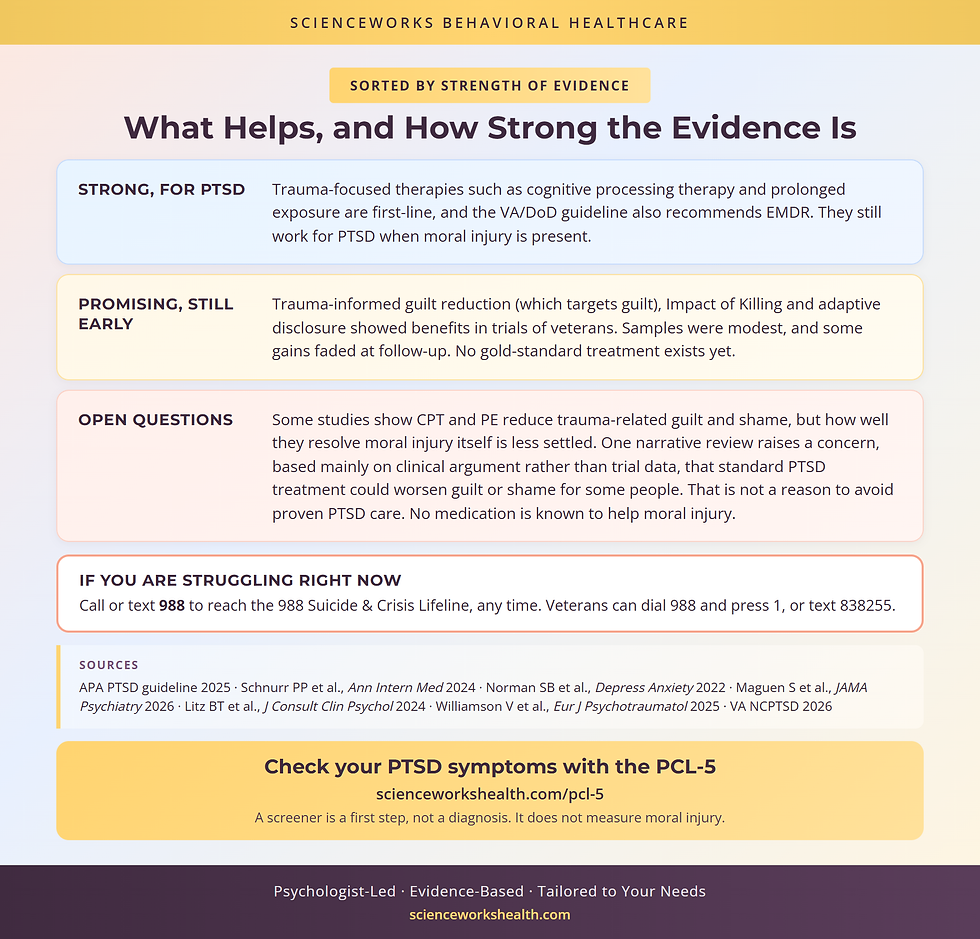
If PTSD is present, the evidence base is strong. The American Psychological Association's PTSD guideline lists cognitive processing therapy (CPT), prolonged exposure (PE) and cognitive behavioral therapy as first-line treatments [19]. The 2023 VA/DoD guideline also recommends PE, CPT and EMDR, and it prefers specific psychotherapies over medication [20]. CPT focuses on modifying "unhelpful beliefs related to the trauma" [19], which is often where self-blame lives.
What these treatments do for moral injury itself is less settled. The VA notes that "PTSD treatments still work well to treat PTSD even when someone also has moral injury" [1]. Some studies show PE and CPT reduce trauma-related guilt and shame, but one found guilt likely to endure afterward [4]. Researchers have "hypothesized" that they can help moral injury, but surprisingly little is known [4]. A 2025 narrative review raises a concern, based mainly on clinical argument rather than trial data, that conventional PTSD treatments such as prolonged exposure may not fully address moral injury and could worsen guilt or shame for some people [21]. That is a real disagreement in the field. It is not a reason to avoid proven PTSD care, but it is worth asking any therapist how they would handle it. If shame about who you are, not just what happened, is the heaviest part, our article on toxic shame in complex PTSD explains why shame often needs direct work.
Moral-injury-specific approaches: what the evidence does and does not yet show
Several treatments have been built for moral injury and its close relatives:
Trauma-informed guilt reduction (TrIGR) is a 6-session therapy. In a trial of 145 post-9/11 veterans, guilt fell more than with supportive therapy, and among participants who had PTSD, half of those in TrIGR no longer met PTSD criteria afterward, compared with 14% with supportive therapy [22]. The trial targeted trauma-related guilt, not a moral-injury measure.
Impact of Killing focuses on self-forgiveness and moral repair and is meant to follow PTSD treatment [4]. In a trial of 100 veterans with PTSD who were distressed by killing in war, it improved PTSD and moral injury symptoms more than an active comparison. It beat that comparison on one of two functioning measures [23].
Adaptive disclosure uses imagined conversations with a compassionate moral authority, and its enhanced version adds letter writing [1][24]. In 174 veterans with loss- or moral-injury-related PTSD, its advantages were "small to medium and not maintained at follow-up" [24].
The honest summary: "no gold-standard intervention exists," and the evidence is "constrained by small samples, military-focused populations, and inconsistent measurement" [21]. The VA also states that "there are no medications that are known to help with moral injury" [1]. For civilians, choosing an approach is still a matter of clinical judgment.
🧩 Key takeaway: Proven PTSD treatments are the right start when PTSD is present. Moral-injury-specific approaches are promising but early, and a good therapist will say which is which.
A practical way to sort what you are carrying
If the distress is mostly about danger, PTSD is the better first question. That means memories that intrude, places you avoid, sleep broken by alarm, a body that will not stand down. If it is mostly about what was done, allowed or betrayed, moral injury belongs in the conversation. That means guilt you cannot argue away, contempt for yourself or your leaders, faith or meaning that cracked. If it is both, say so. An assessment that looks at both will serve you better than one that measures only the part that fits a checklist. And if a hard stretch at work is easing as conditions change, that may be moral distress doing what it often does: fading. If it is not easing, or it is affecting sleep, work or relationships, that is worth raising with a clinician.
Questions to ask a therapist before you book
"How will you tell whether this is PTSD, moral injury, depression, or a mix?"
"Do you measure moral injury directly, or only PTSD symptoms?"
"Which trauma-focused therapies are you trained in, and how would you adapt them for guilt, shame or betrayal?"
"What does the evidence say about the approach you are recommending, and was it tested in people like me or mainly in veterans?"
"If medication might help, how do you coordinate with a prescriber?"
"What would progress look like, and how will we track it?"
Next step: getting support
Moral injury names something many people carry without words for it: a wound to what you believe is right, not to your sense of safety. It is not a diagnosis, and it is not a sign that you are broken. It often travels with PTSD or depression, and both deserve care. If you are in crisis, call or text 988, or chat at chat.988lifeline.org; veterans can dial 988 and press 1, or text 838255 [25]. Otherwise, a clinician who can look at the danger and the moral parts together is a good place to begin. If it would help to talk through options first, you can reach us directly.
Carrying something that still feels close?
Trauma-focused care — including approaches like EMDR — can help you process what happened at a pace that feels safe, with a clinician who understands trauma responses.
Frequently Asked Questions
Is moral injury a mental health diagnosis?
No. Moral injury is not a mental disorder in the DSM-5-TR, and the VA's National Center for PTSD says plainly that it is not a diagnosis. A December 2024 change added the word 'moral' to an existing non-disorder category, Z65.8 Moral, Religious, or Spiritual Problem. A clinician can still make moral injury a focus of treatment. What gets diagnosed are any conditions that travel with it, such as PTSD or depression.
Can you have moral injury without PTSD?
Yes. The VA describes heavy overlap between the two but says it is possible to have either one without the other. Someone with moral injury may have no nightmares, startle or sense of danger, yet still carry guilt, anger, self-punishment or lost trust that gets in the way of work and relationships. That lasting impact is the part worth taking to a clinician, with or without a PTSD diagnosis.
What kind of therapy helps moral injury?
There is no gold-standard treatment yet. If PTSD is present, trauma-focused therapies such as cognitive processing therapy and prolonged exposure are first-line, and they can reduce guilt and shame. Approaches built for moral injury or its core features, such as trauma-informed guilt reduction (which targets guilt) and Impact of Killing, have shown promise in trials, but those trials were modest in size and mostly in veterans. A good clinician will tell you which parts are proven.
Is moral distress at work the same as moral injury?
No. Moral distress is knowing the right thing to do but being blocked from doing it, often by staffing, policy or other constraints, inside or outside yourself. Its effects are usually temporary and moderate. Moral injury is the lasting form: guilt, shame, anger or loss of trust that persists and affects how you function. Distress that is fading as circumstances change is different from distress that has settled in.
Can medication treat moral injury?
Not directly. The VA states that no medications are known to help moral injury itself. Some medications are recommended for PTSD and depression, which often travel with it, and that decision belongs with a prescribing clinician. Our psychologists do not prescribe, so if medication may help, we coordinate with your physician or psychiatric prescriber while therapy addresses the moral injury.
About the Author
Dr. Kiesa Kelly is a licensed clinical psychologist and the founder of ScienceWorks Behavioral Healthcare. She has more than 20 years of experience in psychological assessment and evidence-based treatment, and her practice includes trauma and post-traumatic presentations in adults, alongside ADHD, autism, OCD and insomnia.
Dr. Kelly earned her PhD in Clinical Psychology from Rosalind Franklin University of Medicine and Science and completed her training at the University of Chicago, the University of Wisconsin, the University of Florida, and Vanderbilt University, including an NIH-funded postdoctoral fellowship. She is a psychologist, not a physician, and does not prescribe medication.
References
1. National Center for PTSD, US Department of Veterans Affairs. Moral injury and PTSD. Updated October 2026. Accessed October 11, 2026. https://www.ptsd.va.gov/understand/related/moral_injury_ptsd.asp
2. Litz BT, Stein N, Delaney E, Lebowitz L, Nash WP, Silva C, Maguen S. Moral injury and moral repair in war veterans: a preliminary model and intervention strategy. Clin Psychol Rev. 2009;29(8):695-706. https://doi.org/10.1016/j.cpr.2009.07.003
3. National Center for PTSD, US Department of Veterans Affairs. PTSD and DSM-5. Updated September 2026. Accessed October 11, 2026. https://www.ptsd.va.gov/professional/treat/essentials/dsm5_ptsd.asp
4. Norman SB, Maguen S. Moral injury. National Center for PTSD, US Department of Veterans Affairs. Updated September 2026. Accessed October 11, 2026. https://www.ptsd.va.gov/professional/treat/cooccurring/moral_injury.asp
5. VanderWeele TJ, Wortham JS, Carey LB, et al. Moral trauma, moral distress, moral injury, and moral injury disorder: definitions and assessments. Front Psychol. 2025;16:1422441. https://doi.org/10.3389/fpsyg.2025.1422441
6. Ashbaugh AR, Houle-Johnson S, Herbert C, El-Hage W, Brunet A. Psychometric validation of the English and French versions of the Posttraumatic Stress Disorder Checklist for DSM-5 (PCL-5). PLoS One. 2016;11(10):e0161645. https://doi.org/10.1371/journal.pone.0161645
7. Shay J. Moral injury. Psychoanal Psychol. 2014;31(2):182-191. https://doi.org/10.1037/a0036090
8. Maguen S, Griffin BJ, Pietrzak RH, McLean CP, Hamblen JL, Norman SB. Prevalence of moral injury in nationally representative samples of combat veterans, healthcare workers, and first responders. J Gen Intern Med. 2026;41(2):424-430. https://doi.org/10.1007/s11606-024-09337-x
9. Mewborn EK, Fingerhood ML, Johanson L, Hughes V. Examining moral injury in clinical practice: a narrative literature review. Nurs Ethics. 2023;30(7-8):960-974. https://doi.org/10.1177/09697330231164762
10. Litz BT, Walker HE. Moral injury: an overview of conceptual, definitional, assessment, and treatment issues. Annu Rev Clin Psychol. 2025;21(1):251-277. https://doi.org/10.1146/annurev-clinpsy-081423-022604
11. Watson P, Norman SB, Maguen S, Hamblen J. Moral injury in health care workers. National Center for PTSD, US Department of Veterans Affairs. Accessed October 11, 2026. https://www.ptsd.va.gov/professional/treat/cooccurring/moral_injury_hcw.asp
12. Litz BT, Walker HE, Pietrzak RH, Rusowicz-Orazem L. The prevalence of moral distress and moral injury among U.S. veterans. J Psychiatr Res. 2025;189:435-444. https://doi.org/10.1016/j.jpsychires.2025.06.031
13. Maguen S, Griffin BJ, Pietrzak RH, McLean CP, Hamblen JL, Norman SB. Using the Moral Injury and Distress Scale to identify clinically meaningful moral injury. J Trauma Stress. 2024;37(4):685-696. https://doi.org/10.1002/jts.23050
14. Nichter B, Norman SB, Maguen S, Pietrzak RH. Moral injury and suicidal behavior among US combat veterans: results from the 2019-2020 National Health and Resilience in Veterans Study. Depress Anxiety. 2021;38(6):606-614. https://doi.org/10.1002/da.23145
15. 988 Suicide & Crisis Lifeline. Accessed October 11, 2026. https://988lifeline.org/
16. National Center for PTSD, US Department of Veterans Affairs. PTSD Checklist for DSM-5 (PCL-5). Updated October 1, 2026. Accessed October 11, 2026. https://www.ptsd.va.gov/professional/assessment/adult-sr/ptsd-checklist.asp
17. Blevins CA, Weathers FW, Davis MT, Witte TK, Domino JL. The Posttraumatic Stress Disorder Checklist for DSM-5 (PCL-5): development and initial psychometric evaluation. J Trauma Stress. 2015;28(6):489-498. https://doi.org/10.1002/jts.22059
18. Norman SB, Griffin BJ, Pietrzak RH, McLean C, Hamblen JL, Maguen S. The Moral Injury and Distress Scale: psychometric evaluation and initial validation in three high-risk populations. Psychol Trauma. 2024;16(2):280-291. https://doi.org/10.1037/tra0001533
19. American Psychological Association. Treatments for PTSD. Clinical practice guideline for the treatment of posttraumatic stress disorder. Updated April 2025. Accessed October 11, 2026. https://www.apa.org/ptsd-guideline/treatments
20. Schnurr PP, Hamblen JL, Wolf J, et al. The management of posttraumatic stress disorder and acute stress disorder: synopsis of the 2023 U.S. Department of Veterans Affairs and U.S. Department of Defense clinical practice guideline. Ann Intern Med. 2024;177(3):363-374. https://doi.org/10.7326/M23-2757
21. Williamson V, Kothari R, Bonson A, Campbell G, Greenberg N, Murphy D, Lamb D. Moral injury prevention and intervention. Eur J Psychotraumatol. 2025;16(1):2567721. https://doi.org/10.1080/20008066.2025.2567721
22. Norman SB, Capone C, Panza KE, et al. A clinical trial comparing trauma-informed guilt reduction therapy (TrIGR), a brief intervention for trauma-related guilt, to supportive care therapy. Depress Anxiety. 2022;39(4):262-273. https://doi.org/10.1002/da.23244
23. Maguen S, Gloria R, Lehrner A, et al. Psychotherapy for impact of killing during war: a randomized clinical trial. JAMA Psychiatry. Published online August 5, 2026. https://doi.org/10.1001/jamapsychiatry.2026.2307
24. Litz BT, Yeterian J, Berke D, et al. A controlled trial of adaptive disclosure-enhanced to improve functioning and treat posttraumatic stress disorder. J Consult Clin Psychol. 2024;92(3):150-164. https://doi.org/10.1037/ccp0000873
25. US Department of Veterans Affairs. Veterans Crisis Line. Accessed October 11, 2026. https://www.veteranscrisisline.net/
Disclaimer
This article is for informational and educational purposes only and is not a substitute for professional medical or mental health advice, diagnosis, or treatment. Reading it does not create a clinician-patient relationship, and screeners cannot diagnose PTSD, moral injury or any other condition. If you are in crisis or thinking about harming yourself, call or text 988, or call 911 in an emergency.