
Postpartum Anxiety: The Overlooked Side of Perinatal Mental Health

Updated: 6 days ago
Last reviewed: 07/28/2026
Reviewed by: Dr. Kiesa Kelly
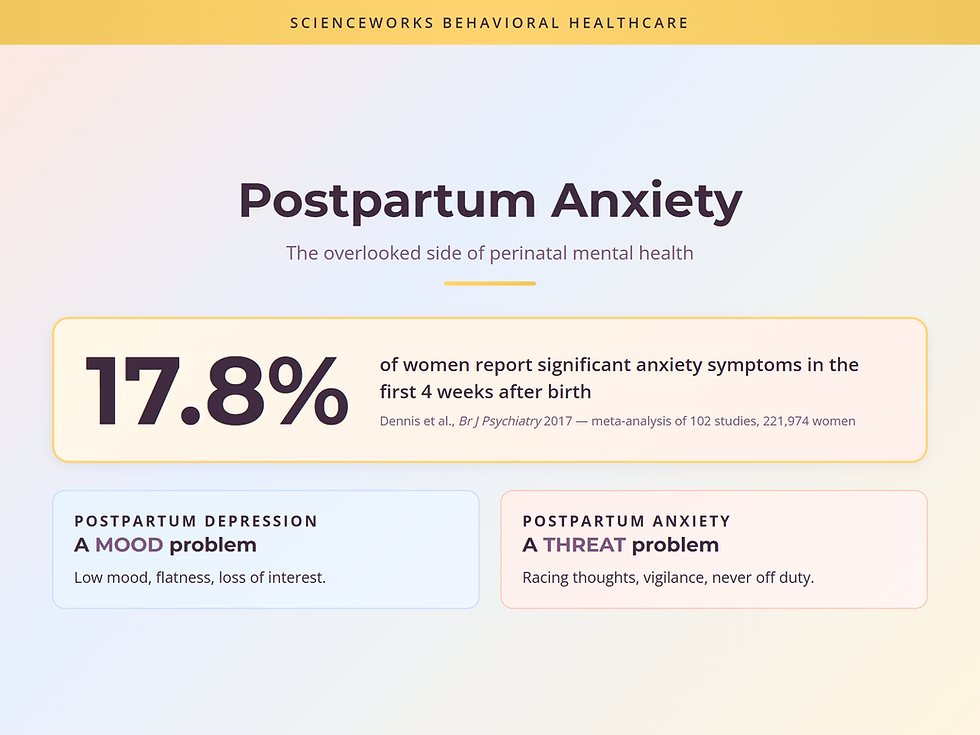
Most people know to watch for postpartum depression. Far fewer know to watch for postpartum anxiety — and that gap is not an accident. The questionnaires handed out at postpartum visits were built primarily to detect depression, the public conversation is organized around depression, and the word people reach for when something is wrong after a baby is "depressed." So a new parent who is not sad at all, who is bonded with her baby and glad she had him, but who has not slept properly in six weeks because she keeps getting up to check that he is breathing, often walks out of that appointment with nothing.
She was not missed because nobody cared. She was missed because nobody asked the right question.
In this article, you'll learn:
What postpartum anxiety is, how common it is, and how it differs from postpartum depression
Three things people commonly get wrong about anxiety after birth
What it actually looks like across an ordinary week
Why depression-focused screening tends to under-detect it — and what the evidence does and doesn't say
What helps, and how to describe what's happening so a clinician can act on it
What postpartum anxiety actually is — and how common it is
Postpartum anxiety is not a single diagnosis. It is a cluster of anxiety and anxiety-related conditions — generalized anxiety, panic, health anxiety, and related presentations — that begin or intensify in the year after birth. What unites them is not sadness but threat. The nervous system behaves as though danger is present and imminent, and it does not stand down when the situation is objectively safe.
That is the cleanest way to separate it from postpartum depression and the baby blues, which is a genuinely different problem with a different shape. Depression pulls energy and interest down. Anxiety keeps them switched on, pointed at everything that could go wrong.
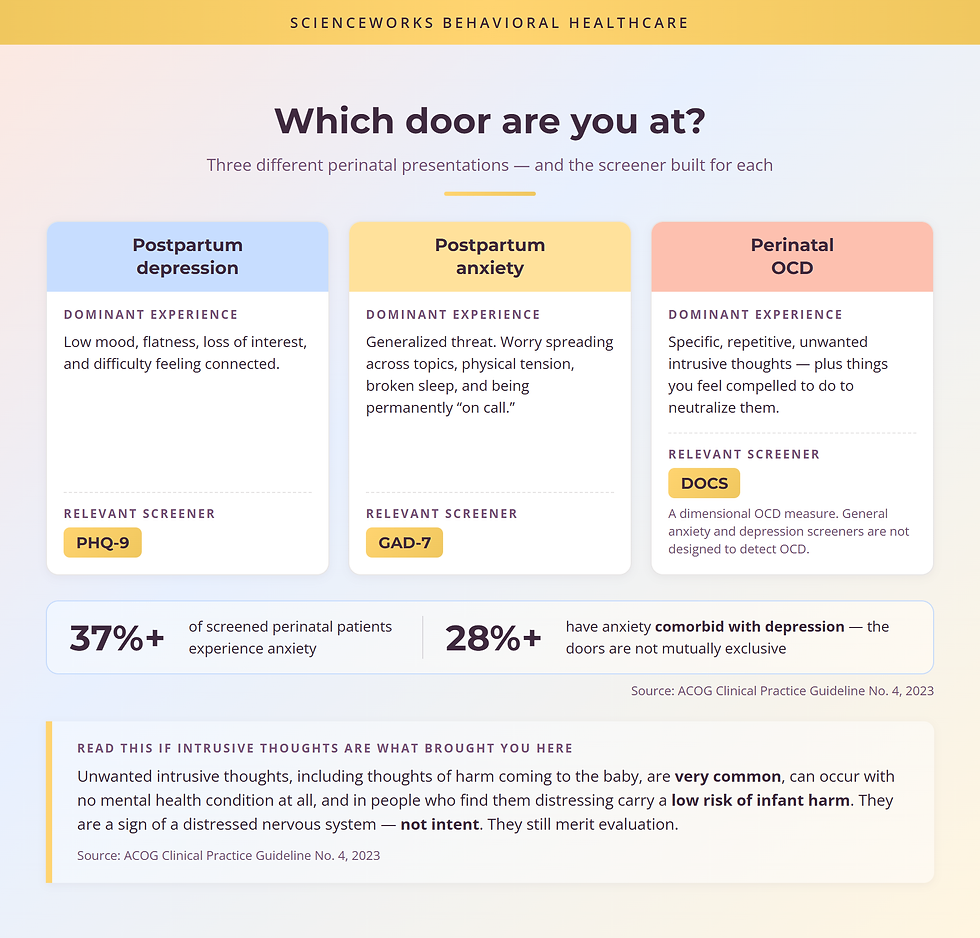
The numbers are substantial. A meta-analysis of 102 studies covering nearly 222,000 women across 34 countries found that 17.8% of women reported significant anxiety symptoms in the first four weeks after childbirth, settling to roughly 15% across the rest of the first year [1]. When researchers used structured diagnostic interviews rather than questionnaires, between 9.3% and 9.9% met criteria for an anxiety disorder at any point in that first year [1]. A separate Bayesian meta-analysis, pooling the evidence differently, put the figure closer to one in five across pregnancy and the postpartum period [7] — a useful reminder that these numbers move with the method used to collect them. The American College of Obstetricians and Gynecologists puts it plainly in its 2023 clinical practice guideline: anxiety occurs in more than 37% of screened perinatal patients, and is comorbid with depression in at least 28% [2].
Read that last figure the other way round, because it matters. If 28% of people with perinatal anxiety also have depression, then the majority do not. Anxiety after birth is not a symptom of depression waiting to be named. It is frequently the whole problem. (Pooled estimates of genuinely co-morbid anxiety and depressive symptoms after birth sit at roughly 8% [8].) A prior history of mental health difficulties, limited social support, and a stressful pregnancy are among the most consistently identified risk factors [9].
😶🌫️ Key takeaway: Postpartum depression is a mood problem. Postpartum anxiety is a threat problem. They overlap often — but most people with perinatal anxiety do not have depression alongside it.
Three things people get wrong about anxiety after birth
"If I were really struggling, I wouldn't be functioning this well"
Anxiety is frequently a high-performance state. It gets the bottles sterilized, the appointments made, the diaper bag packed with three contingencies. Many people with significant postpartum anxiety look more organized than their peers, not less, because the anxiety is doing the organizing. Functioning well is not evidence that nothing is wrong; sometimes the functioning is the symptom, and the cost is being paid somewhere invisible — in sleep, in the ability to sit still, in the fact that nobody else is allowed to hold the baby correctly.
"It's just hormones, it'll pass"
Some of it does pass. The first two weeks after birth involve genuine physiological upheaval, and transient tearfulness and edginess in that window are expected. But the population data do not describe a curve that reliably resolves. Symptoms peak early and then hold at around 15% across the remainder of the first year [1]. Waiting it out is a reasonable plan for two weeks. It is not a reasonable plan for six months.
"Anxiety is a thoughts problem, so the physical stuff must be something else"
Anxiety is at least as much a body state as a thought state, and after birth it is easy to misread. A racing heart at 3am, a chest that will not loosen, nausea, dizziness, the sense that you cannot get a full breath — these are ordinary features of an anxious nervous system, and they are also exactly the symptoms that send new parents to urgent care convinced something is medically wrong. Understanding how anxiety shows up in the body often takes a great deal of fear out of the experience, though new or severe physical symptoms after birth should always be checked medically first.
What it looks like across an ordinary week
Diagnostic criteria are not much use when you are trying to work out whether this is you. Recognizable weeks are more useful.
You have a healthy eight-week-old. You are not sad. You would tell anyone who asked that you love being his mother, and you would mean it. But you have not slept more than three hours consecutively since he was born, and only some of that is his fault. He goes down at nine; you lie there running the monitor volume up and down, and at some point you get up to put a hand on his back. Then you do it again. Your partner offers to take the 2am feed and you say yes and then lie awake through it anyway, listening to make sure he does it right. In the morning you are exhausted in a way that sleep would not fix, and you cannot explain to anyone why a night in which the baby was completely fine has left you feeling like you survived something.
Or: your daughter is four months old and the problem is not nighttime, it is leaving the house. There is a version of every outing where something goes wrong — the car seat, the traffic, the temperature, the stranger who leans too close in line — and you can see all of them in detail. So the outings get shorter. Then they get rarer. You tell yourself you are being sensible, and each individual decision genuinely is sensible, but you have not been further than the corner store in eleven days and the thought of the six-month check makes your chest tighten. Your world has quietly shrunk to the size of a room, one reasonable decision at a time.
Or: you went back to work at five months and the anxiety followed you there. You are competent — more than competent — but you check your phone between every meeting, and the daycare's number puts your stomach through the floor even when it turns out to be a diaper question. You reread emails four times before sending. You are aware that you have become the kind of person who apologizes for things that have not happened yet. Nobody at work has noticed anything except that you seem very on top of everything.
🌙 Key takeaway: The distinguishing cost of postpartum anxiety is vigilance — sleep you were physically able to get but didn't, a world that quietly narrows, a nervous system that never fully stands down. Depression's cost is heaviness. Anxiety's is that you are never off duty.
Why depression-focused screening tends to miss it
Here is the part that explains the gap.
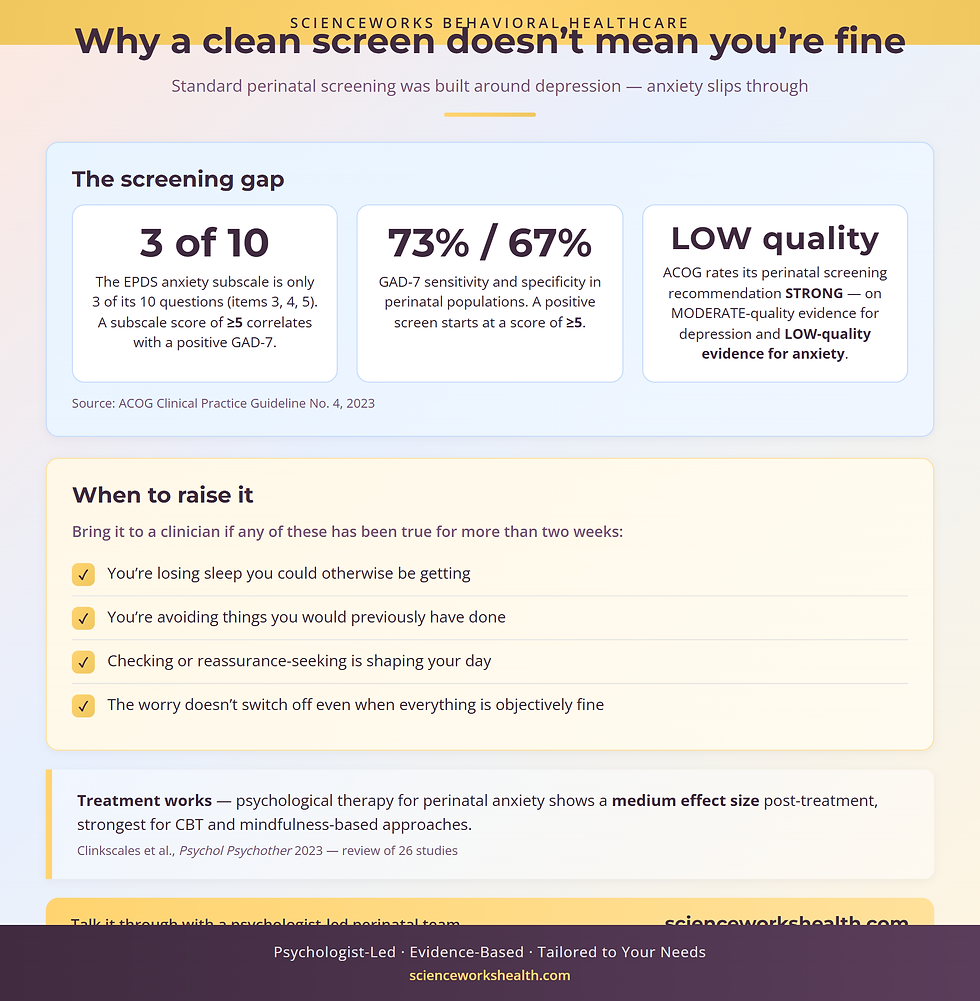
The instrument most postpartum patients encounter is the Edinburgh Postnatal Depression Scale. It is a good tool, and ACOG lists it alongside the PHQ-9 as a validated, widely studied screen [2]. But it was built to detect depression, and its results are benchmarked against a structured clinical interview for major depression [2]. Three of its ten questions — about self-blame, being anxious or worried for no good reason, and feeling scared or panicky for no very good reason — have been examined separately as an anxiety subscale, and when those three sum to five or more, the result correlates significantly with a positive GAD-7 screen [2]. That is genuinely useful. It is also three questions, embedded inside a depression measure, scored as a secondary output.
To be fair to the guidelines, this is a known problem and it is being addressed. ACOG's 2023 guideline recommends screening for both depression and anxiety at the first prenatal visit, again later in pregnancy, and at postpartum visits [2]. What is worth noticing is the strength rating attached: the recommendation is strong, but the underlying evidence is graded moderate quality for depression and low quality for anxiety [2]. The guideline also notes that where a dedicated anxiety measure is wanted, the GAD-7 or the STAI-6 are the recommended options in perinatal populations — and that the GAD-7's performance here is sensitivity 73%, specificity 67% [2]. Those are workable numbers. They are not numbers that catch everyone.
So the honest version is not "nobody is looking." It is that anxiety screening in this population is newer, resting on thinner evidence, usually delivered as a subscale of a depression instrument, and performed with tools that miss a meaningful fraction of true cases. If you are the person whose main experience is anxiety and whose mood is basically intact, a depression-anchored screen can come back unremarkable while you are having the hardest year of your life.
There is one more finding worth sitting with, because it complicates the tidy story. A 2025 diagnostic-interview study found anxiety disorders in 19.9% of a perinatal sample — and also found that 79.8% of those who met criteria did not want professional help or treatment [3]. Most of those who did want it were receiving it. That reframes the problem: detection is real, but it is not the whole of it. A large number of people know something is happening and have decided, for reasons that deserve respect rather than correction, not to seek care. Which means the most useful thing an article like this can do is not just say "get screened." It is to make the thing recognizable, and make clear that it responds to treatment.
🔍 Key takeaway: ACOG does recommend perinatal anxiety screening — but rates the evidence behind that recommendation as low quality, and the most-used tool is a depression scale with a three-question anxiety subscale. A clean screen is not proof you're fine.
Anxiety, depression, or OCD? Which door you're at
Three distinct conditions get called "postpartum anxiety" in ordinary conversation, and they lead to different treatment. A short map:
If the dominant experience is low mood, flatness, loss of interest, or difficulty feeling connected to your baby — that points toward postpartum depression rather than anxiety, and the baby-blues differential linked earlier is the place to start. The PHQ-9 is the relevant screener there.
If the dominant experience is generalized threat — worry that spreads across topics, physical tension, restlessness, broken sleep, a sense of being permanently on call — that is the anxiety picture this article describes.
If the dominant experience is specific, repetitive, unwanted thoughts — including frightening thoughts about harm coming to your baby — accompanied by things you feel compelled to do to neutralize them, that pattern points toward perinatal OCD rather than generalized anxiety, and it is treated differently. This is worth naming clearly, because these thoughts are far more common than people believe and are widely misunderstood. ACOG's guidance is explicit: unwanted or intrusive thoughts, including thoughts of harming the infant, are very common, can occur in the absence of any mental health condition, and in people who find them distressing carry a low risk of infant harm [2]. They are a sign of a distressed nervous system, not of intent. They still merit evaluation.
We treat that presentation as its own topic rather than a footnote here — perinatal OCD and postpartum intrusive thoughts covers what distinguishes it and how it responds to treatment. If that description fits better than this one, go there; it is the more useful page for you.
One practical note on that route: general anxiety and depression screeners are not designed to detect OCD, and studies comparing them for this purpose have found them insufficient. A dimensional OCD measure like the DOCS is the more appropriate starting instrument if that is the pattern you recognize. A screener is never a diagnosis, but it does help point the conversation in the right direction.
What actually helps
Perinatal anxiety responds to treatment, and the evidence for talking therapies is reasonably solid. A systematic review and meta-analysis of psychological interventions for perinatal anxiety — 26 studies, 22 pooled — found interventions more effective than control conditions with a medium post-treatment effect size, with the most robust results for cognitive behavioral and mindfulness-based approaches [4]. Effects held across delivery formats, including online, group, and guided self-help. Treating the anxiety also tended to improve depressive symptoms where both were present [4]. The 2024 CANMAT perinatal guideline similarly positions structured psychological treatment as a central option across perinatal anxiety presentations [5].
In practice, that usually means a structured, skills-based course of therapy rather than open-ended supportive counseling. Cognitive behavioral therapy for anxiety in this context tends to focus on a few specific things: identifying the checking and avoidance that feel protective but keep the alarm calibrated high, testing catastrophic predictions rather than arguing with them, and rebuilding sleep — which is the piece most often written off as unfixable because there is a baby in the house. Sleep is rarely fully protectable in the first year, but the portion being lost to vigilance rather than to the infant usually is. If waking already braced is a familiar pattern, morning anxiety is worth understanding on its own terms.
Medication is a genuine option and, for moderate to severe presentations, often the right one — including while breastfeeding; ACOG's companion treatment guideline covers those decisions in detail [6]. That decision belongs with a prescribing clinician who knows your history; our role is assessment and therapy for the symptoms themselves, working alongside your OB, midwife, or primary care provider rather than in place of them.
🧭 Key takeaway: Psychological treatment for perinatal anxiety works, with medium effect sizes and the strongest evidence for CBT and mindfulness-based approaches — delivered in person, in groups, or online.
How to describe it so it gets taken seriously
Because the form may not ask, the most useful thing you can do is say it directly and behaviorally. Not "I've been feeling anxious," which is easy to normalize, but what the anxiety is costing.
Questions worth asking your clinician, more or less verbatim:
"I'm not depressed, but I'm anxious constantly. Are you screening me for anxiety specifically, or only for depression?" This one sentence closes most of the gap this article describes.
"My score came back fine. Does that rule anxiety out?" It does not, and a good clinician will say so — particularly given the sensitivity and specificity of the tools involved.
"What would you want to know to tell the difference between anxiety, depression, and perinatal OCD?" This signals that you know these are different problems and invites a real differential rather than a reflex.
"If this is anxiety, what does treatment look like, and what are the options that don't involve medication — or that work alongside it?" Gets you a concrete plan rather than a follow-up appointment.
"How much of my sleep loss do you think is the baby, and how much is me?" This is often the most clinically revealing question a new parent can ask, and the answer tends to be illuminating for both of you.
A rule of thumb for when to raise it
If you are unsure whether this crosses a threshold, use cost rather than content as your test. Ordinary new-parent vigilance responds to reassurance, settles once the baby is demonstrably safe, and leaves room for rest. Bring it to a clinician if any of the following has been true for more than two weeks: you are losing sleep you could otherwise be getting; you are avoiding things you would previously have done; checking or reassurance-seeking is shaping your day; or the worry does not switch off even when everything is objectively fine. You do not need to meet criteria for anything to deserve help — and you do not need to be sad to be struggling.
Where this leaves you
If you recognized yourself in the eight-week-old and the monitor, or in the shrinking radius, or in the phone between meetings — you are describing something with a name, a real prevalence, and a treatment literature behind it. Not a personality flaw, not a failure of gratitude, and not something you have to earn help for by first becoming sad enough to score on a depression scale.
The most common reason postpartum anxiety goes untreated is not that it is unrecognizable. It is that it never gets named out loud in a room where someone could do something about it. Naming it is the whole first step.
Navigating a women's-health or hormonal change?
Hannah Pollok works at the intersection of physical and mental health — hormones, reproductive changes, and the mood and cognitive shifts that come with them.
Frequently Asked Questions
How is postpartum anxiety different from postpartum depression?
Postpartum depression is primarily a mood problem; postpartum anxiety is primarily a threat problem. In depression, the dominant experience is low mood, loss of interest, heaviness, and difficulty feeling connected. In anxiety, mood may be intact while the nervous system stays switched on: racing thoughts, physical tension, restlessness, and constant scanning for what could go wrong. The two overlap often, and many people have both.
Can you have postpartum anxiety without feeling depressed?
Yes. Anxiety and depression frequently occur together in the perinatal period, but they do not have to. Roughly a quarter of people with perinatal anxiety also meet criteria for depression, which means most do not. You can be visibly bonded with your baby, glad you had them, and not sad at all, while still spending most of your day braced against a catastrophe that never comes. That is still worth treating.
How long does postpartum anxiety usually last?
There is no fixed timeline, and it does not reliably resolve on its own. Population data show anxiety symptoms are most common in the first four weeks after birth and then settle to a lower but steady level across the first year, meaning a meaningful group of people are still symptomatic many months on. Anxiety that has lasted more than two or three weeks and is shaping your daily decisions is worth raising with a clinician rather than waiting out.
Will my postpartum checkup screening pick up anxiety?
Not necessarily. The most widely used perinatal screening tools were designed and validated primarily to detect depression, and the anxiety questions inside them work as a secondary subscale rather than a standalone anxiety measure. Professional guidance now recommends screening for anxiety as well as depression, but the evidence base behind the anxiety recommendation is rated lower quality. If anxiety is your main experience, say so directly rather than relying on the form.
Is it postpartum anxiety or just normal new-parent worry?
The useful line is not what you worry about but what the worry costs you. Ordinary new-parent vigilance responds to reassurance, settles when the baby is safe, and leaves room for rest. Clinical anxiety does not switch off when the situation is objectively fine, drives behavior you would not otherwise choose, and steals sleep you are physically able to get. If checking, avoiding, or bracing is organizing your day, that is the threshold.
About the Author
Dr. Kiesa Kelly is a licensed clinical psychologist (PhD) and the founder of ScienceWorks Behavioral Healthcare, with more than 20 years of experience in psychological assessment and evidence-based treatment. Her clinical training includes work at the University of Chicago, Vanderbilt University, and the University of Wisconsin, and her practice centers on structured evaluation and therapy for adults and adolescents — including anxiety, mood conditions, and the differential questions that arise around reproductive transitions.
Dr. Kelly's approach emphasizes accurate assessment as the foundation of good care: understanding what is actually happening for a person before deciding what will help. She is a PhD clinical psychologist, not a medical doctor, and for conditions with a medical dimension — including perinatal mood and anxiety changes — she works alongside a person's OB, midwife, or primary care provider rather than in place of them.
References
1. Dennis CL, Falah-Hassani K, Shiri R. Prevalence of antenatal and postnatal anxiety: systematic review and meta-analysis. Br J Psychiatry. 2017;210(5):315-323. https://doi.org/10.1192/bjp.bp.116.187179
2. American College of Obstetricians and Gynecologists. Screening and Diagnosis of Mental Health Conditions During Pregnancy and Postpartum. Clinical Practice Guideline No. 4. Obstet Gynecol. 2023;141(6):1232-1261. https://www.acog.org/clinical/clinical-guidance/clinical-practice-guideline/articles/2023/06/screening-and-diagnosis-of-mental-health-conditions-during-pregnancy-and-postpartum
3. MAP Study Team. Prevalence and treatment of perinatal anxiety: diagnostic interview study. BJPsych Open. 2025;11(1):e5. https://doi.org/10.1192/bjo.2024.823
4. Clinkscales N, Golds L, Berlouis K, MacBeth A. The effectiveness of psychological interventions for anxiety in the perinatal period: a systematic review and meta-analysis. Psychol Psychother. 2023;96(2):296-327. https://doi.org/10.1111/papt.12441
5. Vigod SN, Frey BN, Clark CT, Grigoriadis S, Barker LC, Brown HK, et al. Canadian Network for Mood and Anxiety Treatments (CANMAT) 2024 Clinical Practice Guideline for the Management of Perinatal Mood, Anxiety, and Related Disorders. Can J Psychiatry. 2025;70(4):340-375. https://doi.org/10.1177/07067437241303031
6. American College of Obstetricians and Gynecologists. Treatment and Management of Mental Health Conditions During Pregnancy and Postpartum. Clinical Practice Guideline No. 5. Obstet Gynecol. 2023;141(6):1262-1288. https://www.acog.org/clinical/clinical-guidance/clinical-practice-guideline/articles/2023/06/treatment-and-management-of-mental-health-conditions-during-pregnancy-and-postpartum
7. Fawcett EJ, Fairbrother N, Cox ML, et al. The prevalence of anxiety disorders during pregnancy and the postpartum period: a multivariate Bayesian meta-analysis. J Clin Psychiatry. 2019;80(4):18r12527. https://doi.org/10.4088/JCP.18r12527
8. Falah-Hassani K, Shiri R, Dennis CL. The prevalence of antenatal and postnatal co-morbid anxiety and depression: a meta-analysis. Psychol Med. 2017;47(12):2041-2053. https://doi.org/10.1017/S0033291717000617
9. Biaggi A, Conroy S, Pawlby S, Pariante CM. Identifying the women at risk of antenatal anxiety and depression: a systematic review. J Affect Disord. 2016;191:62-77. https://doi.org/10.1016/j.jad.2015.11.014
Disclaimer
This article is for informational purposes only and is not a substitute for individualized medical or mental health advice, diagnosis, or treatment. Screening tools are not diagnostic instruments. If you are experiencing distressing symptoms after birth, please speak with your OB, midwife, primary care provider, or a licensed mental health clinician. If you have thoughts of harming yourself or your baby, or if symptoms come on suddenly and dramatically within the first two weeks after birth, seek urgent medical attention — sudden, severe postpartum symptoms can indicate a medical emergency requiring immediate care.