
Referring an Adult for an ADHD, Autism or AuDHD Evaluation: What Primary Care Clinicians Need to Know

Last reviewed: 10/20/2026
Reviewed by: Dr. Kiesa Kelly

An adult patient asks whether they might be autistic. Another has read about AuDHD and wonders whether it explains a lifetime of being "capable but overwhelmed." A third wants to try ADHD medication but also describes social exhaustion that has nothing to do with attention. When you refer an adult for an autism evaluation, or a combined evaluation, you are deciding which of these questions primary care can answer, and which need a structured assessment.
This guide is written for family and internal medicine physicians, nurse practitioners, physician assistants and psychiatrists. It focuses on autism and AuDHD in adults, and on ADHD that is not straightforward. Our referral page for clinicians has the practical steps for when you decide to refer.
In this article, you'll learn:
When an adult's question belongs in a referral rather than in primary care
Why adult autism is easy to miss in a short visit
How to use screens without letting them decide for you
How to write a referral question that gets a useful answer
How the evaluation report fits a prescribing decision you keep
What to tell your patient while they wait
The short version: Refer an adult when the question is autism or AuDHD, or ADHD that isn't straightforward, such as symptoms that seem to have started recently, co-occurring conditions or a picture a screen can't settle. ScienceWorks completes ADHD, autism and AuDHD evaluations by secure telehealth, and Dr. Kiesa Kelly does every one. We don't prescribe; the report informs a decision that stays with you.
The short answer: refer when the question is autism, AuDHD, or ADHD that isn't straightforward
For ADHD alone, primary care can do a great deal. The American Academy of Family Physicians notes that primary care physicians can manage many adults with ADHD, that referral to psychiatry or behavioral health is appropriate for severe dysfunction, suicidal ideation, psychosis or resistant symptoms, and that specialist collaboration also helps with complex comorbidities [1]. Our post on primary care ADHD screening versus a full evaluation walks through that stay-or-refer decision from your patient's side, and is a good one to share. Suicidal ideation and psychosis call for psychiatric care first, not a wait for an assessment.
ADHD often persists from childhood into adulthood, and a European consensus statement describes it as underdiagnosed and undertreated in many European countries [2]. Autism and AuDHD are different again. A brief screen cannot settle them, and in our clinical experience, most adults who ask have spent years compensating in ways that make a brief look misleading.
Three misconceptions get in the way.
Misconception 1: "A negative screen rules it out." NICE, the UK's guideline body, says in its guidance for adults to offer a comprehensive autism assessment when a screen is positive or when autism is suspected based on clinical judgment, taking into account history from someone who knows the person [3]. A screen orients. Your judgment, and the history, decide whether the question is worth answering. Our online screening tools are built for exactly that orienting role.
Misconception 2: "An adult who holds a job and a relationship isn't autistic." Some autistic adults, particularly women, camouflage their social differences, an effort that may take considerable energy [4]. A systematic review found higher self-reported camouflaging associated with worse mental health, while describing the evidence as preliminary [5]. Coping well in public can be the reason the diagnosis was missed, not evidence against it.
Misconception 3: "It's ADHD or autism, not both." Across ages, a meta-analysis estimated that roughly 28% of autistic people also have ADHD, though estimates vary widely between studies [6]. An evaluation that asks only one of the two questions can leave the other unanswered.
🧭 Key takeaway: Primary care can handle many straightforward ADHD cases. Autism, AuDHD and ADHD with co-occurring conditions or atypical features are where a structured evaluation adds the most.
Why adult autism is easy to miss in a 15-minute visit
What you see in a short appointment is the most practiced version of your patient. In our clinical experience, the adults most often missed present as articulate, organized and somewhat anxious, with a history of being treated for anxiety or depression that helped only partly. The clues sit in what they report about the hours around the visit, not in the visit itself: needing a full day to recover after a family gathering, scripting phone calls, eating the same few foods, or finding fluorescent lighting and background noise draining.
Picture a 42-year-old accountant who comes in for fatigue. Her labs are normal. Asked about stress, she says work is fine, that she is good at her job, and that she spends most weekends alone because she is "peopled out." She has been treated for generalized anxiety twice, with modest benefit. She mentions, almost apologetically, that she rehearses conversations before meetings and has always found small talk exhausting. None of this is diagnostic. Together, and against a history of only partial response to anxiety treatment, it is the kind of pattern NICE describes as a reason to consider an assessment: persistent social or communication difficulties alongside a history of a mental health condition [3].
Two other findings make this harder. Adults with ADHD also report camouflaging, though less than autistic adults [7], so a polished presentation on its own does not tell you which condition, if either, is present. And among more than 1,200 autistic adults in a Dutch register, about 1 in 4 reported an earlier psychiatric diagnosis they now considered a misdiagnosis, and almost 1 in 3 autistic women did [8]. Those are self-reports from a highly educated sample, so they measure how often people feel misread, not a confirmed error rate.
👁️ Key takeaway: In a short visit, look past how the patient presents to what they describe about recovery, routines and sensory load, especially when anxiety or depression treatment has only partly helped.
Screens you can use, and their limits
The ASRS screener for ADHD and the AQ-10 screener for autism are quick and useful for starting the conversation. The ASRS is a short self-report screener for adult ADHD developed with the World Health Organization [9], and the AQ-10 was designed as a brief "red flag" aid to the decision about referring for a full autism assessment [10]. Neither diagnoses, and in our clinical experience both can miss people who camouflage. Our guide to adult autism screeners explains what each one measures and how clinicians read them together. Use a screen to frame the referral, not to decide it.
Writing a referral question that gets a useful answer
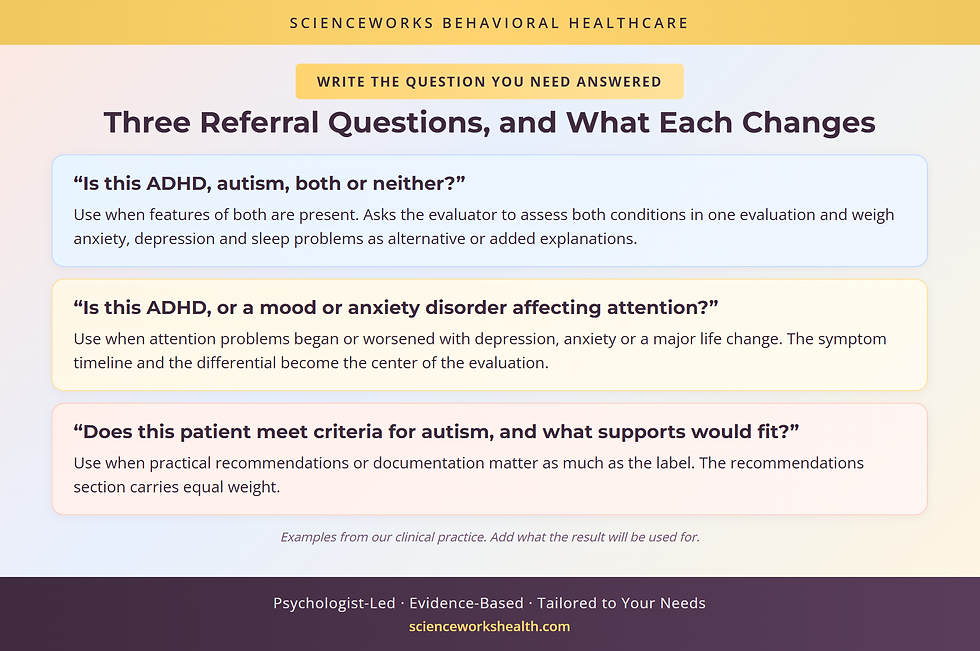
The single most useful thing in a referral is a specific question. A vague reason such as "possible ADHD" tends to produce a report that answers a narrower question than the one you have. Here are three referral questions we see often, and what each one changes about the evaluation.
"Is this ADHD, autism, both or neither?" Use this when features of both are present, or when you are not sure which direction the patient's history points. It tells the evaluator to assess both conditions in the same evaluation and to weigh co-occurring anxiety, depression and sleep problems as alternative or additional explanations. Without it, an ADHD-only evaluation may confirm ADHD and leave the autistic features unexplained.
"Is this ADHD, or a mood or anxiety disorder affecting attention?" Use this when attention problems began or worsened alongside depression, anxiety or a major life change. Adult ADHD is prone to misdiagnosis because its symptoms overlap with many other conditions, and a stepped diagnostic approach includes building a symptom timeline and ruling out alternative explanations [11]. Naming that question makes the timeline, and the differential, the center of the evaluation.
"Does she meet criteria for autism, and what supports would fit?" Use this when the patient wants understanding and practical recommendations more than a label for its own sake, or needs documentation for work. It tells the evaluator that the recommendations section matters as much as the diagnostic conclusion.
Consider a 29-year-old man whose ADHD screen was positive and who asks to start a stimulant. He also mentions that he has never had a close friend, follows strict routines and becomes very distressed when plans change. A referral that says only "ADHD evaluation" may answer the stimulant question and miss the rest. "Is this ADHD, autism, both or neither, and are there coexisting conditions relevant to prescribing?" gets you an answer you can use, whatever the result.
✍️ Key takeaway: Write the question you actually need answered. Name both conditions when both are possible, and say what the result will be used for.
What the evaluation returns, and how it fits your prescribing decision
Dr. Kiesa Kelly completes every evaluation by secure telehealth. Your patient has a feedback session in which the results are explained, and receives a diagnostic letter and a written report, plus an accommodation letter when appropriate. With your patient's written permission, we send you the results and recommendations.
We do not prescribe. When a prescriber is needed, we coordinate with you or refer to a partner. In the UK, NICE describes a full assessment before starting ADHD medication, including a review of coexisting mental health and neurodevelopmental conditions, risk around substance misuse, and a physical health review with a cardiovascular assessment [12]. An evaluation report can speak to the first parts: whether the person meets criteria, and which coexisting conditions are present. The physical health review and the prescribing decision stay with you.
Picture the 29-year-old again. The report concludes he meets criteria for both ADHD and autism, with significant anxiety in social settings and no current substance use concerns. That gives you the diagnostic basis for your decision, and a clear picture of the coexisting anxiety you will want to keep in view. The report informs the decision. It does not make it.
💊 Key takeaway: The report gives you diagnostic clarity and a list of coexisting conditions. The physical health review and the prescribing decision remain yours.
What to tell your patient while they wait
What helps a patient between your referral and the evaluation is practical and specific:
Keep treating what is in front of you. In our clinical judgment, anxiety, depression and sleep problems don't need to wait for a diagnosis.
Gather history. NICE recommends that, where possible, a comprehensive assessment involve a family member, partner or other informant, or use documentary evidence such as school reports [3]. Old report cards, and a parent or sibling willing to talk, help.
Share a patient-facing guide. Our explainer on how a combined AuDHD evaluation works sets expectations.
Help them read a screen they have already taken. Our guide to what an AQ-10 score might mean explains why a score is a starting point.
Keep safety in the loop. If your patient has thoughts of suicide or of harming someone, that comes first: call or text 988, or call 911 in an emergency.
🗂️ Key takeaway: While your patient waits, treat what is present, help them gather childhood history and an informant, and give them a clear picture of what the evaluation involves.

Questions to ask about any adult evaluation
Before you refer, whether to us or elsewhere, these questions show whether an evaluation will answer the question you have:
When both ADHD and autism are plausible, will one evaluation assess both?
How does the evaluation account for camouflaging and long-standing compensation?
How are anxiety, depression, sleep and substance use weighed as alternative or coexisting explanations?
What developmental history is gathered when childhood records or a parent are not available?
What will I receive with my patient's permission, and does it address coexisting conditions relevant to prescribing?
A simple way to decide
If the question is ADHD alone, the history is lifelong, others can confirm it and nothing else is going on, primary care may be able to answer it [1]. If the question is autism or AuDHD, if a screen and your impression disagree, if anxiety or depression treatment has only partly helped, or if coexisting conditions complicate a prescribing decision, refer for an evaluation and write the question down. If suicidal ideation or psychosis is present, start with psychiatric care.
✅ Key takeaway: Refer when the question is autism, AuDHD or ADHD with complications, and send a specific referral question. Keep straightforward ADHD where you can manage it.
Conclusion
Most adults who ask about autism, AuDHD or late-recognized ADHD have spent years being partly understood. A short visit will rarely settle the question, but a well-aimed referral can. Refer when the question is bigger than a screen, write down exactly what you need answered, and use the report to sharpen a prescribing and treatment plan that stays in your hands.
Your patient can book a free phone consultation (or text 931-223-1095) and mention you. No referral or prior authorization is needed. Please don't send health information by email or web form; once your patient signs a release, we arrange a secure exchange.
Frequently Asked Questions
Can a primary care clinician refer an adult for an autism evaluation without a positive screen?
Yes. A screen is one input, not a gate. NICE, the UK's guideline body, says in its adult guidance to offer a comprehensive autism assessment when a person's AQ-10 screen is positive, or when autism is suspected based on clinical judgment, taking into account history from someone who knows the person. A negative screen in a patient whose history and presentation still suggest autism is a reason to say so in the referral, not a reason to withhold it.
Will the evaluation report help me decide about prescribing ADHD medication?
It can inform that decision, but it does not make it. The report states whether the person meets criteria for ADHD, autism, both or neither, and which coexisting conditions are present, which is part of what NICE, the UK guideline body, describes reviewing before starting ADHD medication. The physical health review, the cardiovascular assessment and the prescribing decision itself stay with you. We do not prescribe.
Should I refer if my patient already has an anxiety or depression diagnosis?
Often, yes. The UK's NICE guidance lists a history of a mental health condition, or current contact with mental health services, among the reasons to consider an autism assessment when social or communication differences are also present. Anxiety and depression can co-occur with autism or ADHD, and they can also be the better explanation. A structured evaluation weighs both possibilities instead of assuming either one.
About the Author
Dr. Kiesa Kelly is a clinical psychologist and the founder of ScienceWorks Behavioral Healthcare. She earned her PhD in clinical psychology, with a concentration in neuropsychology, from Rosalind Franklin University of Medicine and Science, and her postdoctoral training included an NIH-funded National Research Service Award fellowship focused on ADHD research and clinical work.
Dr. Kelly completed practica, internship and fellowship training at the University of Chicago, the University of Wisconsin, the University of Florida and Vanderbilt University, and has more than 20 years of experience with psychological assessment. She completes every ADHD, autism and AuDHD evaluation at ScienceWorks. She is a psychologist, not a physician, and does not prescribe medication.
References
1. American Academy of Family Physicians. Adult ADHD toolkit for family physicians. Accessed October 20, 2026. https://www.aafp.org/clinical-insights/cognitive-and-behavioral-health/adult-adhd
2. Kooij JJS, Bijlenga D, Salerno L, et al. Updated European Consensus Statement on diagnosis and treatment of adult ADHD. Eur Psychiatry. 2019;56:14-34. https://doi.org/10.1016/j.eurpsy.2018.11.001
3. National Institute for Health and Care Excellence. Autism spectrum disorder in adults: diagnosis and management. Clinical guideline CG142. Published June 27, 2012; updated June 14, 2021. https://www.nice.org.uk/guidance/cg142
4. Lai MC, Lombardo MV, Ruigrok AN, Chakrabarti B, Auyeung B, Szatmari P, Happé F, Baron-Cohen S; MRC AIMS Consortium. Quantifying and exploring camouflaging in men and women with autism. Autism. 2017;21(6):690-702. https://doi.org/10.1177/1362361316671012
5. Cook J, Hull L, Crane L, Mandy W. Camouflaging in autism: a systematic review. Clin Psychol Rev. 2021;89:102080. https://doi.org/10.1016/j.cpr.2021.102080
6. Lai MC, Kassee C, Besney R, Bonato S, Hull L, Mandy W, Szatmari P, Ameis SH. Prevalence of co-occurring mental health diagnoses in the autism population: a systematic review and meta-analysis. Lancet Psychiatry. 2019;6(10):819-829. https://doi.org/10.1016/S2215-0366(19)30289-5
7. van der Putten WJ, Mol AJJ, Groenman AP, Radhoe TA, Torenvliet C, van Rentergem JAA, Geurts HM. Is camouflaging unique for autism? A comparison of camouflaging between adults with autism and ADHD. Autism Res. 2024;17(4):812-823. https://doi.org/10.1002/aur.3099
8. Kentrou V, Livingston LA, Grove R, Hoekstra RA, Begeer S. Perceived misdiagnosis of psychiatric conditions in autistic adults. EClinicalMedicine. 2024;71:102586. https://doi.org/10.1016/j.eclinm.2024.102586
9. Kessler RC, Adler L, Ames M, Demler O, Faraone S, Hiripi E, Howes MJ, Jin R, Secnik K, Spencer T, Ustun TB, Walters EE. The World Health Organization Adult ADHD Self-Report Scale (ASRS): a short screening scale for use in the general population. Psychol Med. 2005;35(2):245-256. https://doi.org/10.1017/S0033291704002892
10. Allison C, Auyeung B, Baron-Cohen S. Toward brief "red flags" for autism screening: the Short Autism Spectrum Quotient and the Short Quantitative Checklist for Autism in toddlers in 1,000 cases and 3,000 controls [corrected]. J Am Acad Child Adolesc Psychiatry. 2012;51(2):202-212.e7. https://doi.org/10.1016/j.jaac.2011.11.003
11. Sibley MH. Empirically-informed guidelines for first-time adult ADHD diagnosis. J Clin Exp Neuropsychol. 2021;43(4):340-351. https://doi.org/10.1080/13803395.2021.1923665
12. National Institute for Health and Care Excellence. Attention deficit hyperactivity disorder: diagnosis and management. NICE guideline NG87. Published March 14, 2018; updated September 13, 2019. https://www.nice.org.uk/guidance/ng87
Disclaimer
This article is for informational and educational purposes only. It is not a substitute for professional clinical judgment and does not create a clinician-patient relationship. Screeners cannot diagnose ADHD, autism or any other condition. ScienceWorks does not prescribe medication. ScienceWorks is not an emergency service. If a patient is in crisis or thinking about harming themselves, call or text 988, or call 911 in an emergency.