
Seasonal Affective Disorder: Why Winter Depression Happens and What Helps

Last reviewed: 07/17/2026
Reviewed by: Dr. Kiesa Kelly
Every fall, something shifts for a lot of people. The alarm goes off in the dark, the drive home is dark too, and by late November a heaviness has settled in that feels harder to shake than an ordinary bad mood. If your energy, sleep, and outlook seem to move with the calendar, you are not imagining it, and you are not simply bad at winter. You may be describing seasonal affective disorder, a recognized form of depression that follows a seasonal pattern.
The good news is that seasonal depression is well understood and treatable. Knowing why it happens, how to tell it apart from a passing slump, and which treatments have real evidence behind them can turn a season you dread into one you can plan for.
In this article, you'll learn:
What seasonal affective disorder is, and how clinicians define it
The specific signs that separate SAD from ordinary "winter blahs"
Common misconceptions that keep people from getting help
Why shorter days can trigger real depressive episodes
Which treatments have the strongest evidence, including light therapy and CBT
When it is worth getting a professional evaluation
What seasonal affective disorder actually is
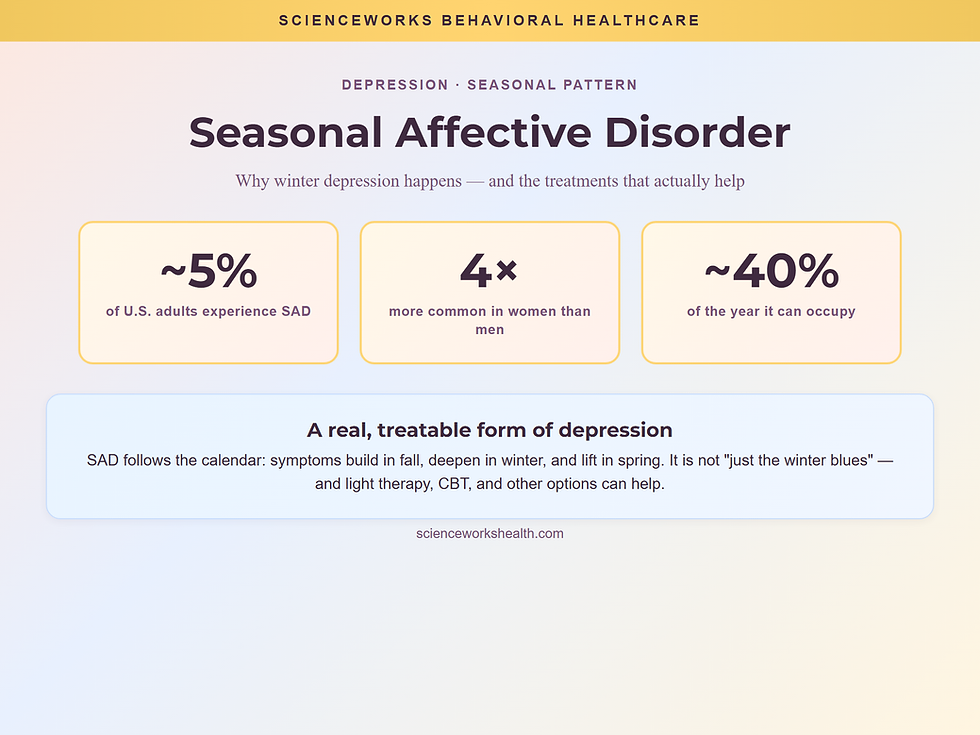
Seasonal affective disorder is not a separate diagnosis from depression. It is a pattern within depression. In the current diagnostic manual, the DSM-5, clinicians describe it as a "seasonal pattern" specifier attached to recurrent major depression, meaning the depressive episodes reliably start and stop at the same time of year [1][5]. Most people with SAD have the winter type: symptoms build in the fall, deepen through the darkest months, and lift on their own in spring.
This is more common than many people realize. About 5% of adults in the United States experience seasonal affective disorder, and for those affected it can occupy roughly 40% of the year [1]. Another sizable group has a milder version, sometimes called the "winter blues," that is real but does not rise to the level of a clinical diagnosis [10]. If the weight of winter has been interfering with your work, relationships, or ability to enjoy anything, that is worth taking seriously rather than waiting out. Evidence-based specialized therapy for depression can help whether your low mood is seasonal, ongoing, or a mix of both.
SAD is also not evenly distributed. It is roughly four times more common in women than in men, tends to begin in young adulthood, and shows up more often the farther you live from the equator, where winter days are shortest [1][4]. That geographic pattern is one of the strongest clues that light itself, not just cold weather or holiday stress, is part of the mechanism.
The signs that set SAD apart
Core features
Winter-pattern SAD carries the core symptoms of any major depressive episode: persistent low mood, loss of interest in things you normally enjoy, trouble concentrating, and feelings of hopelessness or worthlessness. What makes the seasonal type distinctive is a cluster of "atypical" symptoms. Instead of the insomnia and appetite loss many people associate with depression, winter SAD more often brings oversleeping, a heavy craving for carbohydrates, weight gain, and a bone-deep fatigue that no amount of rest seems to fix [2][3][4].
A short screener like the PHQ-9 depression screener can help you gauge how severe your symptoms are and track whether they change with the seasons. Because seasonal depression so often travels alongside anxiety, checking in with the GAD-7 anxiety screener can add a useful second data point. Neither tool diagnoses SAD on its own, but both give you something concrete to bring to an evaluation.
How it shows up day to day
Picture a schoolteacher who is energetic and organized in September. By mid-January she is sleeping nine or ten hours and still hitting snooze, dragging through mornings that used to feel easy. She skips the gym she loved all summer, cancels plans with friends because leaving the house feels like too much, and finds herself eating bread and pasta at night without really deciding to. She is not lazy and nothing catastrophic has happened. Her nervous system is responding to a season, and by March the fog usually clears on its own, which is exactly why the pattern is so easy to dismiss.
Or picture a remote worker who tells himself every fall that he is just tired. He stops answering texts, his projects stall, and he feels a flat grayness that he cannot argue himself out of. He assumes he needs more discipline. What he may actually need is a name for what is happening and a plan, because willpower has never been the missing ingredient in a depressive episode.
⏱️ Key takeaway: The signature of winter SAD is timing plus atypical symptoms, oversleeping, carb cravings, and heavy fatigue that arrive with the dark months and lift in spring.
Common misconceptions worth clearing up
Seasonal depression gets minimized more than almost any other mood condition, and the myths get in the way of care.
"It's just the winter blues, everyone feels it." Many people do feel a little flatter in winter, and that mild dip is not a disorder. But SAD is a diagnosable depressive episode that meets the full criteria for major depression, just on a seasonal schedule [1][5]. The difference is not how cold it is outside; it is how much your functioning, mood, and quality of life are affected.
"If it lifts on its own in spring, it isn't serious." Seasonal episodes do tend to remit as daylight returns, but "it goes away eventually" is not the same as "it does no harm." A person can lose months each year to depression, strain relationships, and fall behind at work, all while telling themselves it does not count because April is coming. Treatment can shorten and soften those months rather than surrendering them.
"You just need more willpower or a better attitude." Depression is not a motivation problem, and seasonal depression is no exception. Shortened daylight appears to disrupt the body's internal clock and brain chemistry in measurable ways [2]. Telling someone with SAD to try harder is like telling someone with a fever to simply cool down.
Why winter depression happens
You do not need to understand the biology to get help, but it can be reassuring to know there are real physical mechanisms behind seasonal depression rather than a personal failing.
The leading explanation centers on light. As days shorten, reduced sunlight can throw off your circadian rhythm, the internal 24-hour clock that governs sleep, energy, and mood [2]. Many people with SAD produce melatonin, the hormone that makes you sleepy, on a delayed or extended schedule in winter, which helps explain the oversleeping and morning grogginess. Shorter days also appear to affect serotonin, a brain chemical closely tied to mood regulation, and some research points to lower vitamin D levels from limited sun exposure as a contributing factor [2][4].
The practical upshot is that SAD is not caused by winter being unpleasant. It is driven, at least in part, by how much light your brain and body are getting. That is precisely why one of the most effective treatments involves adding light back in.
🔆 Key takeaway: Seasonal depression is tied to reduced daylight disrupting your circadian rhythm and brain chemistry, which is why it clusters in winter and at higher latitudes, not because winter is simply hard.
How seasonal affective disorder is diagnosed
There is no blood test or brain scan for SAD. It is diagnosed through a careful clinical conversation. A clinician is essentially confirming two things: that you meet the criteria for a major depressive episode, and that those episodes follow a genuine seasonal pattern rather than lining up with, say, a stressful season at work.
Formally, the seasonal-pattern specifier requires that seasonal depressive episodes have occurred for at least two years, and that these seasonal episodes substantially outnumber any non-seasonal depression you have had over your lifetime [1][5]. A thorough psychological assessment also screens for conditions that can masquerade as, or coexist with, seasonal depression, including bipolar disorder, thyroid problems, and non-seasonal depression. This distinction matters because the treatment path can differ, and light therapy in particular needs to be used carefully in people with bipolar disorder [2].
If you are considering an evaluation, a few concrete questions can help you find the right fit. It is reasonable to ask a provider: Do you assess whether my low mood follows a true seasonal pattern, or could it be year-round depression? How do you rule out bipolar disorder before recommending light therapy? What treatment options do you offer beyond medication? And what will I actually walk away with, in terms of a plan I can use this winter and next?
What actually helps
Seasonal depression responds to treatment, and you have more than one evidence-based option. The best choice depends on your symptoms, your history, and your preferences, and the options can be combined.
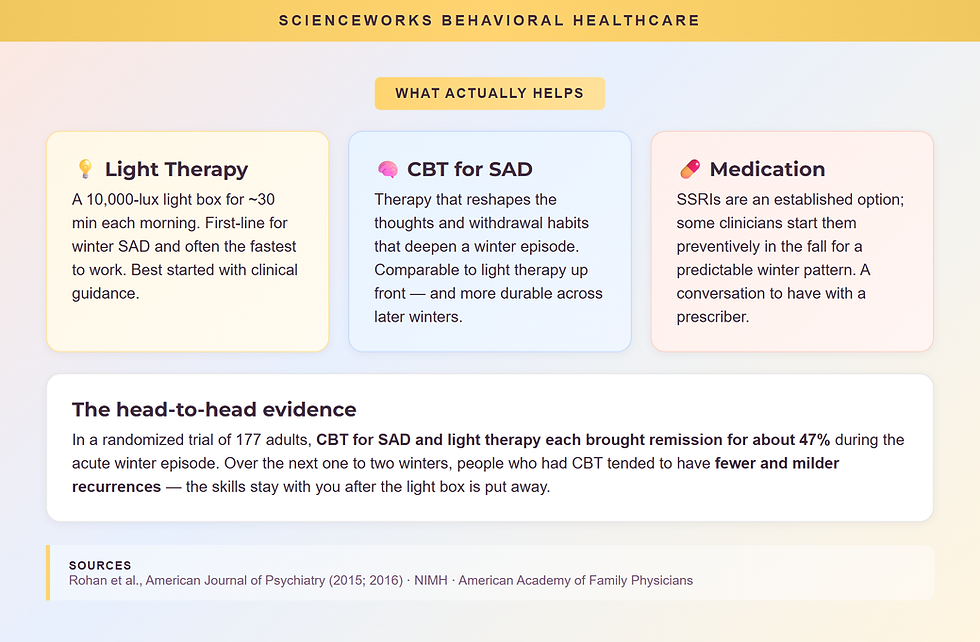
Light therapy. Bright light therapy is a first-line treatment for winter-pattern SAD. The standard approach uses a 10,000-lux light box for about 30 minutes each morning, positioned so the light reaches your eyes indirectly [2][4]. Meta-analyses generally support light therapy as helpful for seasonal depression, though researchers note that the overall quality of the evidence is uneven and that it does not work for everyone [8][9][10]. Because light therapy can occasionally trigger agitation or a manic swing in people with bipolar disorder, it is best started with clinical guidance.
Cognitive behavioral therapy. Here is where the research has shifted the picture in a way many roundups miss. A form of cognitive behavioral therapy specifically adapted for seasonal depression, sometimes called CBT-SAD, teaches you to identify and shift the thoughts and behavioral patterns, such as social withdrawal and dropping enjoyable activities, that deepen a winter episode. In a randomized trial of 177 adults, CBT-SAD and light therapy produced comparable improvement during the acute winter episode, with both achieving remission for roughly 47% of participants [6]. What stands out is what happened next: over the following one and two winters, people who received CBT tended to have fewer and less severe recurrences than those treated with light therapy alone [7]. In other words, therapy may offer more durable, longer-lasting protection because the skills stay with you after the light box is put away. You can see how structured cognitive behavioral therapy for depression is applied to seasonal and non-seasonal low mood alike, and how it compares to other approaches in our overview of therapy types for depression.
Medication. Antidepressants, particularly SSRIs, are an established option for SAD, and for people with a predictable history of winter episodes, some clinicians start medication preventively in the fall before symptoms return [2][4]. Whether medication is right for you is a conversation to have with a prescriber.
Behavioral basics and vitamin D. Getting outside during daylight, keeping a steady sleep schedule, staying physically active, and maintaining social contact all support recovery, and they pair well with formal treatment [2]. Vitamin D is frequently discussed, but the evidence that supplements treat SAD is mixed, so it is worth testing and correcting a genuine deficiency rather than assuming it is the cure [4].
So how do you choose? A simple way to think about it: if you want the fastest possible relief and do not have bipolar disorder or eye concerns, light therapy is a reasonable first step you can start early each fall. If you have had SAD for several winters running and want tools that reduce the odds of it coming back, CBT is a strong choice because its benefits appear to last beyond the season you are treated in. If your episodes are severe, or if you already take an antidepressant that helps, medication belongs in the conversation. And if you are not sure, that uncertainty is itself a good reason to get evaluated rather than to guess.
🧭 Key takeaway: Light therapy often works fastest, while CBT for SAD appears to offer more durable protection across future winters, and the two can be combined depending on your history and goals.
When to get evaluated
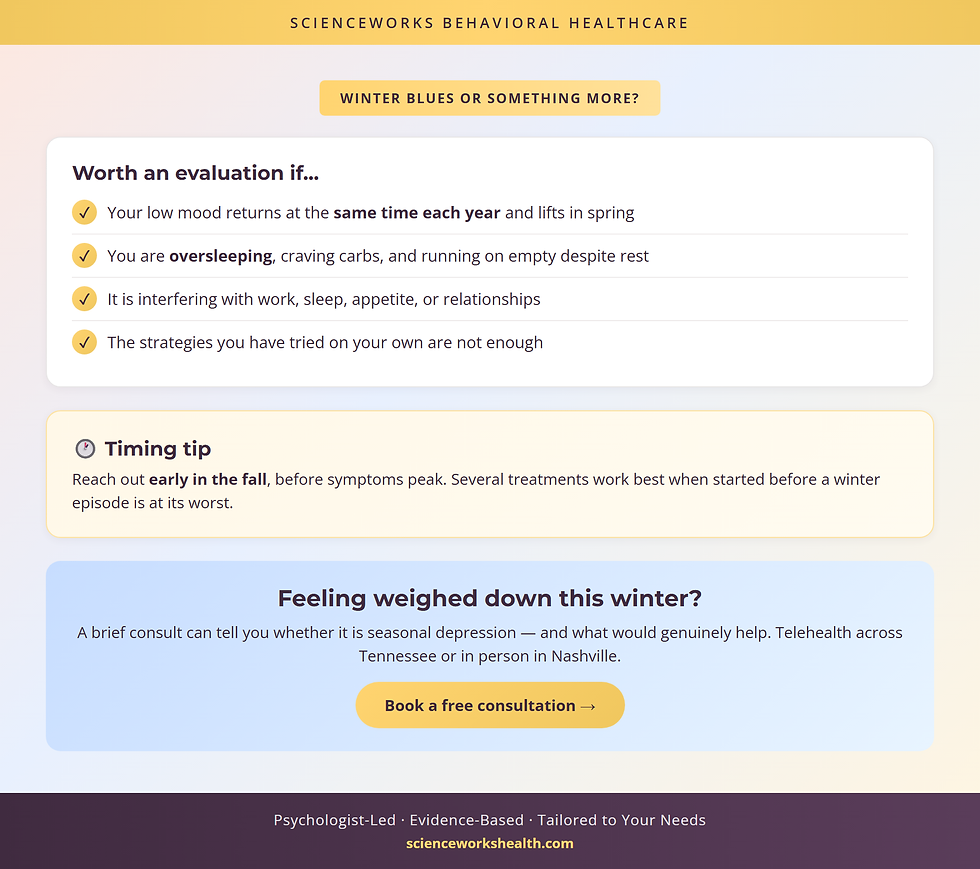
Feeling a little low on a gray day is part of being human. Seasonal affective disorder is different: it is a recurring pattern that meaningfully disrupts how you live for a chunk of every year. It is worth reaching out for an evaluation if your low mood returns at the same time each year and interferes with work, sleep, appetite, or relationships; if the strategies you have tried on your own are not enough; or if you find yourself simply enduring several months annually that you would rather reclaim.
If you ever have thoughts of harming yourself or feel you may not be safe, do not wait for a scheduled appointment. Call or text 988 in the United States to reach the Suicide and Crisis Lifeline, available around the clock.
Reaching out early in the fall, before an episode is at its worst, gives you the most options, because several treatments work best when started before symptoms peak. A brief conversation with a clinician, sometimes prompted by results from our mental health screening tools, is often enough to tell whether what you are experiencing is seasonal depression and what would genuinely help. When you are ready, our team, including Dr. Kiesa Kelly, can help you sort out the pattern and build a plan.
Feeling weighed down lately?
Depression is treatable, and the right support makes a difference. A clinician can help you understand what's going on and what would help you feel like yourself again.
Frequently Asked Questions
Is seasonal affective disorder the same as regular depression?
Seasonal affective disorder is a form of major depression with a seasonal pattern, not a separate illness. In the DSM-5, it is a seasonal-pattern specifier applied to recurrent depression, where episodes reliably begin and end with a season, most often fall and winter. The symptoms overlap with non-seasonal depression, but the timing and year-to-year predictability are what set SAD apart.
Can seasonal affective disorder happen in the summer?
Yes, though it is far less common than the winter pattern. A smaller group of people experiences summer-pattern SAD, with symptoms emerging in late spring or summer and easing in fall. Summer-pattern SAD can also look different, with more agitation, trouble sleeping, and reduced appetite rather than the oversleeping and carbohydrate cravings that often mark winter SAD.
Does light therapy actually work for seasonal affective disorder?
For many people with winter-pattern SAD, bright light therapy helps and is considered a first-line option. Typical protocols use a 10,000-lux light box for about 30 minutes each morning. Research reviews support its benefit, though the quality of evidence varies and it does not work for everyone. It is worth reviewing with a clinician first, especially if you have bipolar disorder or an eye condition.
How is seasonal affective disorder diagnosed?
SAD is diagnosed through a clinical interview, not a lab test or a single questionnaire. A clinician looks for episodes of major depression that follow a seasonal pattern for at least two years, with seasonal episodes clearly outnumbering non-seasonal ones. Screeners like the PHQ-9 can help track symptom severity over time, but they support the conversation rather than replace it.
Does therapy for seasonal affective disorder work over telehealth?
Yes. Talk therapy for SAD, including cognitive behavioral therapy adapted for seasonal depression, translates well to secure video visits, and research on CBT for SAD supports its durability across future winters. Telehealth also makes it easier to keep appointments on dark, low-energy winter days. We provide depression care by telehealth across Tennessee and in person in Nashville.
About the Author
Dr. Kiesa Kelly is a licensed clinical psychologist and the founder of ScienceWorks Behavioral Healthcare, with more than 20 years of experience in psychological assessment and evidence-based treatment. Her background includes clinical training and academic work in psychology, with particular depth in mood and anxiety conditions, neurodevelopmental assessment, and the evaluation of adults whose symptoms have gone unrecognized or misattributed for years.
At ScienceWorks, Dr. Kelly leads a telehealth-forward practice serving Tennessee, with an in-person option at the practice's Nashville office. She and her clinical team focus on accurate diagnosis and treatment for depression, anxiety, ADHD, autism, OCD, trauma, and insomnia, and every article on this site is reviewed by a licensed clinician for accuracy before publication.
References
1. American Psychiatric Association. Seasonal Affective Disorder (SAD). https://www.psychiatry.org/patients-families/seasonal-affective-disorder
2. National Institute of Mental Health. Seasonal Affective Disorder. https://www.nimh.nih.gov/health/publications/seasonal-affective-disorder
3. Mayo Clinic. Seasonal affective disorder (SAD): Symptoms and causes. https://www.mayoclinic.org/diseases-conditions/seasonal-affective-disorder/symptoms-causes/syc-20364651
4. Galima SV, Vogel SR, Kowalski AW. Seasonal Affective Disorder: Common Questions and Answers. American Family Physician. 2020;102(11):668-672. https://www.aafp.org/pubs/afp/issues/2020/1201/p668.html
5. Melrose S. Seasonal Affective Disorder: An Overview of Assessment and Treatment Approaches. Depression Research and Treatment. 2015;2015:178564. https://pmc.ncbi.nlm.nih.gov/articles/PMC4673349/
6. Rohan KJ, Meyerhoff J, Ho SY, Evans M, Postolache TT, Vacek PM. Randomized Trial of Cognitive-Behavioral Therapy Versus Light Therapy for Seasonal Affective Disorder: Acute Outcomes. American Journal of Psychiatry. 2015;172(9):862-869. https://pubmed.ncbi.nlm.nih.gov/25859764/
7. Rohan KJ, Mahon JN, Evans M, Ho SY, Meyerhoff J, Postolache TT, Vacek PM. Outcomes One and Two Winters Following Cognitive-Behavioral Therapy or Light Therapy for Seasonal Affective Disorder. American Journal of Psychiatry. 2016;173(3):244-251. https://psychiatryonline.org/doi/10.1176/appi.ajp.2015.15060773
8. Chen R, Yin Y, Zhao Z, et al. Treatment measures for seasonal affective disorder: A network meta-analysis. Journal of Affective Disorders. 2024;350:531-539. https://www.sciencedirect.com/science/article/abs/pii/S0165032724000399
9. Effectiveness of visible light for seasonal affective disorder: A systematic review and network meta-analysis. Medicine (Baltimore). 2025. https://pmc.ncbi.nlm.nih.gov/articles/PMC12237333/
10. Kurlansik SL, Ibay AD. Seasonal affective disorder. American Family Physician. 2012;86(11):1037-1041. https://www.aafp.org/pubs/afp/issues/2012/1201/p1037.html
Disclaimer
This article is for informational and educational purposes only and is not a substitute for professional diagnosis or treatment. Reading it does not create a therapist-client relationship with ScienceWorks Behavioral Healthcare. If you are concerned about seasonal affective disorder or depression, consult a licensed clinician. If you are in crisis or may be at risk of harming yourself or others, call or text 988 (U.S.) or call 911.