
Sensory Overload at Work: Open Offices, RTO, and What Helps

Updated: 5 days ago
Last reviewed: 08/10/2026
Reviewed by: Dr. Kiesa Kelly
You used to be fine at work. Then you spent a few years working from home, and now three days a week in an open-plan office leaves you so depleted that the evening is gone before it starts.
A lot of people are having some version of this experience right now, and a lot of them are quietly concluding that something has gone wrong with them. Usually nothing has. What changed is the environment — and, for people whose nervous systems are more reactive to sensory input in the first place, the environment was always doing more work than anyone accounted for.
In this article, you'll learn:
Why office environments specifically got harder, and why return-to-office lands differently than the first office era did
How sensory overload differs between autistic and ADHD nervous systems
The cost curve that runs from sensory load to masking to shutdown
A practical order of operations for the things you can change yourself
When a formal accommodation, or an evaluation, is the more useful next step
Why the office got harder
Three things changed at once, and they compound.
Open floor plans became the default. This is not a matter of taste. The occupational research on open-plan offices is fairly consistent and not especially flattering: compared with cellular offices, open-plan environments are associated with lower satisfaction, reduced productivity, and poorer self-reported health [1]. The mechanism is mostly speech. Irrelevant background conversation is unusually disruptive to exactly the tasks knowledge work is made of — reading comprehension, serial recall, mental arithmetic, proofreading — and in controlled comparisons people remembered fewer words and reported more fatigue after working in high-noise conditions than low-noise ones [2][3].
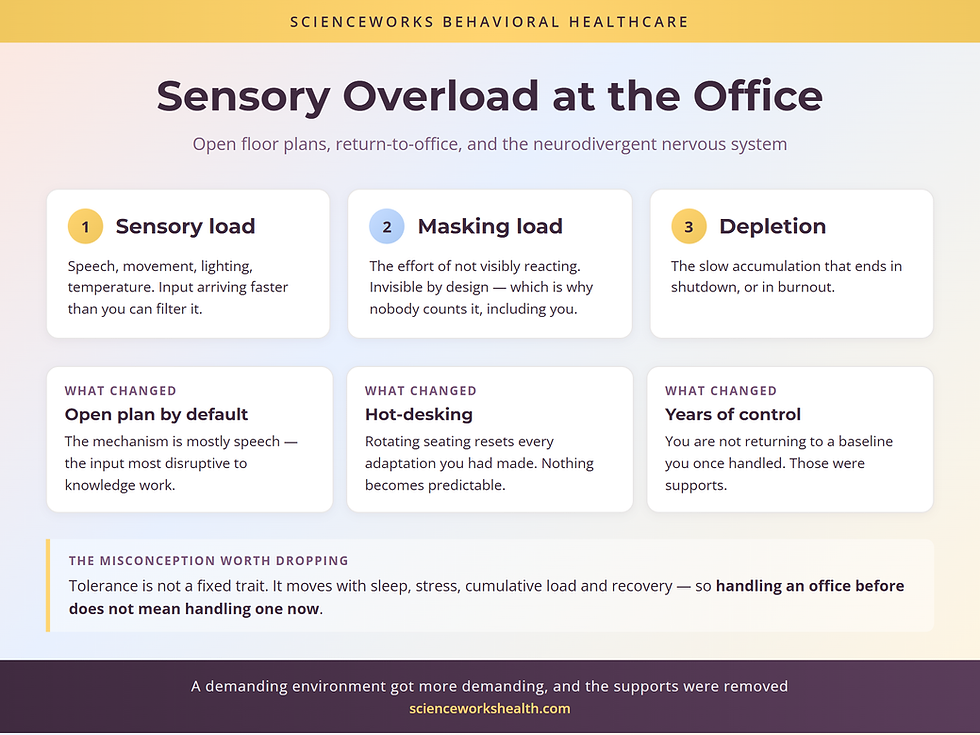
Hot-desking removed the small adaptations people used to make. When a desk was yours, you could angle a monitor away from a walkway, learn which neighbors were loud, and settle. Rotating seating resets that every morning, which means the environment never becomes predictable — and predictability is doing a lot of quiet work for a sensitized nervous system.
And return-to-office is not the same as the original office. This is the piece most commentary misses. You are not going back to a baseline you once handled. You are going back after several years of near-total environmental control, during which you could manage light, sound, temperature, and interruption timing, and could recover without anyone watching. Those were supports. They were just invisible, because nobody called them supports.
Misconception: if you handled an office before, you should handle one now. Tolerance is not a fixed trait. It moves with sleep, stress, hormonal shifts, cumulative load, and how much recovery you are getting — and a multi-year period of environmental control changes the baseline you are comparing against.
Misconception: this is a preference, not a real cost. Sensory over-responsivity is a measurable, documented phenomenon rather than a matter of fussiness, and it is common and typically persistent into adulthood among autistic adults [4]. It also carries downstream costs: in adults on the autism spectrum, sensory avoidance has been associated with higher anxiety and loneliness [5].
Misconception: noise-canceling headphones solve it. They help with one channel. Visual movement, unpredictable interruption, lighting, temperature, and the social demand of being observed all continue unabated — which is why people who wear headphones all day are often still exhausted by three o'clock.
🔊 Key takeaway: Open-plan noise costs are documented in the general working population. If you are also sensory-sensitive, you are paying that cost on top of a nervous system that starts closer to its ceiling.

What sensory overload is — and how it differs by wiring
Sensory overload is what happens when incoming input exceeds your capacity to filter and process it. The result is not simply discomfort; it is a genuine reduction in available cognitive resources, which is why it shows up as forgetting words, rereading paragraphs, and a shortening fuse.
The mechanism differs meaningfully depending on what is driving it, and this distinction is more useful than the label:
In autistic adults, sensory sensitivity tends to be consistent and trigger-specific. The same fluorescent flicker, the same texture, the same frequency of speech reliably causes distress, and has usually done so for as long as you can remember. Altered sensory reactivity is a recognized part of the autism diagnostic picture rather than an add-on [9][11].
In ADHD, it is more often fluctuating and capacity-dependent. The open office is tolerable when you are rested and unbearable when you are depleted. The difficulty is less about the specific stimulus and more about filtering when regulatory resources are low [10].
In misophonia, the reaction is specific to particular sounds — often chewing, tapping, repetitive keyboard noise — and is more intense and more emotionally charged than general noise annoyance.
We go deeper on the general mechanics in our guide to sensory overload and overstimulation in adults; if the trouble is sound-specific rather than environment-wide, the misophonia end of our library is the more accurate place to look.
🧠 Key takeaway: Consistent, specific triggers point one way; tolerance that rises and falls with how depleted you are points another. Both are real, and they respond to different adjustments.
The cost curve: sensory load, masking load, shutdown
Here is the part that explains why a workday can cost so much more than it looks like it should.
Sensory load is the first layer. On top of it sits masking load — the effort of not visibly reacting. Not flinching. Keeping your face pleasant while someone chews near you. Producing the expected amount of small talk on the way to the kitchen. Looking engaged in a meeting that is mostly noise. That effort is invisible by design, which is precisely why nobody, including you, counts it.
The two together produce a third thing: the slow depletion that ends in shutdown, or in burnout. Autistic burnout has been described in the research literature as a syndrome arising from chronic life stress and a mismatch between expectations and abilities without adequate support, characterized by long-term exhaustion, loss of function, and reduced tolerance to stimulus [6]. That last clause matters here — reduced tolerance to stimulus is part of the burnout picture, which means sensory overload is both an input to burnout and a symptom of it. That is why it can feel like it is accelerating.
The evidence base on autistic burnout is still young and is drawn substantially from community and qualitative research rather than large clinical trials, and it is worth holding it as a well-described experience rather than a settled diagnostic entity. If the exhaustion has moved past bad days into months, our post on recovering from autistic burnout while working full-time deals with the version of this where quitting is not an available option.
🔋 Key takeaway: The workday costs sensory load plus masking load. Masking is the invisible half, and it is usually the half that finishes you.
What to change first: a working order of operations
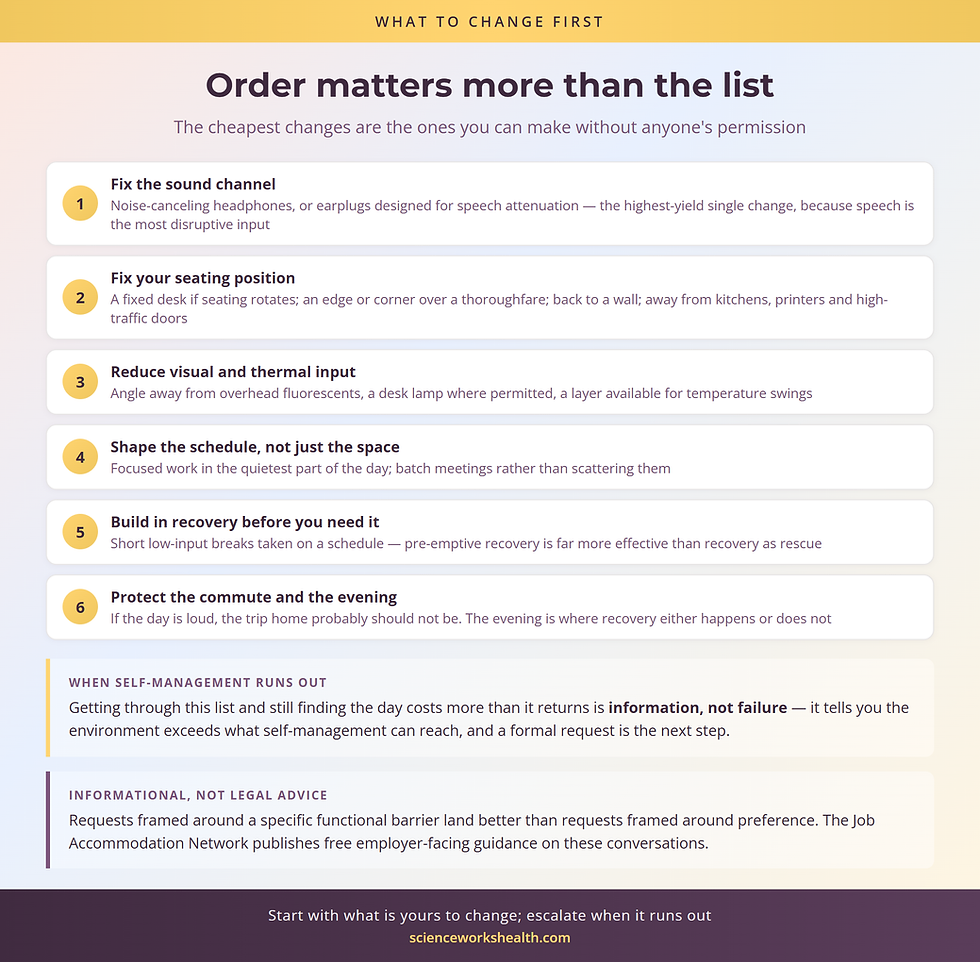
Most advice hands you a list. Order matters more than the list does, because the cheapest changes are the ones you can make without anyone's permission. Work down this sequence:
1. Fix the sound channel. Noise-canceling headphones, or earplugs designed for speech attenuation rather than total blocking. Instrumental audio or brown noise if silence feels conspicuous. This is the highest-yield single change because speech is the most disruptive input.
2. Fix your seating position. Ask for a fixed desk if seating rotates. Take an edge or corner over a thoroughfare, get your back to a wall so movement is not in your peripheral vision, and move away from kitchens, printers, and high-traffic doors.
3. Reduce visual and thermal input. Angle away from overhead fluorescents, use a desk lamp instead where permitted, and keep a layer available so temperature swings are not one more thing to absorb.
4. Shape the schedule, not just the space. Put focused work in the quietest part of the day, batch meetings rather than scattering them, and take the harder calls from a quiet room if one exists.
5. Build in recovery before you need it. Short, deliberate low-input breaks — outside, in a stairwell, in your car — taken on a schedule rather than at the point of collapse. Recovery taken pre-emptively is far more effective than recovery taken as rescue.
6. Protect the commute and the evening. If the day is loud, the trip home probably should not be. The evening is where the recovery either happens or does not.
If you get through that list and the day is still costing more than it returns, that is useful information rather than a failure — it tells you the environment is exceeding what self-management can reach.
When to ask for a formal accommodation
At some point, individual coping runs out and the question becomes structural. A systematic review of physical workplace adjustments for neurodivergent workers found this is a real and growing area of practice, though the evidence base for specific adjustments is still developing [7].
We are not going to restate the mechanics of asking here, because we have covered them properly elsewhere: our guide to workplace and school accommodations walks through what to request, how to frame it, what documentation employers typically ask for, and how the process actually runs. It is written around sound sensitivity, but the process is the same whatever the input.
Two things worth knowing before you start. First, requests framed around a specific functional barrier ("background speech makes sustained code review unreliable; a fixed desk away from the walkway would address it") consistently land better than requests framed around preference. Second, this is genuinely an informational overview and not legal advice — the Job Accommodation Network publishes free, employer-facing guidance on exactly these conversations, and it is the right first read [8].
When it's worth getting evaluated
Not everyone who finds an open office punishing needs an evaluation. Plenty of people are simply working in a badly designed room.
It becomes worth asking a different question when several of these are true at once: the sensitivity has been there since childhood rather than arriving with the RTO mandate; it shows up outside work too, in restaurants, shops, or at home; masking is costing you enough that you are unavailable for hours after work; and the accumulating exhaustion has started to look less like a hard week and more like a slow decline.
A decision heuristic: if changing the environment reliably fixes it, it is an environment problem. If the same reactions follow you across environments and always have, that is worth a real look. A structured adult evaluation can tell you whether what you are experiencing sits within an autism or ADHD profile, something else, or a combination — and, more usefully, what actually helps in each case.
If you would like a lower-commitment starting point, the AQ-10 and the ABO are brief self-report screeners covering autistic traits and autistic burnout respectively. Neither diagnoses anything — they sit within our broader mental health screening set as a way to decide whether the fuller question is worth pursuing. Where sensory difficulty is entangled with anxiety or low mood, therapy that addresses the whole picture is often more useful than treating the sensory piece alone.
🧭 Key takeaway: Environment-dependent reactions point at the room. Reactions that travel with you across environments, and always have, point at something worth evaluating properly.
Where this leaves you
If the office is costing you more than it used to, the most likely explanation is not that you have become fragile. It is that a demanding environment got more demanding, the supports you had were removed, and the cost of holding it together in public was never on anyone's ledger — including yours.
Start with the changes that are yours to make. Escalate to a formal request when self-management runs out. And if the pattern is older and wider than this job, treat that as the more interesting question, because it changes what actually helps.
Considering an autism evaluation?
An adult autism evaluation accounts for masking and lifelong compensation — not just the older, narrower picture — so the results reflect how autism actually shows up for you.
Frequently Asked Questions
Is sensory overload ADHD or autism?
It can be either, and it is not exclusive to either. Sensory over-responsivity is common and often lifelong in autistic adults, and it also shows up in ADHD, where it tends to track your overall regulatory capacity — worse when you are tired, stressed, or depleted. The pattern is usually more informative than the symptom: consistent triggers point one direction, fluctuating tolerance points another. Neither is diagnosable from the sensory experience alone.
What does being overstimulated in an open-plan office actually look like?
Most people describe it as a slow narrowing rather than a dramatic event. Speech you cannot tune out, movement at the edge of vision, and unpredictable interruptions accumulate until reading the same paragraph four times becomes normal. Irritability rises, word-finding gets harder, and by mid-afternoon the goal has shifted from doing good work to getting through the day without snapping at anyone.
Why is returning to the office harder than working from home was?
Remote work handed you environmental control — light, sound, temperature, interruption timing, and the ability to recover unobserved. Returning removes all of it at once, and it also removes the recovery gaps you may not have realized were doing the work. It is not that you lost tolerance. It is that you had been running with supports in place, and those supports were withdrawn without replacement.
Can I ask to work from home as a sensory accommodation?
Yes, remote or hybrid work is a commonly requested workplace adjustment, though whether any specific request is granted depends on your employer, your role, and the documentation involved. Requests framed around a specific functional barrier tend to land better than general preference. This is an informational overview and not legal advice — the Job Accommodation Network publishes free, employer-facing guidance worth reading first.
How do I tell sensory overload from ordinary work stress?
Ordinary stress usually tracks workload — it rises with deadlines and eases when they pass. Sensory overload tracks the environment instead, so a light workday in a loud room can be worse than a heavy day somewhere quiet. The clearest test is what actually restores you: if quiet and low input help more than time off does, the driver is more likely sensory than workload.
About ScienceWorks
ScienceWorks Behavioral Healthcare was founded by Dr. Kiesa Kelly, a licensed clinical psychologist with more than 20 years of experience in psychological assessment and evidence-based treatment. Our clinical team evaluates autism and ADHD in adults and adolescents, including presentations involving sensory differences, masking, and burnout, and provides therapy for the anxiety and depression that often accompany them.
We are a telehealth-forward practice serving Tennessee, with an in-person option at our Nashville office. Adult evaluations are built to account for masking and lifelong compensation rather than the narrower childhood-referenced picture. Every article we publish is reviewed by a licensed clinician for accuracy before it goes live.
References
1. Pejtersen JH, et al. Open-plan offices: Task performance and mental workload. Journal of Environmental Psychology. https://www.sciencedirect.com/science/article/abs/pii/S0272494408000728
2. Jahncke H, Hygge S, Halin N, Green AM, Dimberg K. Open-plan office noise: Cognitive performance and restoration. Journal of Environmental Psychology, 2011. https://www.sciencedirect.com/science/article/abs/pii/S0272494411000429
3. Jahncke H. Open-plan office noise: the susceptibility and suitability of different cognitive tasks for work in the presence of irrelevant speech. Noise Health. 2012;14(61):315-320. https://pubmed.ncbi.nlm.nih.gov/23257585/
4. Tavassoli T, Miller LJ, Schoen SA, Nielsen DM, Baron-Cohen S. Sensory over-responsivity in adults with autism spectrum conditions. Autism. https://pubmed.ncbi.nlm.nih.gov/24085741/
5. Syu YC, Lin LY. Sensory Overresponsivity, Loneliness, and Anxiety in Taiwanese Adults with Autism Spectrum Disorder. https://www.ncbi.nlm.nih.gov/pmc/articles/PMC6139193/
6. Raymaker DM, Teo AR, Steckler NA, et al. "Having All of Your Internal Resources Exhausted Beyond Measure and Being Left with No Clean-Up Crew": Defining Autistic Burnout. Autism in Adulthood, 2020. https://www.liebertpub.com/doi/full/10.1089/aut.2019.0079
7. Weber C, et al. Physical workplace adjustments to support neurodivergent workers: A systematic review. Applied Psychology, 2024. https://iaap-journals.onlinelibrary.wiley.com/doi/10.1111/apps.12431
8. Job Accommodation Network. Workplace accommodation guidance. https://askjan.org/
9. National Institute for Health and Care Excellence. Autism spectrum disorder in adults: diagnosis and management (CG142). https://www.nice.org.uk/guidance/cg142
10. National Institute for Health and Care Excellence. Attention deficit hyperactivity disorder: diagnosis and management (NG87). https://www.nice.org.uk/guidance/ng87
11. National Institute of Mental Health. Autism Spectrum Disorder. https://www.nimh.nih.gov/health/topics/autism-spectrum-disorders-asd
Disclaimer
This article is for informational purposes only and is not a substitute for individualized clinical advice, diagnosis, or treatment, and nothing here is legal advice about employment or accommodation rights. If sensory difficulties are affecting your work or wellbeing, speak with a qualified clinician about your specific situation.