
What to Expect in a Brainspotting Session, Step by Step

Updated: Sep 13
Last reviewed: 07/18/2026
Reviewed by: Dr. Kiesa Kelly

If you are wondering what to expect in a Brainspotting session, the good news is that it is gentle, paced by you, and easier than most people imagine. Brainspotting can look unusual from the outside, but from the inside it is a calm, guided process — and knowing what happens is often the last thing people need before taking the step into trauma work.
This article walks through a session step by step, so you can start with confidence. You will see what happens before, during, and after, how it feels, and how well it works over telehealth.
In this article, you'll learn:
What happens before your first session
Each step of a Brainspotting session, from finding the brainspot to grounding
How you might feel during and after
How Brainspotting works beautifully over telehealth
How progress is tracked
Before your first session
A first session usually starts with a conversation, not processing. Your therapist asks about your history, what you want to work on, and how you cope now. Together you decide that Brainspotting is a good fit and set the stage for the work, part of your broader trauma-focused care.
It helps to come with a rough sense of what you would like to feel differently, a private and comfortable space, and no pressure to perform. There is no wrong way to show up, and you can ask as many questions as you need about how the work fits into your overall trauma care.
A Brainspotting session, step by step
Naming what you want to work on
Your therapist helps you identify a focus and notice where you feel it in your body. Rather than asking for the whole story, they might ask, "what is the worst part of this for you right now?" and then, "where do you notice that in your body?" The felt sense, not the narrative, is the starting point.
Finding the brainspot
Next, your therapist helps you locate the eye position that connects most strongly to that sensation. They may slowly move a pointer across your field of vision and watch for reflexive cues — a blink, a swallow, a shift in breathing, a change in expression. You may also notice for yourself where the feeling intensifies as you look. That position becomes the brainspot.
Holding the gaze and letting material surface
You hold your gaze on that spot and let whatever comes, come. This is the quiet center of the work. You might notice memories, images, waves of emotion, or shifts in body sensation. There is nothing you need to make happen. Your therapist stays present and attuned, often saying very little, so your own processing can lead.
Body and emotion during processing
As you stay with the brainspot, your body may respond — with tears, warmth, tension releasing, a sigh, or a settling. Emotions can rise and then ease. Your therapist tracks these changes with you and helps you stay inside a comfortable range.
Grounding and closing
Sessions end with grounding so you leave settled and steady. Your therapist may guide you back to the present with breath, orienting to the room, or a brief check-in about how you feel. Closing well is part of the method.
How you might feel during and after
During a session, feelings can be vivid but usually come in waves that rise and settle. Afterward, some people feel lighter or calmer; others feel pleasantly tired as processing continues over the next day or two. All of this is a normal part of the process. It helps to plan something gentle afterward. If you understand how trauma affects the brain and body, these after-effects make sense: your nervous system is doing real work.
Here is what that can look like. Consider someone in an early Brainspotting session for a car accident that still tightens their chest whenever they merge onto a highway. They find the brainspot near the left edge of their vision, and for a minute or two, not much happens. Then their breathing shifts, their eyes water, and the moment of impact rises into awareness, holds, and slowly loosens. By the end, the chest tightness that had been a low constant hum has eased into something quieter. Nothing dramatic happened on the outside, but something real moved on the inside — and that is often how the work goes: subtle, internal, and paced by your own nervous system.

How Brainspotting works over telehealth
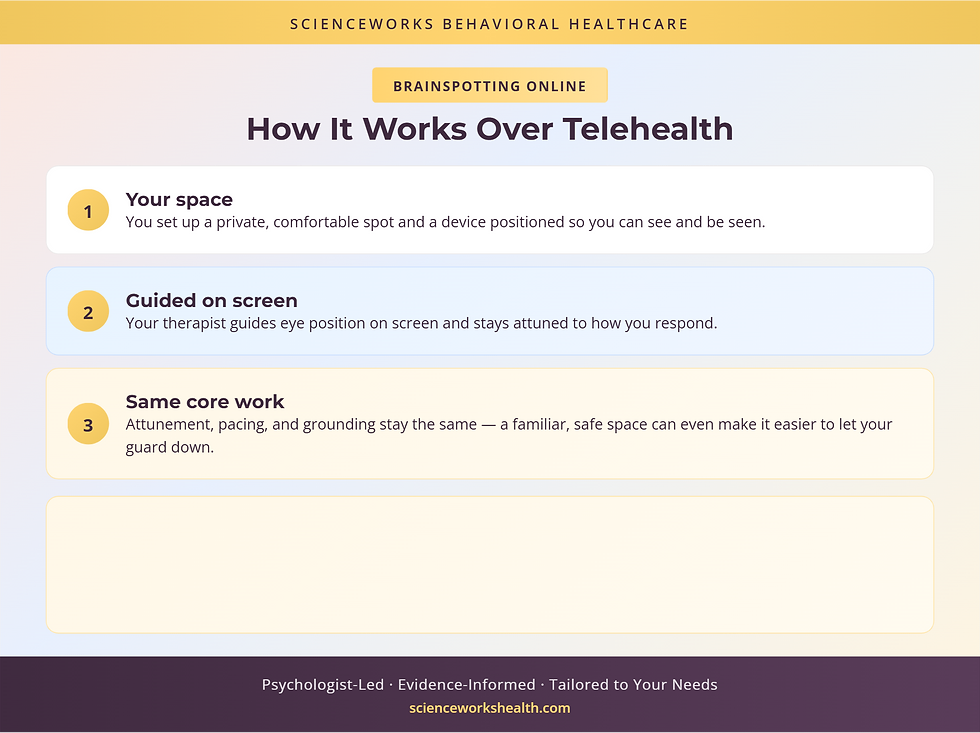
Brainspotting translates to secure video even more smoothly than people expect. Your therapist guides eye position on screen, watches your responses, and stays attuned exactly as they would in person. You set up your own comfortable, private space and a device positioned so you can see and be seen. The core of the work — the attunement, the pacing, the grounding — is fully intact. Many people find that being in their own home actually helps, since a familiar, safe space can make it easier to let their guard down and process.
We provide Brainspotting on a telehealth basis across Tennessee, which removes travel and makes it easy to work with a clinician trained in the approach.
How many sessions, and how progress is tracked
There is no fixed number of sessions. Some people notice meaningful shifts within a few sessions; others build progress over a longer arc. Rather than promising a timeline, we set goals with you and check in on how symptoms and daily functioning are changing. A validated measure like the PCL-5 helps track post-traumatic symptoms over time so you can see your progress clearly.
Safe, guided, and paced by you
Brainspotting is well tolerated and gentle, and a skilled clinician paces the work so it always stays manageable. That is exactly why Brainspotting belongs in the hands of a trained trauma therapist who can attune to you and keep the process comfortable. If you are unsure where to start, our overview of trauma treatment options can help you think it through.
What to expect from your results
Here is the encouraging picture. Studies suggest Brainspotting can reduce trauma, anxiety, and depression symptoms, with short-term effects comparable to EMDR [1][2], and a randomized study found benefits that held at follow-up [3]. For the right person within a thoughtful plan, Brainspotting is a genuinely promising path — one many people are glad they tried.
Carrying something that still feels close?
Trauma-focused care — including Brainspotting and EMDR — can help you process what happened at a pace that feels safe. We are glad to help you take the first step.
Frequently Asked Questions
Does Brainspotting hurt or feel intense?
Brainspotting is not physically painful. It can bring up strong emotions or body sensations as material surfaces, but that intensity usually comes in waves and settles, and your therapist paces the work and grounds you so it stays manageable. You remain in control throughout and can slow down or pause at any point.
What if nothing comes up during my session?
That is completely normal and not a sign of failure. Some sessions are quiet, and processing often continues in the days afterward. Your therapist may adjust the eye position, return to the body sensation, or give it more time. Brainspotting follows your nervous system's pace.
How is a Brainspotting session different from EMDR?
In EMDR, your eyes usually move back and forth in a structured, phased protocol. In Brainspotting, your eyes hold one fixed position while you notice what surfaces, and the process follows your body more flexibly. Sessions tend to feel quieter and less scripted.
Can I do Brainspotting online?
Yes, and it works well. Brainspotting is delivered over secure video, with your therapist guiding eye position on screen and staying attuned to your responses. We offer it on a telehealth basis across Tennessee.
How soon might I notice a difference?
It varies. Some people notice shifts within a few sessions, while others build progress over time. We track how you are doing and adjust the plan so it reflects real change.
About the Author
Dr. Kiesa Kelly is a licensed clinical psychologist and the founder of ScienceWorks Behavioral Healthcare, with more than 20 years of experience in psychological assessment and evidence-based treatment. Her clinical background includes advanced training in trauma care, and she leads the practice's telehealth-forward model serving clients across Tennessee.
References
1. Hildebrand A, Grand D, Stemmler M. Brainspotting — the efficacy of a new therapy approach for the treatment of Posttraumatic Stress Disorder in comparison to Eye Movement Desensitization and Reprocessing. Mediterr J Clin Psychol. 2017;5(1). https://www.semanticscholar.org/paper/Brainspotting-%E2%80%93-the-efficacy-of-a-new-therapy-for-Hildebrand-Grand/34593072b2769274a0e1117403004f72c5cc6887
2. D'Antoni F, Matiz A, Fabbro F, Crescentini C. Psychotherapeutic Techniques for Distressing Memories: A Comparative Study between EMDR, Brainspotting, and Body Scan Meditation. Int J Environ Res Public Health. 2022;19(3):1142. https://pmc.ncbi.nlm.nih.gov/articles/PMC8835026/
3. Horton LM, Schwartzberg A, Goldberg P, Grieve K, Brdecka L. Brainspotting: Introducing Brainspotting as a treatment for PTSD. Int Body Psychother J. 2023-2024;22(2):57-72. https://ibpj.org/issues/articles/Horton,%20Schwartzberg,%20Goldberg,%20Grieve,%20Brdecka%20-%20Brainspotting.pdf
4. American Psychological Association. Clinical Practice Guideline for the Treatment of Posttraumatic Stress Disorder (PTSD) in Adults. 2017. https://www.apa.org/ptsd-guideline
Disclaimer
This article is for informational and educational purposes only and is not a substitute for professional diagnosis, treatment, or advice. Reading this content does not create a clinician-patient relationship. If you are in crisis or may harm yourself, call or text 988 (the Suicide and Crisis Lifeline) or seek emergency care. For guidance about your own situation, please consult a qualified clinician.