
Moral OCD: Why It Feels Like a Moral Problem (But Isn't)

Updated: 5 days ago
Last reviewed: 08/26/2026
Reviewed by: Dr. Kiesa Kelly

Moral OCD can turn ordinary doubts into a gut-level fear: “What if I’m a bad person?” If you live with moral OCD, the distress often isn’t only about what might happen but about what it might mean about you. That’s why it can feel like a moral emergency instead of “just anxiety.”
In this article, you’ll learn:
Why OCD morality intrusive thoughts feel so personal
How guilt and hyper-responsibility keep the loop going
What moral and religious compulsions often look like
How ERP can help and where to find religious OCD treatment support in Tennessee
🧭 Key takeaway: Moral OCD targets what you care about most, not what you truly want.
When OCD Attacks Your Sense of Right and Wrong
Moral OCD is often discussed alongside scrupulosity OCD, a form of OCD where obsessions and compulsions latch onto moral or religious rules. Scrupulosity can sound like “Did I sin?” or “Did I violate my values?” but the engine is the same: doubt, distress, and an urgent drive to neutralize uncertainty. [1]
Intrusive thoughts about morality
Intrusive thoughts in moral OCD can be blasphemous, cruel, or totally out of character. They often show up as:
“What if I meant that?”
“Maybe I lied” or “Maybe I manipulated them”
Fear that you broke a sacred rule without realizing
Images of harming someone you love
What keeps the thought sticky is the meaning OCD assigns: “If I can think it, it must say something true about me.”
Fear of being a “bad person”
A common pattern is “character checking.” You scan your reaction: “Did I feel guilty enough?” You compare yourself to others. You look for proof that you’re safe, honest, and good. The problem is that OCD doesn’t accept “good enough,” so the checking becomes endless.
Hyper-responsibility and guilt
Many people with OCD experience an inflated sense of responsibility: the feeling that it’s your job to prevent harm with perfect certainty. Responsibility beliefs have long been highlighted in cognitive models of OCD and are closely linked to guilt and repeated neutralizing behaviors. [2,3]
Practical example: You remember a conversation and think, “Maybe I misled them.” The next hour is spent rereading texts, replaying your tone, and drafting follow-up messages until it “feels certain.”
🧠 Key takeaway: In moral OCD, guilt is often a signal of uncertainty, not proof of wrongdoing.
Why moral OCD feels so convincing
The brain's threat system and "the ick"
Neurobiologically, OCD involves hyperactivation of circuits tied to error detection and threat appraisal [24]. When your brain flags a moral concern, the same circuitry that would flag a physical threat fires — same felt sense of urgency, same need to act now. Scrupulosity hijacks a system designed to keep you safe and points it at content that can never be fully resolved.
This is why the doubt feels true. It is not arriving as a reasoned argument; it is arriving as an alarm. You are trying to apply reasoning to something that is not happening in the reasoning part of your brain.
Key takeaway: 🚨 The conviction that "this one is different, this one really matters" is a signature of OCD, not a clue that you finally hit the real concern. Every scrupulosity loop presents as the urgent exception.
Why "just decide it's fine" doesn't work
People with scrupulosity are often good at logical analysis. They have usually, at some point, decided that a concern was fine — only to have the doubt return five minutes later, in slightly different language. This is not a failure of reasoning. It is how OCD works. The doubt survives every rational argument because it does not need to be rational to keep firing.
This is also why reassurance from others — a friend, a partner, a spiritual director — provides only short-term relief. The next doubt will arrive unchanged.
Misconception: If the doubt feels this strong, there must be something to it. In reality, strength of feeling is not a reliable signal for moral validity. OCD is specifically designed to amplify doubt beyond what evidence supports. The felt conviction is the disorder, not the truth.
Misconception: I can treat scrupulosity by becoming more certain of my moral stance. Seeking certainty is a compulsion. Treatment goes in the opposite direction — making peace with uncertainty and learning that you can act on your values without fully resolving every doubt first.
Misconception: Scrupulosity means I care too much. People with scrupulosity usually hold their values very seriously, but the disorder is not caused by caring too much. It is caused by OCD attaching itself to whatever you care most about, the same way contamination OCD attaches to safety or harm OCD attaches to the people you love.
Why OCD Creates Moral Panic
OCD is skilled at turning “maybe” into “must,” especially when the topic is integrity, harm, or faith. Two cognitive patterns matter a lot here: thought-action fusion and inflated responsibility.
Thought-action fusion
Thought-action fusion (TAF) describes beliefs like “Having the thought is morally equivalent to doing it” or “Thinking it makes it more likely to happen.” [4] In moral OCD, the “moral” part of TAF can be especially painful: “If I pictured it, I’m guilty.”
Misconception #1: Intrusive thoughts are not confessions. The presence of a thought is not the same as intent, desire, or character.
Overestimating responsibility for harm
Responsibility in OCD can expand until it covers outcomes no one can truly control. Research suggests that “neutralizing” (rituals done to reduce risk or guilt) can strengthen the sense that you must keep performing the ritual to stay safe. [3,5]
Misconception #2: “If I don’t do the ritual, I’m choosing harm.” In reality, the ritual is an OCD strategy for certainty, not an ethical requirement.
Why values become OCD targets
OCD often attacks what you value because the stakes are higher. If honesty matters, OCD builds an endless honesty test. If faith matters, OCD turns prayer into a performance. When something is sacred to you, “I need to be sure” feels urgent.
🧯 Key takeaway: OCD uses your values as “evidence” that you should never tolerate doubt.
How Moral OCD Differs From Values, Conscience, or Growth
Real repair versus compulsive certainty-seeking
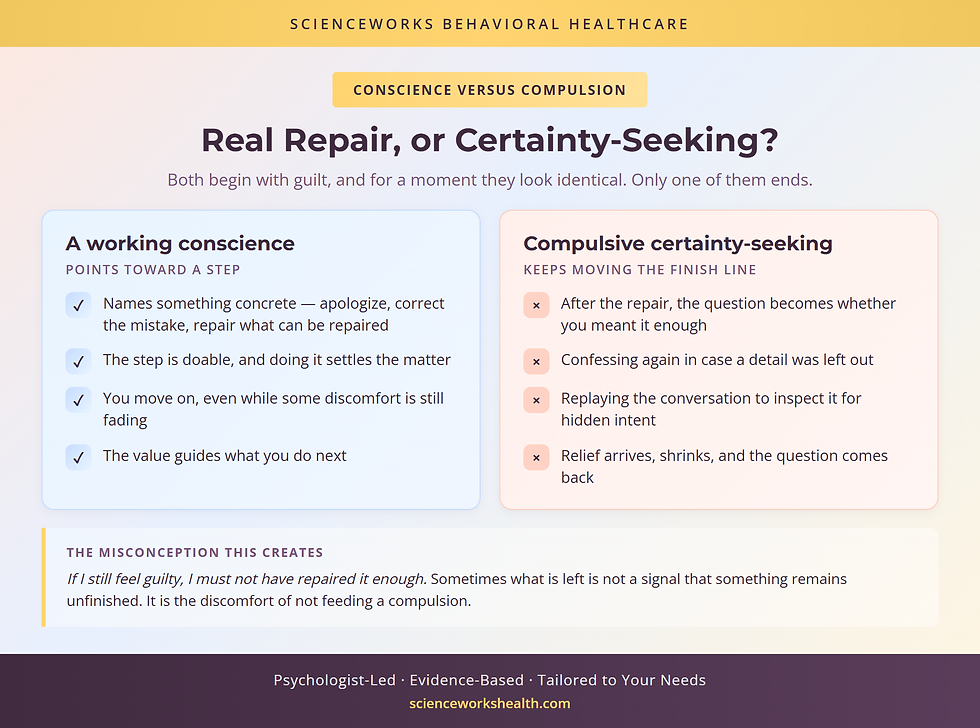
Healthy conscience usually points toward a concrete step: apologize, correct the mistake, repair what you can, and move on. Moral OCD keeps moving the finish line. Even after repair, the mind keeps asking whether you meant it enough or left out one terrible detail. [14][15][17]
Misconception #1: “If I still feel guilty, I must not have repaired it enough.” Sometimes what remains is the discomfort of not feeding a compulsion.
Why OCD turns values into traps
OCD often latches onto the values you care about most. If honesty matters to you, OCD may make accidental dishonesty feel catastrophic. If kindness matters, it may turn minor social imperfections into proof of harm. If faith matters, it may become scrupulosity. [15][16]
Because of that, scrupulosity OCD therapy is not about removing values. It is about separating values from rituals.
⚖️ Key takeaway: Values help you live. OCD uses those same values to pull you into checking, confessing, and second-guessing. [15][16]
Compulsions in Moral OCD
Compulsions can be visible (asking for reassurance) or hidden (hours of mental reviewing). In moral OCD, the compulsion usually aims at one thing: relief from uncertainty and guilt.
Confessing thoughts repeatedly
Some people feel compelled to confess intrusive thoughts to a partner, therapist, or faith leader. Confession can be meaningful when it’s value-based, but in scrupulosity it often becomes urgent, repetitive, and never satisfying: “I told them, but what if I left out a detail?” [1]
Practical example: After an intrusive image during prayer, you confess it, feel relief, then re-confess because you’re not sure you confessed “correctly.”
Seeking reassurance about character
Reassurance-seeking might sound like:
“Do you think I’m a bad person?”
“Was that immoral?”
“If I were dangerous, would I worry this much?”
Reassurance reduces distress briefly, but it can reinforce the idea that you need certainty before you can move on. [6]
Mental reviewing of past actions
“Mental checking” is one of the most exhausting moral OCD rituals: replaying conversations, reviewing memories for hidden intent, and debating moral rules until you land on a “final answer.”
Misconception #3: Rumination is not problem-solving. In OCD, rumination is a ritual that keeps the threat alarm turned on.
🧩 Key takeaway: If the thinking is meant to erase doubt, it’s probably a compulsion.
How ERP Helps With Moral OCD
Exposure and Response Prevention (ERP) is a form of CBT with strong evidence for treating OCD and is recommended in major guidelines. [7,8] In ERP therapy scrupulosity work, you practice changing your response to doubt.
ERP for scrupulosity is not about becoming careless or abandoning faith. It’s about changing the response that keeps OCD powerful: rituals, avoidance, and reassurance. [11]
Exposure to uncertainty about character
ERP helps you practice approaching triggers while allowing uncertainty to be present. For moral OCD, exposures might include:
Reading ambiguous scenarios without “figuring it out”
Writing a short statement like “Maybe I offended someone” and letting it sit
Leaving a message as-is (no rereading) when the urge is to perfect it
Noticing a moral intrusive thought during prayer and allowing it to pass without neutralizing
A trained ERP therapist helps you choose exposures that target OCD rules without violating your real-world moral commitments. [11]
Reducing reassurance and confession rituals
Response prevention means practicing not doing the ritual that usually follows, such as:
Confessing “just to be safe”
Asking others to judge your character
Googling moral questions until you feel certain
Mentally replaying until it “feels right”
At first, guilt and anxiety may spike. Over time, the brain learns: “I can feel uncertain and still live according to my values.” [11]
Learning to tolerate doubt about morality
A core skill in ERP is tolerating imperfect certainty. The goal is not to stop caring. It’s to stop treating certainty as a requirement for being good.
🧠 Key takeaway: ERP helps you practice value-based living with uncertainty, rather than ritual-based living to avoid it.
What Moral OCD Therapy Can Look Like
Clinical guidelines consistently recommend CBT that includes exposure and response prevention (ERP) as a first-line psychotherapy for OCD. [19,20] Moral OCD therapy usually adapts these tools to targets like confession, reassurance, and rumination, while staying aligned with your values.
ERP for confession and reassurance rituals
ERP (exposure and response prevention) helps your brain learn: “I can feel the doubt and choose not to do the ritual.” The IOCDF describes ERP as systematically facing triggers while resisting compulsive responses. [11] Exposure-based approaches have also been described for scrupulosity in clinical case literature. [23]
In moral OCD, exposures are usually less about “doing something immoral” and more about practicing not chasing certainty, such as:
Delaying or skipping “just in case” apologies
Not sending the follow-up text that asks for reassurance
Letting a memory exist without replaying it for the “right” intent
Choosing values-based action while uncertainty is present
Practical example #2 (reassurance detox, done gently): If you ask your partner “Are we okay?” ten times a day, ERP might start by reducing to eight, then five, then one, while you practice tolerating the urge without asking again.
🤝 Key takeaway: ERP is collaborative and paced. The goal isn’t to shock you, it’s to help your nervous system learn that you can handle uncertainty without rituals. [11]
I-CBT for doubt, possibility, and “what kind of person am I?” spirals
Inference-based CBT (I-CBT) targets the reasoning style that fuels obsessional doubt, including the slide from a real detail into a “maybe story.” In a randomized controlled trial, I-CBT reduced OCD severity and was presented as an effective alternative treatment approach for OCD. [21] A later multisite randomized trial found significant improvements in both CBT and I-CBT, with I-CBT showing higher treatment acceptability, though the non-inferiority question was statistically inconclusive. [22]
For moral OCD, I-CBT can be helpful when you feel trapped in identity questions (for example, “What kind of person would even think this?”) and “possibility” starts to feel like “proof.”
🧩 Key takeaway: I-CBT helps you step out of the OCD story where possible becomes certain. It targets the doubt generator, not your morals. [21,22]
If you’re looking for i-cbt for moral ocd tennessee or a scrupulosity therapist Tennessee, ask a provider how they handle confession, reassurance, and mental rituals, not only how they “talk about guilt.”
What Not to Expect From Good Therapy
No moral verdicts
A therapist isn’t there to act as judge or referee. If sessions revolve around deciding whether you “really did something wrong,” therapy can accidentally become a reassurance ritual. For scrupulosity, the IOCDF notes the goal is to disentangle OCD from genuine beliefs and values. [18]
No shaming, arguing, or forcing certainty
Good therapy won’t shame you for intrusive thoughts or try to argue you into certainty. You can expect:
A clear OCD formulation (obsession, compulsion, reinforcement)
Skills for responding to doubt without confessing or reassurance seeking
A plan that respects your values while interrupting the loop
If you want to get a sense of who you might work with, you can meet the ScienceWorks team or learn more about Dr. Kiesa Kelly.
Finding Specialized OCD Treatment
When OCD guilt thoughts and morality intrusive thoughts dominate your day, it’s a sign the OCD cycle has gotten loud, not a sign you’re morally broken. Specialized treatment focuses on your pattern (obsession → distress → compulsion), not on debating your goodness.
When guilt and intrusive thoughts dominate daily life
Consider specialty care if you notice:
You spend significant time reviewing, confessing, praying, or “fixing”
Relationships are strained by repeated reassurance needs
Faith practice feels fear-driven rather than meaningful
You avoid roles or people because you’re scared of harming or sinning
If you want to learn more about themes and evidence-based approaches, visit our OCD treatment overview and our specialized therapy services.
Why ERP is recommended for scrupulosity
ERP targets the cycle that keeps scrupulosity OCD alive. Clinical trials and reviews show ERP reduces OCD symptoms across themes, including guilt- and responsibility-driven obsessions. [9,10]
If you’re wondering whether what you’re experiencing fits OCD, tools like the OCD screening overview can help you learn the language to discuss symptoms with a clinician.
Therapy options in Tennessee
If you’re in Tennessee, look for providers who can clearly describe how they use ERP for scrupulosity or religious OCD treatment concerns (including response prevention for reassurance and confession).
Helpful steps:
Use the International OCD Foundation’s “Find Help” directory to search for ERP-trained providers and teletherapy options. [12]
Confirm licensure and telehealth eligibility in Tennessee, especially if you plan to meet online. [13]
If you’d like a next step with a structured plan, you can explore our psychological assessments, or reach out to schedule a free consult. You can also meet our clinicians on the Meet the ScienceWorks team page.
🧩 Key takeaway: The goal is not perfect moral certainty, it’s getting your life back from OCD rituals.
If moral OCD has you living like every moment is an ethics exam, consider reaching out for OCD-focused care and asking directly about ERP experience with scrupulosity and moral themes.
Questions to ask a provider before booking
What is your specific training in ERP for OCD, and how many clients with scrupulosity have you worked with?
How do you address mental compulsions as part of treatment, not just behavioral ones?
If my scrupulosity has a religious component, how do you design exposures that challenge the disorder without asking me to violate my beliefs?
What does a typical course of ERP look like, in number of sessions and between-session practice?
Frequently Asked Questions
What is moral OCD (and how is it different from regular OCD)?
Moral OCD is a form of OCD where obsessions and compulsions latch onto moral or religious rules — often discussed alongside scrupulosity. The thoughts can be blasphemous, cruel, or feel out of character, but what makes them stick is the meaning OCD assigns: "If I can think it, it must say something true about me." The engine is the same as other OCD: doubt, distress, and an urgent drive to neutralize uncertainty.
Does having an intrusive moral thought mean I'm a bad person?
No. Intrusive thoughts are not confessions, and the presence of a thought is not the same as intent, desire, or character. In moral OCD, thoughts about being immoral, dishonest, or harmful are common and do not predict behavior. Research and clinical guidelines treat unwanted intrusive thoughts as symptoms of a doubt-and-anxiety cycle, not evidence about who you are.
How does ERP help with moral and scrupulosity OCD?
ERP (Exposure and Response Prevention) helps you change the response that keeps moral OCD powerful: the rituals, avoidance, and reassurance-seeking that follow doubt. Exposures might include reading ambiguous moral scenarios without "figuring it out," sitting with statements like "Maybe I offended someone," or noticing intrusive thoughts during prayer without neutralizing. The goal is not abandoning your values — it's tolerating uncertainty so OCD stops running your day.
Can moral OCD start after you've actually done something wrong?
Yes. A real lapse can be the starting point: OCD latches onto the values you care about most, so if honesty matters to you, accidental dishonesty can feel catastrophic. The difference isn't whether something happened — it's what follows. A healthy conscience points toward a concrete step: apologize, correct the mistake, repair what you can, and move on. Moral OCD keeps moving the finish line, so even after repair the mind keeps asking whether you meant it enough or left out one terrible detail. Guilt that lingers after real repair is often the discomfort of not feeding a compulsion.
About ScienceWorks
Dr. Kiesa Kelly leads the ScienceWorks Behavioral Healthcare team and provides specialized therapy and assessment services for adults and teens, including OCD care that may include ERP, I-CBT, and ACT.
She has a PhD in Clinical Psychology with a concentration in neuropsychology and has advanced training in psychological assessment and evidence-based therapy approaches. You can learn more about Dr. Kelly’s background and services on her profile page.
References
International OCD Foundation. Scrupulosity (fact sheet). https://iocdf.org/wp-content/uploads/2014/10/IOCDF-Scrupulosity-Fact-Sheet.pdf
Rachman S. Obsessions, responsibility and guilt. Behav Res Ther. 1993;31(2):149-154. https://pubmed.ncbi.nlm.nih.gov/8442740/
Salkovskis PM, Shafran R, Rachman S, Freeston MH. Multiple pathways to inflated responsibility beliefs in obsessional problems: possible origins and implications for therapy and research. Behav Res Ther. 1999;37(11):1055-1072. https://doi.org/10.1016/S0005-7967(99)00063-7
Shafran R, Thordarson DS, Rachman S. Thought-action fusion in obsessive compulsive disorder. J Anxiety Disord. 1996;10(5):379-391. https://doi.org/10.1016/0887-6185(96)00018-7
Wilson KA, Chambless DL. Inflated perceptions of responsibility and obsessive-compulsive symptoms. Behav Res Ther. 1999;37(4):325-335. https://pubmed.ncbi.nlm.nih.gov/10204278/
Gillihan SJ, Williams MT, Malcoun E, Yadin E, Foa EB. Common Pitfalls in Exposure and Response Prevention (EX/RP) for OCD. J Obsessive Compuls Relat Disord. 2012;1(4):251-257. https://pmc.ncbi.nlm.nih.gov/articles/PMC3423997/
National Institute for Health and Care Excellence (NICE). Obsessive-compulsive disorder: evidence and guideline (CG31). 2005. https://www.nice.org.uk/guidance/cg31/evidence/full-guideline-pdf-194883373
Reddy YCJ, et al. Clinical practice guidelines for obsessive-compulsive disorder. Indian J Psychiatry. 2017;59(Suppl 1):S74-S90. https://pmc.ncbi.nlm.nih.gov/articles/PMC5310107/
Foa EB, Liebowitz MR, Kozak MJ, et al. Randomized, placebo-controlled trial of exposure and ritual prevention, clomipramine, and their combination in the treatment of obsessive-compulsive disorder. Am J Psychiatry. 2005;162(1):151-161. https://doi.org/10.1176/appi.ajp.162.1.151
Himle JA, et al. Exposure and response prevention versus stress management training for adults and adolescents with obsessive compulsive disorder: A randomized clinical trial. Behav Res Ther. 2024;172:104458. https://doi.org/10.1016/j.brat.2023.104458
International OCD Foundation. Exposure and Response Prevention (ERP). https://iocdf.org/ocd-treatment-guide/erp/
International OCD Foundation. Find Help (Resource Directory). https://iocdf.org/find-help/
Tennessee Department of Health. Professional Counselors, Marital and Family Therapists & Clinical Pastoral Therapists Board: Licensure. https://www.tn.gov/health/health-program-areas/health-professional-boards/pcmft-board/pcmft-board/licensure.html
National Institute for Health and Care Excellence. Obsessive-compulsive disorder and body dysmorphic disorder: treatment (CG31). Last reviewed July 11, 2024. Available from: https://www.nice.org.uk/guidance/cg31
International OCD Foundation. Moral Scrupulosity. Available from: https://iocdf.org/faith-ocd/living-with-ocd-religious-traditions/moral-scrupulosity/
Miller CH, Hedges DW. Scrupulosity disorder: an overview and introductory analysis. J Anxiety Disord. 2008;22(6):1042-1058. Available from: https://pubmed.ncbi.nlm.nih.gov/18226490/
Haciomeroglu B, Karakaya I, Tuzun Z, Gul AI, Aydin A, Sahin SK. The role of reassurance seeking in obsessive compulsive symptom dimensions and negative emotions. J Obsessive Compuls Relat Disord. 2020;26:100551. Available from: https://pubmed.ncbi.nlm.nih.gov/32635924/
International OCD Foundation. What is OCD & Scrupulosity? https://iocdf.org/faith-ocd/what-is-ocd-scrupulosity/
Arumugham SS, Narayanaswamy JC, Balachander S, et al. Clinical practice guidelines for obsessive-compulsive disorder: 2025 update. Indian J Psychiatry. 2026;68(1):44-67. https://doi.org/10.4103/indianjpsychiatry_1259_25
Hezel DM, Simpson HB. Exposure and response prevention for obsessive-compulsive disorder: A review and new directions. Indian J Psychiatry. 2019;61(Suppl 1):S85-S92. https://doi.org/10.4103/psychiatry.IndianJPsychiatry_516_18
Aardema F, Bouchard S, Koszycki D, et al. Evaluation of Inference-Based Cognitive-Behavioral Therapy for Obsessive-Compulsive Disorder: A Multicenter Randomized Controlled Trial with Three Treatment Modalities. Psychother Psychosom. 2022;91(5):348-359. https://doi.org/10.1159/000524425
Wolf N, van Oppen P, Hoogendoorn AW, et al. Inference-Based Cognitive Behavioral Therapy versus Cognitive Behavioral Therapy for Obsessive-Compulsive Disorder: A Multisite Randomized Controlled Non-Inferiority Trial. Psychother Psychosom. 2024;93(6):397-411. https://doi.org/10.1159/000541508
Abramowitz JS. Treatment of scrupulous obsessions and compulsions using exposure and response prevention: A case report. Cogn Behav Pract. 2001;8(1):79-85. https://doi.org/10.1016/S1077-7229(01)80046-8
Pauls DL, Abramovitch A, Rauch SL, Geller DA. Obsessive-compulsive disorder: an integrative genetic and neurobiological perspective. Nature Reviews Neuroscience. 2014;15(6):410-424. https://doi.org/10.1038/nrn3746
Disclaimer
This article is for informational purposes only and is not a substitute for diagnosis, treatment, or medical advice. If you are in crisis or may be at risk of harm, call 911 or go to the nearest emergency room.