
Afternoon Crash: Recognizing ADHD Medication Wear-Off and What to Bring Your Prescriber

Last reviewed: 10/09/2026
Reviewed by: Dr. Kiesa Kelly
The morning goes well. You take your medication with breakfast, clear your inbox, finish the report you have been avoiding, and actually return the phone call. Then, somewhere around 3 o'clock, the floor drops out. You reread the same email four times. Small noises feel unbearable. You snap at your kid in the car, eat everything in the pantry when you get home, and by evening you feel like a different person from the one who started the day.
If that sounds familiar, you may be noticing ADHD medication wear-off, sometimes called the afternoon crash. Many people describe it once their medication is working, and it is rarely explained well. As a practice that provides therapy, coaching and psychological assessment but does not prescribe, we see it from the other side of the prescription. This article will not tell you how to change your dose. It will help you work out what the dip is, and bring your prescriber the information they need to decide.
In this article, you'll learn:
What wear-off and rebound are, and how they differ from side effects
Common look-alikes, including sleep debt, low food intake, stress and hormonal changes
A simple one-week log you can keep
What to bring and ask at your next prescriber appointment
Non-medication supports for the late-day dip, and when it is more than wear-off
The short answer: what wear-off and rebound are
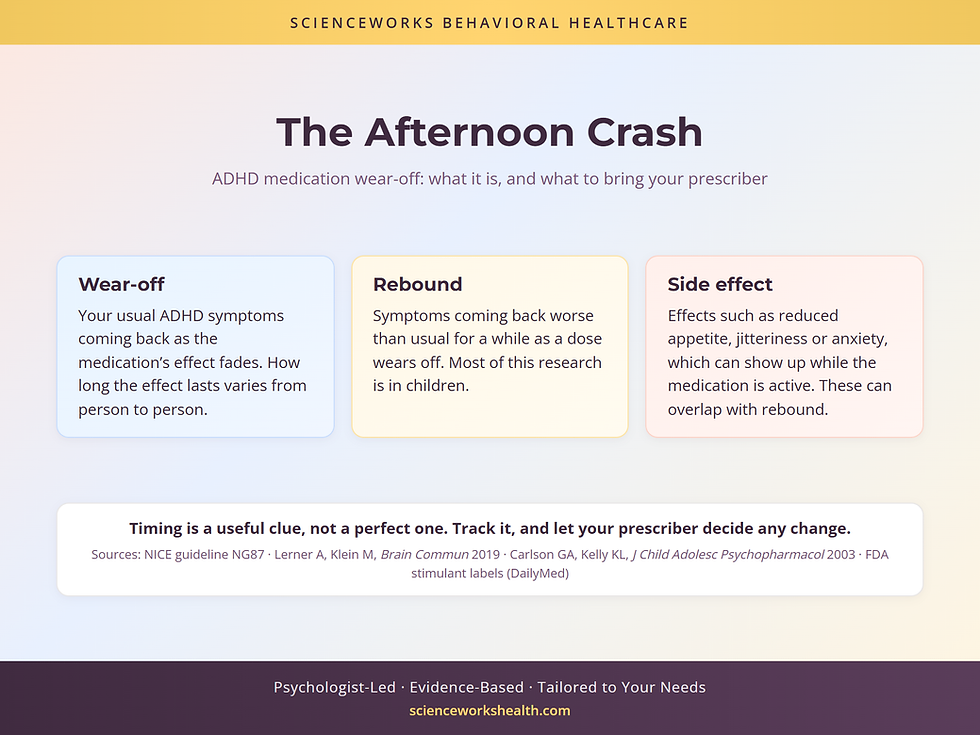
Wear-off is your usual ADHD symptoms returning as the medication's effect fades. That is expected. Every stimulant works for a limited time, and UK guidance tells prescribers that the effect size, duration of effect and side effects of stimulants all "vary from person to person" [1].
Rebound is narrower. Researchers use it for symptoms that come back stronger than they were before treatment as a dose wears off, sometimes with mood changes such as irritability, sadness, tearfulness or restlessness [2][3]. Most of that research is in children [2][3]. At one outpatient psychiatric practice whose patients were mostly adults, routine surveys ask about an "end-of-dose crash" and the "return of symptoms as dose wears off," and the researchers note that rebound and wear-off are related experiences that are hard to separate without tracking time of day [4].
Our article on what ADHD medication does and does not fix covers the wider picture. This one focuses on the late-day dip itself.
⏳ Key takeaway: Wear-off is your usual symptoms coming back as the effect fades. Rebound is those symptoms coming back worse than usual for a while. Both are worth tracking, and neither is something to fix on your own.
Three misconceptions about the afternoon crash
"If it wears off by 3 o'clock, the medication isn't working." Wear-off is not the same as failure. A medication can work well for part of the day and fade before you need it to stop. UK guidance asks clinicians, at medication reviews, to look at "how well the current treatment is working throughout the day" [1], which treats time of day as a normal part of judging whether a medication fits. A short window is information for your prescriber, not proof that the medication is wrong for you.
"The crash is always the medication." Sometimes it is something else, or several things at once. Short sleep builds up over days and dulls attention, and people tend to underestimate how impaired they are [5]. Stimulants are linked with eating less while they are active, and some people eat more in the evening as the effect wears off [6]. Anxiety is a common side effect listed in stimulant labels [7][8], and it can also be a separate condition. If worry is part of your afternoon, the GAD-7 screener is a quick way to put a number on it.
"Rebound means something is seriously wrong, so I should stop taking it." In one frequently cited study of rebound, in hospitalized children, it appeared at some point in 30 percent of them, was serious enough to stop treatment in only 8.7 percent, and did not seem to carry any special diagnostic meaning [3]. Those figures come from children on short-acting stimulants, so they do not tell you how common rebound is in adults. What they do suggest is that rebound is a known pattern to discuss with your prescriber, not an emergency on its own, and not a reason to stop medication without talking to them first.
🧩 Key takeaway: A late-day dip is information, not a verdict. It can be wear-off, rebound, a side effect, or something else entirely, and often it is a mix.
What it looks like day to day
Wear-off vs. rebound vs. a side effect
Timing is a useful clue, though not a perfect one. Reduced appetite, trouble sleeping, irritability and anxiety are among the most common adverse reactions listed for adults in stimulant labels [7][8], and side effects often show up while the medication is active. But research in children also lists irritability and trouble sleeping among rebound symptoms that appear after the last dose wears off [2], so the same symptom can point in more than one direction. Wear-off shows up as the effect fades: your familiar ADHD symptoms drift back. Rebound also shows up as the effect fades, but things feel worse than your usual baseline for a while [2]. Mood symptoms complicate this, because irritability and emotional ups and downs can be part of ADHD itself or can emerge as a medication effect, as a review of children's medication trials notes [9].
Here is a composite example of how wear-off can look. Dana is an accountant who takes her medication at 7 a.m. By 2 p.m. she notices she is rereading lines in a spreadsheet, getting pulled into her phone, and starting three things without finishing any. She is not upset or exhausted, just scattered, the way she felt every afternoon before she was diagnosed. By 5 p.m. she feels like her old self, which is frustrating but familiar.
Or here is a composite example of how rebound might look in an adult. Rebound has mostly been studied in children, so this is an illustration rather than a research finding. Marcus, a high school teacher, feels steady through his teaching day. Around 4:30, on the drive home, he becomes irritable and restless in a way that is sharper than anything he remembers from before treatment. He is short with his partner, tearful over small things, and cannot settle until dinner is over. By 8 p.m. it has passed. His pattern is not just his usual symptoms returning. It is a short burst of something more intense, timed to the end of his medication's day.
The distinguishing pattern: side effects often cost you while the medication is working. Wear-off costs you your usual baseline back as it fades. Rebound costs you a temporary dip below your usual baseline at the same point. These categories overlap in real life, which is exactly why writing down the time matters.
Look-alikes: skipped meals, sleep debt, anxiety, hormonal shifts
Before assuming the medication is the whole story, consider these:
Low food intake. Stimulants are associated with reduced appetite and lower intake while they are active, and that may be followed by more eating in the evening as the effect declines [6]. No study we found shows that under-eating causes the afternoon crash, but a missed lunch is worth noting.
Sleep debt. In a lab study, healthy adults limited to six hours in bed a night for two weeks built up deficits in attention and thinking, and largely did not notice how impaired they were [5]. If your sleep is short, a weak afternoon may be partly about the night before. Our insomnia services can help if sleep itself is the problem.
Stress and anxiety. A hard meeting or a buildup of worry can make any afternoon feel like a crash. UK guidance also lists anxiety disorders among the conditions that call for closer monitoring while ADHD medication is being adjusted [1].
Hormonal changes. In a small case series from an adult ADHD clinic, several women described worse ADHD and mood symptoms in the week before their period, or a sense that their usual medication was less effective then [10]. Perimenopause can also worsen or unmask attention, mood and sleep problems that overlap with ADHD [11]. Our article on ADHD medication in perimenopause goes into that question.
🔋 Key takeaway: Sleep, food, stress and hormones can all mimic or worsen a medication dip. Log them alongside your medication so you and your prescriber can see what lines up.
How to track the pattern for one week
UK guidance encourages people taking ADHD medication to monitor and record their own side effects, and names a sleep diary as a way to track sleep changes [1]. A simple log brings those ideas together. A week is long enough to cover several workdays and a weekend. That length is a practical suggestion from clinical experience, not a research standard.
A simple log: time taken, when it fades, what you noticed
Each day, jot down a few lines. A notes app or a sheet of paper works fine.
Time you took your medication, and whether you took it with food.
When you first noticed it working, roughly.
When you first noticed it fading, and what told you: focus, mood, restlessness, energy.
How the dip felt, on a simple 0 to 3 scale, where 0 is "not noticeable" and 3 is "it took over my afternoon."
Whether it felt like your usual self returning, or worse than your usual self.
Anything that happened while the medication was active, such as low appetite, a racing heart, jitteriness or worry.
Meals, sleep and stressors worth noting
Sleep: what time you went to bed, what time you got up, and roughly how much you slept.
Food: whether you ate breakfast and lunch, and when you got hungry again.
Stressors: demanding meetings, deadlines, conflict, or an unusually long day.
Cycle or hormone changes, if relevant: cycle day, or perimenopause symptoms such as hot flashes or night sweats.
Caffeine and alcohol, roughly how much and when.
📋 Key takeaway: One week of short notes on timing, sleep, food and stress turns "it stops working in the afternoon" into a pattern your prescriber can actually act on.

What to bring to your prescriber
Questions worth asking
Bring your log and a few questions. These are written to open a conversation, not to steer it toward a particular change.
"From my notes, does this look more like wear-off, rebound or a side effect?"
"Does my current plan fit the hours when I need to function most?"
"Could something else, like my sleep, eating, stress or hormones, explain part of this?"
"If we change anything, what should I track to know whether it helped?"
"Is there anything I should not change on my own, such as caffeine, the time I take it, or skipping doses?"
UK guidance encourages people with ADHD to discuss any preferences about changing or stopping medication, and to be involved in decisions about stopping treatment [1]. Your log is how you do that well.
Decisions that belong to the prescriber (and why this post gives no dosing advice)
Dose, timing, formulation and any added medication are prescriber decisions. A US pediatric guideline describes a child's response to stimulants as "variable and unpredictable," and notes that finding the right dose can take a few months of monitoring [12]. UK guidance, which covers adults too, says the effects of stimulants vary from person to person [1]. Changes also have trade-offs. For example, one stimulant's label says it should be taken in the morning, with afternoon doses avoided "because of the potential for insomnia" [8]. That is why we do not suggest specific changes here. Please do not change, stop, or add to your medication without talking to your prescriber.
Do not wait for a week of notes if you have chest pain, shortness of breath or fainting. A stimulant medication guide tells patients to call their healthcare provider right away or go to the nearest emergency room for these [8]. The same guide says to call right away about new or worsening mental symptoms, especially hearing voices, seeing or believing things that are not real, or new manic symptoms [8].
🗣️ Key takeaway: Your job is to observe and report clearly. Your prescriber's job is to decide what, if anything, changes. Safety symptoms skip the log and get a call right away.

Non-medication supports for the late-day dip
Medication is not the only tool for the afternoon. A large 2025 review of adult ADHD treatments found that stimulants, along with one non-stimulant medication, had the most consistent short-term evidence for reducing core symptoms, but medications did not show benefits on outcomes like quality of life, and evidence beyond the short term is limited [13]. UK guidance suggests considering psychological support alongside medication for adults whose symptoms still cause problems despite medication [1].
Practical supports for the dip include:
Front-load demanding work. Put tasks that need sharp focus in the hours when your medication is working best, and save routine or physical tasks for later.
Plan the handoff. Before your dip arrives, write down the next step for anything unfinished, so the late afternoon does not start with a blank page.
Build an end-of-day routine that runs on cues rather than willpower, such as a checklist or a set order for leaving work.
Get help building systems. Executive function coaching focuses on routines, planning and follow-through. We have not found studies testing coaching for the afternoon dip specifically, so treat it as one practical option.
If emotional swings or stress are a big part of your afternoons, therapy can help with the coping side. Cognitive behavioral therapy and psychoeducation showed benefits on clinician ratings in that 2025 review, though results were inconsistent across raters [13].
🛠️ Key takeaway: Routines and support do not replace good medication management, but they can protect your hardest hours while you and your prescriber work out the medication side.
When it's more than wear-off: signs to get re-evaluated
UK guidance says that if behavior worsens on medication, the prescriber should adjust medication and "review the diagnosis" [1]. Here is a rule of thumb for when the afternoon crash may be part of something bigger:
If symptoms are present all day, not just as the medication fades, the plan or the diagnosis may need another look.
If low mood, worry or irritability show up most days regardless of timing, a mood or anxiety condition may be part of the picture. Our article on ADHD and irritability explains how to tell the short fuse of ADHD from look-alikes.
If your sleep has been getting steadily worse since starting or changing medication, bring that up soon.
If you were diagnosed years ago and your life has changed a lot, such as a new job, parenthood or perimenopause, an updated evaluation can clarify what is ADHD and what is something else.
If the pattern suggests a fresh look, our page on ADHD and autism testing in Tennessee explains how our evaluations work. An evaluation does not replace your prescriber. It gives you both a clearer picture to work from.
Next step: getting support
Many people describe an afternoon crash, and it is not a sign that you or your medication have failed. It is a pattern with several possible causes: the medication wearing off, a short rebound, side effects while it is active, or the ordinary effects of short sleep, missed meals, stress and hormones. A week of notes can show which is which. From there, your prescriber can make medication decisions with real information, and therapy, coaching and an updated evaluation can cover the parts that medication cannot.
Wondering if ADHD explains the pattern?
A structured ADHD evaluation can tell you whether what you're noticing is ADHD, something else, or both — and what would actually help.
Frequently Asked Questions
Why does my ADHD medication seem to stop working later in the day?
Often because the medication's effect is fading as the day goes on. How long a stimulant's effect lasts varies from person to person, so the same dose can carry one person into the evening and leave another struggling by mid-afternoon. A late-day dip can also come from short sleep, eating little while the medication is active, stress or hormonal changes. Tracking when it happens is the best way to find out which.
What is ADHD medication rebound?
Rebound is the term researchers use for symptoms coming back stronger than usual as a stimulant wears off, sometimes with irritability, tearfulness or restlessness. Most of the research is in children. In one study of hospitalized children on short-acting stimulants, it was serious enough to stop treatment in fewer than 1 in 10. There is little research on how common it is in adults.
How can I avoid an ADHD medication crash?
Start by finding out what the crash actually is. Keep a short log for a week: when you took your medication, when you noticed it fading, what you ate, how you slept and what was going on. Bring it to your prescriber, who can decide whether anything about the medication should change. In the meantime, plan lighter tasks for your hardest hours, and avoid changing the dose or timing yourself.
Is it a side effect or is my ADHD medication wearing off?
Timing is one clue. Some side effects, such as reduced appetite, jitteriness or anxiety, can show up while the medication is active. Wear-off is your usual ADHD symptoms returning as the effect fades. Rebound is those symptoms returning worse than usual for a while, and in children it can include irritability and trouble sleeping. Because these overlap, note the time of day each change appears and let your prescriber sort out which is which.
Can I change when I take my ADHD medication if it wears off early?
Not on your own. Dose, timing and formulation are your prescriber's decisions, and a change that fixes the afternoon can create a new problem, such as trouble falling asleep. What you can do is bring a clear record of when the medication starts working, when it fades and what you notice, so your prescriber can make that decision with real information.
About the Author
Dr. Kiesa Kelly is a licensed clinical psychologist and the founder of ScienceWorks Behavioral Healthcare. A neuropsychologist by training with more than 20 years of experience in psychological assessment, she completed an NIH-funded postdoctoral fellowship focused on ADHD in both research and clinical practice, including research on cognitive control in ADHD. She has also trained in neurodiversity-affirming ADHD and autism assessment through individual consultation with Dr. Paige Victorine, PsyD.
Dr. Kelly earned her PhD in Clinical Psychology, with a concentration in Neuropsychology, from Rosalind Franklin University of Medicine and Science. She completed practica, internship, and postdoctoral training at the University of Chicago, the University of Wisconsin, the University of Florida, and Vanderbilt University. She is a psychologist, not a physician, and does not prescribe medication.
References
1. National Institute for Health and Care Excellence. Attention deficit hyperactivity disorder: diagnosis and management. NICE guideline NG87. 2018, updated 2019. https://www.nice.org.uk/guidance/ng87/chapter/Recommendations
2. Lerner A, Klein M. Dependence, withdrawal and rebound of CNS drugs: an update and regulatory considerations for new drugs development. Brain Commun. 2019;1(1):fcz025. https://doi.org/10.1093/braincomms/fcz025
3. Carlson GA, Kelly KL. Stimulant rebound: how common is it and what does it mean? J Child Adolesc Psychopharmacol. 2003;13(2):137-142. https://doi.org/10.1089/104454603322163853
4. Young JL, Powell RN, Powell A, Welling LLM, Granata L, Saal J, Nash M, Corliss M. Real-world evaluation of attention deficit hyperactivity disorder symptoms and side effects in patients prescribed serdexmethylphenidate/dexmethylphenidate or other stimulants. Front Pharmacol. 2026;17:1769333. https://doi.org/10.3389/fphar.2026.1769333
5. Van Dongen HP, Maislin G, Mullington JM, Dinges DF. The cumulative cost of additional wakefulness: dose-response effects on neurobehavioral functions and sleep physiology from chronic sleep restriction and total sleep deprivation. Sleep. 2003;26(2):117-126. https://doi.org/10.1093/sleep/26.2.117
6. Engbrink JM, Dapprich J, Fischer T, Markant A. Dual Effects of ADHD Pharmacotherapy on Nutrition: A Scoping Review of Appetite, Eating Behavior, and Growth Across the Lifespan. Nutrients. 2026;18(18):3039. https://doi.org/10.3390/nu18183039
7. Janssen Pharmaceuticals, Inc. CONCERTA (methylphenidate hydrochloride) tablet, extended release. Prescribing information. DailyMed. Updated April 20, 2026. Accessed October 9, 2026. https://dailymed.nlm.nih.gov/dailymed/drugInfo.cfm?setid=1a88218c-5b18-4220-8f56-526de1a276cd
8. Takeda Pharmaceuticals America, Inc. VYVANSE (lisdexamfetamine dimesylate) capsule; tablet, chewable. Prescribing information and Medication Guide. DailyMed. Updated April 30, 2026. Accessed October 9, 2026. https://dailymed.nlm.nih.gov/dailymed/drugInfo.cfm?setid=704e4378-ca83-445c-8b45-3cfa51c1ecad
9. Pozzi M, Carnovale C, Peeters GGAM, Gentili M, Antoniazzi S, Radice S, Clementi E, Nobile M. Adverse drug events related to mood and emotion in paediatric patients treated for ADHD: A meta-analysis. J Affect Disord. 2018;238:161-178. https://doi.org/10.1016/j.jad.2018.05.021
10. de Jong M, Wynchank DSMR, van Andel E, Beekman ATF, Kooij JJS. Female-specific pharmacotherapy in ADHD: premenstrual adjustment of psychostimulant dosage. Front Psychiatry. 2023;14:1306194. https://doi.org/10.3389/fpsyt.2023.1306194
11. Wynchank D, Kooij S. Pharmacological Management of ADHD in Women Across Perimenopause, Menopause and Post-Menopause. Drugs Aging. 2026;43(5):385-395. https://doi.org/10.1007/s40266-026-01291-z
12. Wolraich ML, Hagan JF Jr, Allan C, et al. Clinical Practice Guideline for the Diagnosis, Evaluation, and Treatment of Attention-Deficit/Hyperactivity Disorder in Children and Adolescents. Pediatrics. 2019;144(4):e20192528. https://doi.org/10.1542/peds.2019-2528
13. Ostinelli EG, Schulze M, Zangani C, Farhat LC, Tomlinson A, Del Giovane C, Chamberlain SR, Philipsen A, Young S, Cowen PJ, Bilbow A, Cipriani A, Cortese S. Comparative efficacy and acceptability of pharmacological, psychological, and neurostimulatory interventions for ADHD in adults: a systematic review and component network meta-analysis. Lancet Psychiatry. 2025;12(1):32-43. https://doi.org/10.1016/S2215-0366(24)00360-2
Disclaimer
This article is for informational and educational purposes only and is not a substitute for professional medical or mental health advice, diagnosis, or treatment. It does not give dosing advice. Do not start, stop or change any medication without talking to your prescriber. If you have chest pain, shortness of breath or fainting, call your prescriber right away or seek emergency care. If you are in crisis or thinking about harming yourself, call or text 988, or call 911 in an emergency.