
Delayed-Onset PTSD: Why Symptoms Can Appear Months or Years After a Trauma

Last reviewed: 10/30/2026
Reviewed by: Dr. Kiesa Kelly
It has been a long time since the worst thing happened. You got through it and kept going. Then, months or even years later, the nightmares start, or you find yourself scanning every room, or a familiar sound suddenly makes your heart pound. It can feel confusing, even embarrassing: why now, when the danger is long over?
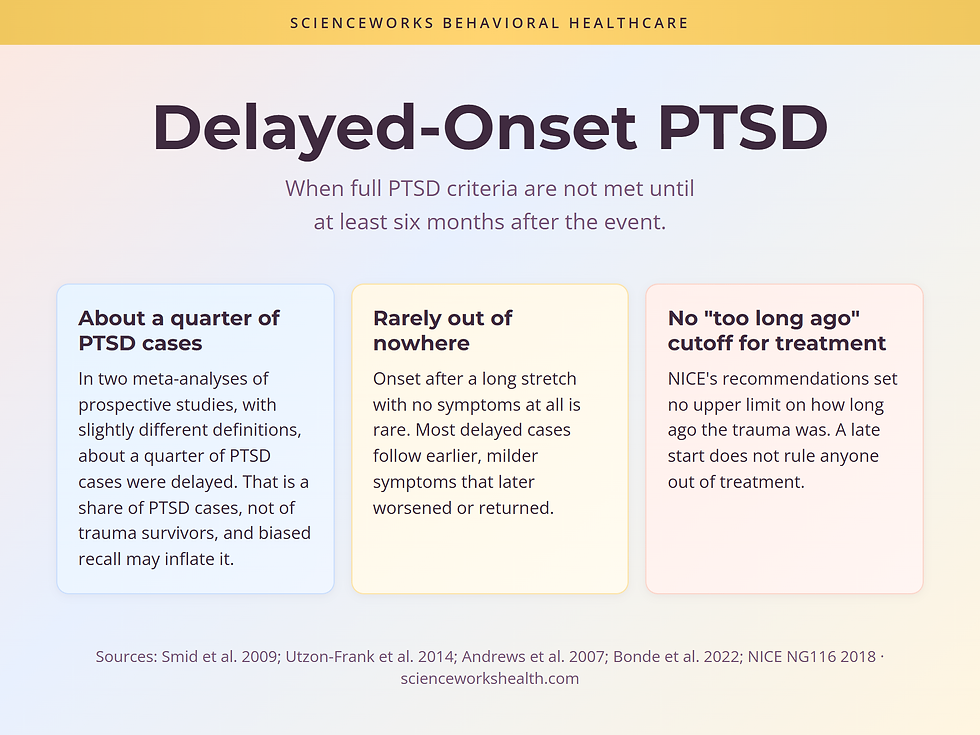
The short answer is that this pattern has a name. Delayed-onset PTSD, also called PTSD "with delayed expression" [6], describes post-traumatic stress disorder that does not reach full diagnostic criteria until at least six months after the event [1]. It is real, and the same trauma-focused care recommended for PTSD in general applies [11]. The research also shows that in most cases, the symptoms did not come out of nowhere.
In this article, you'll learn:
What the delayed specifier means, and what the six-month line does and does not measure
How common delayed-onset PTSD is in long-term studies
Why "out of nowhere" is usually not quite what happened
What tends to bring symptoms forward later in life
How late symptoms are assessed and treated, and what to ask before you book
The short answer: yes, PTSD can first meet criteria months or years later
PTSD symptoms usually begin soon after a traumatic event. But the National Center for PTSD is direct about the exception: symptoms "may not appear until months or years later," and they "also may come and go over many years" [2]. If you have symptoms now that trace back to something that happened long ago, it can help to organize what you notice before you talk with a clinician, and the PCL-5 PTSD checklist is one reasonable place to start. It is a starting point, not a diagnosis.
Three misconceptions keep people from taking late symptoms seriously.
"PTSD shows up right away, so if mine didn't, it can't be PTSD." In reality, the diagnostic criteria include a specific delayed specifier for exactly this situation [1]. Timing changes the label's wording, not whether the condition counts.
"Delayed means it came out of nowhere." In reality, onset after a long stretch with no symptoms at all is rare. Systematic reviews consistently find that most delayed cases follow earlier, milder symptoms that later worsened or returned [5][6].
"It has been years, so it's too late to do anything about it." In reality, NICE's PTSD guideline frames treatment by whether someone presents more than a month after the trauma, with no cutoff for "too long ago" [11]. The National Center for PTSD puts it plainly for older adults: "It's never too late to heal" [10].
⏳ Key takeaway: Delayed-onset PTSD is a recognized form of PTSD, not a lesser one. The delay describes when full criteria were met, not how serious the symptoms are.
What the delayed specifier means
PTSD is diagnosed when a person has been exposed to a traumatic event and has symptoms in four areas: re-experiencing, avoidance, negative changes in thoughts and mood, and changes in arousal and reactivity. The symptoms must last more than a month, cause real distress or impairment, and not be better explained by a medication, substance, or other illness [1]. These criteria did not change for adults in the 2022 text revision of the manual [1].
The delayed specifier adds one piece of information. It applies when full diagnostic criteria are not met until at least six months after the trauma, even though some symptoms may have started right away [1].
The six-month line: what it measures and what it does not
The six-month line marks when a person first met all the criteria. It does not say the trauma had no effect before then. Early reactions are common, and most people start to feel better after a few weeks [2]; we cover that recovery curve in our post on single-incident trauma and CBT. But someone can also have poor sleep, a few avoided places, and an occasional intrusive memory for months without meeting the full picture, and then cross the threshold later.
The line also does not measure severity, and it does not mean a memory was missing. Delayed expression is about when the symptom pattern became complete, not about recovering a memory you did not know you had, which is a separate question.
Delayed onset vs delayed recognition vs reactivation
These three get blurred together:
Delayed onset: symptoms build, and full criteria are first met six months or more after the event.
Delayed recognition: full PTSD was there earlier, but nobody named it. This can happen when symptoms were explained as stress, burnout, or "just how I am."
Reactivation: PTSD, or a strong set of symptoms, eased for a while and then returned.
A careful assessment tries to tell these apart.
How common delayed-onset PTSD is
What the prospective studies found
The best evidence comes from prospective studies, which assess people soon after a trauma and then follow them for a year or more. Two meta-analyses reached similar answers despite slightly different definitions. Pooling 24 prospective studies and counting new cases that appeared at a later follow-up, Smid and colleagues estimated that about a quarter of PTSD cases (24.8%, after statistical adjustment) were delayed [3]. Using a stricter definition, onset more than six months after the event, Utzon-Frank and colleagues pooled 39 studies and found that 24.5% of PTSD cases were delayed-onset, with large variation between studies [4]. In that second review, the share was almost twice as high among veterans and other professional groups as among people who were not exposed through their work [4].
A 2024 study of more than 1,000 patients hospitalized at a South Korean trauma center after a physical injury showed the same pattern up close. Over two years, 79 people developed PTSD within the first six months and 35 developed it later [9], so roughly three in ten of the cases were delayed.
Two cautions: these figures are shares of PTSD cases, not of trauma survivors. And Utzon-Frank's group urged care in reading prevalence rates, noting that contextual factors and biased recall may inflate reporting [4].
Why "out of nowhere" usually is not: subthreshold symptoms first
When researchers looked at what came before a delayed diagnosis, they found that delayed onset with no prior symptoms was rare, while delayed onsets that were a worsening or return of earlier symptoms made up, on average, about 38% of PTSD cases in military studies and about 15% in civilian studies [5]. A systematic review of 34 prospective studies grouped people by how their symptoms changed over time. In the 29 study populations with a delayed-worsening group, that group's symptom scores were already about 25% higher (median) than the low-symptom group's during the first six months [6]. The authors concluded that delayed PTSD is "preceded by PTSD symptoms during the first year in most cases," while a few people may have no symptoms in between [6].
Across 54 symptom-trajectory studies, the most common response to a potentially traumatic event was steady resilience (about 66%), followed by recovery (about 21%), lasting symptoms (about 11%), and a delayed course (about 9%), a pattern found in only about a third of the samples studied [7]. A 2024 meta-analysis of adults exposed to collective violence found a similar delayed-worsening group of about 8% [8].
🧩 Key takeaway: If your symptoms seem to have arrived suddenly, look back gently. Most people with delayed-onset PTSD had quieter symptoms first, such as sleep trouble, avoidance, or feeling on edge.

What can bring symptoms forward later
New stressors and reminders that reactivate an old threat response
The National Center for PTSD notes that stress can make PTSD more likely, while social support can make it less likely [2]. In the injury study above, delayed-onset PTSD was linked to subthreshold PTSD and stressful life events three months after the injury [9]. Reminders matter too. A news report, an accident, or fireworks can act as a trauma reminder [2].
Consider a composite example: a woman who was rear-ended on the interstate. For a few weeks she was shaken, then mostly fine, though she started taking side roads and flinched at screeching brakes. Ten months later she has a near-miss on the same highway in the same week she learns her job is being cut. Within a month she is having vivid images of the crash, cannot sleep, and has stopped driving except when she has to. Looking back, the early avoidance was the thread; the near-miss and the job loss pulled it tight.
Life changes that lower coping reserves
For older adults, the National Center for PTSD describes how retirement or health problems can increase symptoms, how retirement leaves "more time on their hands, which can make PTSD symptoms more obvious," and how quieter years invite reflection when "unwanted memories can return" [10]. Losing a spouse, partner, or friends can shrink the support that once helped [10].
Picture another composite: a man who served in combat in his twenties, came home, and worked hard for thirty years. He slept badly, avoided fireworks, and never talked about the deployment, but he would have told you he was fine. Within months of retiring, the nightmares are back most nights, he is irritable with his wife, and he checks the locks twice before bed. Nothing new happened to him; the work and routine that kept the memories at arm's length are gone.
In our clinical experience, other turning points can do the same: becoming a parent, a child reaching the age you were when the trauma happened, caregiving for an aging parent, a medical procedure, or getting sober and losing a way of numbing that once worked.
📈 Key takeaway: Late symptoms often follow a change that adds stress or removes a buffer. Naming that change is part of understanding why the timing makes sense.
How a clinician assesses symptoms that appear late
Building the timeline: a screener as a starting point, not a verdict
An assessment for late symptoms starts with the story, not a score. A clinician will usually ask what happened, what the months after were like, when you first noticed anything (even small things), and what was going on when the symptoms grew. People close to you may have noticed changes you did not.
A self-report screener such as the PCL-5 can help organize the current picture. It is a 20-item measure that covers the 20 DSM-5 PTSD symptoms and asks how much each has bothered you in the past month [13], and its initial development studies, in trauma-exposed college students, supported its reliability and validity [12]. But the National Center for PTSD is clear that interpretation "should be made by a clinician," and that the gold standard for diagnosis is a structured interview such as the CAPS-5 [13]. If you have already taken it, our post on what a high PCL-5 score can and cannot tell you covers the numbers.
Ruling out look-alikes
Late-appearing distress is not always PTSD. Depression, anxiety disorders, grief, and adjustment problems after a recent stressor can all overlap with it, and some people have more than one. If low mood, loss of interest, or hopelessness are central, a PHQ-9 depression screener adds useful information. When trauma was repeated or prolonged, such as ongoing abuse, a clinician will also consider complex PTSD, which adds problems with emotions, self-image, and relationships; we explain that distinction in complex PTSD vs PTSD. And because the criteria exclude symptoms better explained by a medication, substance, or medical illness [1], a clinician may ask about your health as well.
🗓️ Key takeaway: You do not need a perfect timeline. An approximate history plus a careful look at what else could explain the symptoms is what a good assessment is built on.
When to get assessed
A simple rule: if symptoms you link to a past trauma have lasted more than a month and are upsetting you or getting in the way of work, relationships, or sleep, that is reason enough to be assessed, whenever the trauma happened [2]. Seek help sooner if symptoms are severe or you cannot function day to day. If you are having thoughts of harming yourself, call or text 988 [14], or call 911 if you are in immediate danger. Veterans can dial 988 and press 1 for the Veterans Crisis Line, or text 838255 [15].
Questions to ask before you book:
Will you look at when my symptoms started and how they changed over time, not just how I feel today?
Do you use a structured interview, or only questionnaires?
How will you check for depression, anxiety, grief, or complex PTSD alongside PTSD?
What will I receive afterward: a written summary, a diagnosis if one fits, and specific treatment recommendations?
If it is PTSD, which trauma-focused therapies do you offer, and how do you choose among them?

Does late onset change treatment?
Guidelines do not treat late onset differently. NICE recommends offering an individual trauma-focused CBT intervention, such as cognitive processing therapy or prolonged exposure, to adults with PTSD or clinically important symptoms who present more than a month after a traumatic event, and it recommends EMDR for adults presenting more than three months after a non-combat trauma [11]. Neither recommendation sets an upper limit on how long ago the trauma was. In our clinical experience, treatment choice depends more on your symptoms, history, and preferences than on when the diagnosis arrived. Our guide to PTSD treatment options and how to choose walks through the main approaches, and our EMDR and bilateral stimulation services page describes one of them.
Reactivation can look similar. Consider a third composite: a woman who was assaulted in college, did trauma-focused therapy in her twenties, and felt well for over a decade. When her daughter left for college, the old fear came back: trouble sleeping, checking her phone constantly, avoiding the news. A return like this is not a failure of the earlier work. It is a reason to reconnect with care, and coping skills from earlier treatment can help manage symptoms that come back [10].
🔁 Key takeaway: A late start does not rule anyone out of treatment. The same trauma-focused therapies are recommended, and for many people with PTSD, treatment can reduce or resolve symptoms [2][11].
Next step: getting support
If symptoms have surfaced long after a trauma, the timing usually makes sense once the full story is laid out. Something was often there earlier, something later added stress or took away a buffer, and the same evidence-based treatments recommended for PTSD apply. Our trauma team offers assessment and trauma-focused treatment by telehealth across Tennessee, and you can browse our broader specialized therapy options to see how that care is organized.
🧭 Key takeaway: You do not have to prove the symptoms are "bad enough" or "recent enough." If they are affecting your life now, that is the right time to look at them.
Carrying something that still feels close?
Trauma-focused care — including approaches like EMDR — can help you process what happened at a pace that feels safe, with a clinician who understands trauma responses.
Frequently Asked Questions
How long can it take for PTSD to develop after a trauma?
There is no set deadline. Most PTSD is recognized within the first months, but the DSM-5 delayed-expression specifier exists because full criteria are sometimes first met six months or more after the event, and occasionally years later. In most delayed cases, some symptoms were present earlier at a lower level, so looking back often reveals a thread that began closer to the trauma.
Can PTSD symptoms show up many years after the event that caused them?
Yes, although onset after a long stretch with no symptoms at all appears to be rare. In studies that followed people after a trauma, most delayed cases had milder symptoms early on, and later stress was linked to crossing the diagnostic threshold. In everyday life that change might be retirement, a new loss, a health problem, or a fresh reminder. A clinician will ask about both the recent change and the years in between.
Can PTSD come back years later after it seemed to go away?
It can. Symptoms may ease for long stretches and then return, and the National Center for PTSD notes that they can come and go over many years. A return is not a sign that earlier treatment failed or that you did something wrong. It is a reason to get reassessed, and coping skills learned in earlier treatment can help you manage symptoms that come back while you do.
Do I need to know exactly when my symptoms started to be assessed?
No. Many people cannot date their first symptoms, especially when they built slowly or were explained away as stress. A clinician pieces the timeline together with you, using what you remember, what changed in your life, and sometimes what people close to you noticed. An approximate picture is enough to begin, and the assessment focuses on how symptoms are affecting you now.
Why would PTSD symptoms start once life finally calms down?
Busy years can keep trauma memories at a distance. Work, raising children, and constant demands leave little quiet time, and staying very busy can itself be a way of not thinking about the event. When the pace drops, for example after retirement, there is more room for memories to surface and fewer ways to stay away from them. That is a recognized pattern, not a sign of weakness, and it can be treated.
About the Author
Dr. Kiesa Kelly is a licensed clinical psychologist and the founder of ScienceWorks Behavioral Healthcare, with more than 20 years of experience in psychological assessment and evidence-based treatment. Her clinical work centers on trauma-related conditions, obsessive-compulsive spectrum disorders, anxiety, and neurodevelopmental assessment in adults and adolescents, and careful assessment matters especially when symptoms appear long after the event behind them.
She earned her PhD in Clinical Psychology with a concentration in Neuropsychology from Rosalind Franklin University of Medicine and Science, and completed practica, internship, and an NIH-funded postdoctoral fellowship at the University of Chicago, the University of Wisconsin, the University of Florida, and Vanderbilt University. Dr. Kelly is a psychologist, not a physician, and does not prescribe medication.
References
1. National Center for PTSD. PTSD and DSM-5. U.S. Department of Veterans Affairs. https://www.ptsd.va.gov/professional/treat/essentials/dsm5_ptsd.asp
2. National Center for PTSD. PTSD basics. U.S. Department of Veterans Affairs. https://www.ptsd.va.gov/understand/what/ptsd_basics.asp
3. Smid GE, Mooren TT, van der Mast RC, Gersons BP, Kleber RJ. Delayed posttraumatic stress disorder: systematic review, meta-analysis, and meta-regression analysis of prospective studies. J Clin Psychiatry. 2009;70(11):1572-1582. https://doi.org/10.4088/JCP.08r04484
4. Utzon-Frank N, Breinegaard N, Bertelsen M, Borritz M, Eller NH, Nordentoft M, et al. Occurrence of delayed-onset post-traumatic stress disorder: a systematic review and meta-analysis of prospective studies. Scand J Work Environ Health. 2014;40(3):215-229. https://doi.org/10.5271/sjweh.3420
5. Andrews B, Brewin CR, Philpott R, Stewart L. Delayed-onset posttraumatic stress disorder: a systematic review of the evidence. Am J Psychiatry. 2007;164(9):1319-1326. https://doi.org/10.1176/appi.ajp.2007.06091491
6. Bonde JPE, Jensen JH, Smid GE, Flachs EM, Elklit A, Mors O, et al. Time course of symptoms in posttraumatic stress disorder with delayed expression: a systematic review. Acta Psychiatr Scand. 2022;145(2):116-131. https://doi.org/10.1111/acps.13372
7. Galatzer-Levy IR, Huang SH, Bonanno GA. Trajectories of resilience and dysfunction following potential trauma: a review and statistical evaluation. Clin Psychol Rev. 2018;63:41-55. https://doi.org/10.1016/j.cpr.2018.05.008
8. Oppo A, Forresi B, Barbieri A, Koenen KC. Trajectories of posttraumatic stress symptoms following collective violence: a systematic review and meta-analyses. J Trauma Stress. 2024;37(6):837-849. https://doi.org/10.1002/jts.23090
9. Kang SG, Kim JW, Kang HJ, Jang H, Kim JC, Lee JY, et al. Differential predictors of early- and delayed-onset post-traumatic stress disorder following physical injury: a two-year longitudinal study. Front Psychiatry. 2024;15:1367661. https://doi.org/10.3389/fpsyt.2024.1367661
10. National Center for PTSD. Older adults and PTSD. U.S. Department of Veterans Affairs. https://www.ptsd.va.gov/understand/what/aging_veterans.asp
11. National Institute for Health and Care Excellence. Post-traumatic stress disorder (NG116). 2018. https://www.nice.org.uk/guidance/ng116/chapter/Recommendations
12. Blevins CA, Weathers FW, Davis MT, Witte TK, Domino JL. The Posttraumatic Stress Disorder Checklist for DSM-5 (PCL-5): development and initial psychometric evaluation. J Trauma Stress. 2015;28(6):489-498. https://doi.org/10.1002/jts.22059
13. National Center for PTSD. PTSD Checklist for DSM-5 (PCL-5). U.S. Department of Veterans Affairs. https://www.ptsd.va.gov/professional/assessment/adult-sr/ptsd-checklist.asp
14. 988 Suicide & Crisis Lifeline. https://988lifeline.org/
15. Veterans Crisis Line. https://www.veteranscrisisline.net/
Disclaimer
This article is for informational and educational purposes only and is not a substitute for professional medical or mental health advice, diagnosis, or treatment. It is not a self-assessment tool, and only a qualified clinician can diagnose PTSD. If you are in crisis or thinking about harming yourself, call or text 988, or call 911 in an emergency. Veterans can dial 988 and press 1, or text 838255.