
Late-Diagnosed ADHD in Women: Why It's Missed for Decades

Updated: Aug 26
Last reviewed: 08/26/2026
Reviewed by: Dr. Kiesa Kelly

If you’ve been told you’re “just anxious,” “too sensitive,” or “bad at adulting,” but you’ve spent your life working twice as hard to keep up, you may be wondering why ADHD in women often gets missed until midlife. Many women reach adulthood with strong coping skills and good intentions, yet still feel chronically behind, exhausted, or ashamed.
In this article, you’ll learn:
Why many girls and women aren’t flagged in childhood
Why high-achieving women often get diagnosed later
Why so many women start asking bigger questions in midlife
Why ADHD can look like burnout or aging
When a lifelong pattern is worth looking at more closely
Key takeaway: 🧭 If your struggles are lifelong but your “coping system” is failing now, that pattern is worth taking seriously.
Late-Diagnosed ADHD in Women: Signs at a Glance
Before the detail below, here is the short version. When ADHD in women is recognized late, it usually shows up less as obvious hyperactivity and more as a lifelong pattern of quietly working harder than everyone else to keep up.[1]
A quiet, inattentive pattern since childhood: daydreaming, missing details, losing track of time, and disorganization, even when grades or performance looked fine.[1]
Anxiety, perfectionism, and shame doing much of the work of holding everything together.[1,3]
Heavy masking and compensation: overpreparing, endless lists and reminders, people-pleasing, and saying yes before scrambling to deliver.[2,8]
Outward competence paired with private chaos, followed by exhaustion and long recovery time.
A coping system that worked for years but starts failing under midlife load.
Being told the problem is 'just anxiety' or being 'too sensitive,' while privately feeling chronically behind.
Emotional sensitivity and burnout that never quite fit an anxiety-only explanation.[3]
Each of these is unpacked below, along with why the pattern is so often missed and when it is worth a closer look.
Why High-Achieving Women Often Get Diagnosed Later
Many adults assume ADHD would have been obvious in school. But the way ADHD shows up in girls can be quieter, more internal, and easier for adults to miss. Reviews on ADHD in women and girls describe how referrals often happen later because symptoms are less disruptive and more likely to be misunderstood. [1]
Quiet inattentive presentation and “good student” bias
Inattentive ADHD in women may not look “hyper.” Instead, it may look like daydreaming, missing instructions, overlooking details, losing items, underestimating time, or struggling with organization while grades still look fine.
A common misconception is that good grades rule out ADHD. In reality, academic performance can be held up by intelligence, supportive structure, or high effort, even while attention and organization are fragile. [1]
Practical example: A student who gets A’s because she’s up until 1 a.m. rewriting essays, triple-checking assignments, and panicking the night before deadlines may be coping, not thriving.
Internalized anxiety and perfectionism
For many high-achieving women, anxiety becomes the “engine” that keeps life moving. Perfectionism and fear of letting others down can mask ADHD-related disorganization for years. Reviews and qualitative research describe how women often experience internalizing symptoms like anxiety and shame alongside ADHD, which can misdirect clinicians toward anxiety alone. [1,3]
Masking and compensation: how it works
High masking ADHD women often develop habits that look like “being responsible,” but function as scaffolding to prevent things from falling apart. Research on women’s lived experiences describes how masking can reduce visibility of symptoms and delay recognition. [2,8]
Common compensation patterns include:
Overpreparing for meetings, social plans, or appointments
Keeping dozens of reminders, lists, alarms, and “systems”
People-pleasing to avoid conflict or criticism
Saying yes automatically, then scrambling to deliver
“White-knuckling” through tasks with adrenaline and last-minute urgency
This can overlap with ADHD in high-achieving women: outward competence plus private chaos. If you want a fuller companion overview of the signs of ADHD in adult women, it can help put this pattern in context.
Practical example: A manager who looks polished at work but spends the weekend recovering from the mental effort it takes to stay organized and emotionally regulated.
The hidden cost is often exhaustion and shame. Many women describe chronic fatigue, burnout, and self-criticism: “Why is everything so hard for me?” Systematic reviews of adult diagnosis in women highlight themes of overwhelm, lack of control, and self-blame before diagnosis, with relief when their experiences finally make sense. [3]
Key takeaway: 🧠 Sometimes the very traits that make someone look capable from the outside, like perfectionism, overpreparing, and people-pleasing, are part of why ADHD stays hidden for so long.
Why Are So Many Women Getting ADHD Diagnoses in Midlife?
For many women, the first real “collapse” happens in the 30s, 40s, or 50s. That does not usually mean ADHD suddenly appeared. More often, life became less forgiving while stress and biology reduced the margin that used to hold everything together.
Midlife can amplify demands:
Parenting and school schedules
Caregiving for parents
More complex work roles
Household logistics that never end
When responsibilities multiply, compensation strategies may no longer cover the load. What looked sustainable in a more structured season of life can stop working once the number of moving parts increases.
This helps explain why so many women are getting ADHD diagnoses in midlife. In many cases, it is not a new condition. It is an older pattern finally becoming visible.
Hormonal shifts can add to that visibility. Perimenopause and menopause can affect sleep, mood, and cognition. A 2025 systematic review on ADHD and sex hormones in females describes evidence that hormonal changes across the lifespan may influence ADHD symptoms and related vulnerabilities. [6] Recent research and reviews also note that menopause transition symptoms like concentration difficulties can overlap with ADHD and may intensify perceived impairment. [7]
If midlife hormone and sleep changes are part of your story, our overview of adult ADHD assessment for women in perimenopause and menopause explains why this stage of life can bring long-standing patterns into sharper focus.
Key takeaway: 🌙 Midlife diagnosis is often about visibility, not a sudden beginning. The demands are higher, the recovery time is lower, and older coping systems may stop covering the same load.
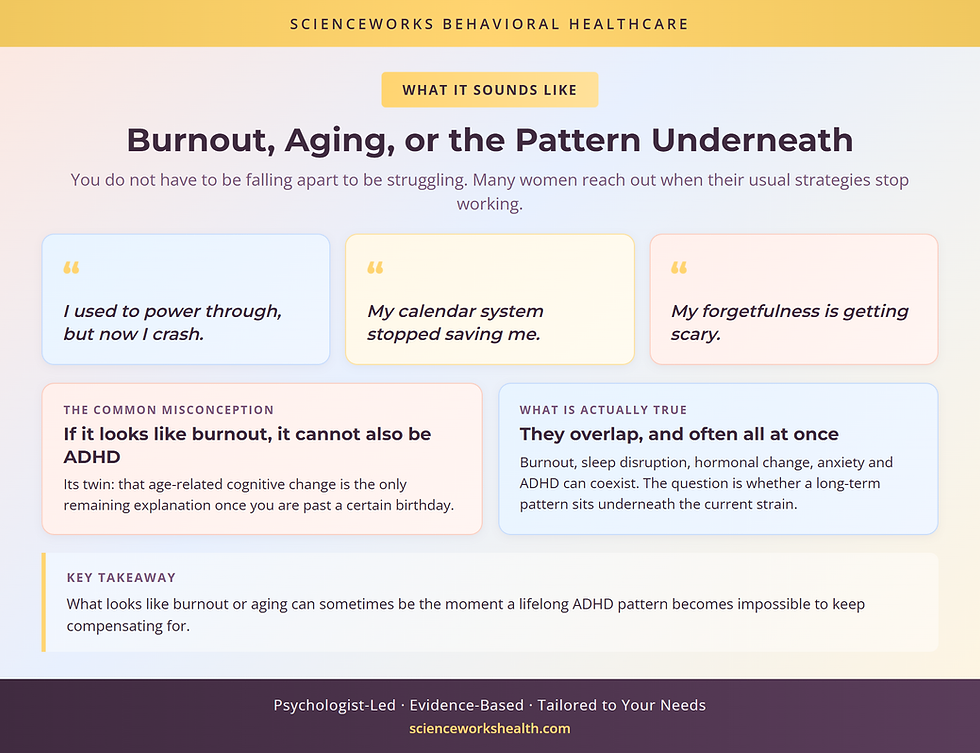
Why ADHD in Women Can Look Like Burnout or Aging
You do not have to be “falling apart” to be struggling. Many women reach out when their usual strategies stop working, especially when the experience gets mislabeled as simple stress, aging, or poor self-management.
Common descriptions include:
Too many choices leads to freezing or avoiding
Starting feels impossible, even for small tasks
Sensory overload and irritability by late afternoon
“Buffering” on your phone because your brain can’t switch tasks
Emotional overwhelm after a normal day of demands
These experiences can look like anxiety, depression, burnout, menopause transition, or “getting older.” They can also reflect ADHD-related executive function strain, especially when the pattern is longstanding. [3]
A common misconception is that if it looks like burnout, it cannot also be ADHD. Another is that age-related cognitive change is the only explanation. In reality, burnout, sleep disruption, hormonal change, anxiety, and ADHD can overlap. The question is whether there is a long-term pattern underneath the current strain.
This often sounds like:
“I used to power through, but now I crash.”
“My calendar system stopped saving me.”
“My forgetfulness is getting scary.”
If this section feels especially familiar, you may also relate to our guide on when to seek an ADHD assessment, which goes deeper into how to tell when a pattern has moved beyond ordinary stress.
Key takeaway: 🧯 What looks like burnout or aging can sometimes be the moment a lifelong ADHD pattern becomes impossible to keep compensating for.
What Makes the Pattern Easier to Recognize Now
A quality evaluation is more than a checklist. Major guidelines emphasize comprehensive assessment, functional impairment, and careful differential diagnosis. [5]
What often matters most is not whether your life looks successful from the outside, but whether there is a consistent pattern across settings and across time. Clinicians look at childhood history, current impairment, and other factors that could better explain the picture, such as sleep disorders, trauma, anxiety, depression, substance use, or medical issues. [4,5]
Misconceptions we often hear include:
“If it wasn’t obvious in childhood, it can’t be ADHD.”
“If I’m successful, I don’t have ADHD.”
“It’s just anxiety.”
If you want the fuller assessment process, you can read about our psychological assessments and what to expect. If it helps to organize your observations before an appointment, the Adult ADHD Self-Report Scale (ASRS) can be a useful starting point, but it does not diagnose you.
Key takeaway: 🗂️ The “why now?” question is often answered by pattern plus pressure: a lifelong vulnerability, years of compensation, and a life stage that finally exposes the cost.
Signs of ADHD in Adult Women
ADHD in adult women does not always look loud or disruptive. More often, it looks like internal restlessness, overwhelm, chronic disorganization, time blindness, inconsistent follow-through, and a mind that never fully quiets down. Many women spend years assuming these patterns are personality flaws rather than signs of ADHD in adult women. [1,9]
If you want more context on why ADHD in women is often missed for decades, it can help to see how these patterns often get mislabeled early on.
Internalized symptoms, perfectionism, overcompensation
Often, what others notice is indirect:
Chronic stress, worry, or “always on” mental noise
Perfectionism that keeps you performing but drains you
Overpreparing, overchecking, and overworking to avoid mistakes
Emotional overwhelm that looks like sensitivity or “moodiness”
Masking can work for years, especially when you’re bright, conscientious, and motivated. But it comes with a hidden price: anxiety, burnout, and a constant sense of being behind. [1–3]
🔎 Key takeaway: ADHD in women is often missed because coping strategies like perfectionism, people-pleasing, and overpreparing can camouflage impairment until they stop working. [1–3]
High achievement doesn’t cancel impairment
One of the most painful misconceptions is: “If I’m successful, it can’t be ADHD.” In reality, many women with ADHD do well in structured environments, then struggle when the scaffolding disappears in college, independent work, parenting, or management roles. ADHD is diagnosed based on persistent symptoms and meaningful impairment, not on whether you look competent on paper. [1,5,9]
Common “high-achiever” red flags can include:
You meet deadlines through adrenaline and all-nighters, then crash
You’re great in a crisis, but daily routines feel impossible
You look organized publicly, while your home or admin life is chaos
Misconception #1: “I can’t have ADHD because I got good grades.”
Misconception #2: “If I just tried harder, it would be fine.”
Misconception #3: “Online quizzes can diagnose me.” Screeners can help you decide whether to seek care, but they do not replace a clinical evaluation. [4–6]
If this pattern sounds familiar, our plain-English guide on ADHD screeners versus a full evaluation explains why a checklist alone is not enough.
ADHD vs anxiety, trauma, and burnout
Attention problems can come from ADHD, but they can also show up with anxiety, trauma, depression, sleep loss, medical issues, and chronic stress.[5,10]
⚖️ Key takeaway: A good evaluation does not ask only “does this look like ADHD?” It asks what best explains the pattern, what coexists, and what changed over time.
Overlap without oversimplifying
Anxiety can narrow attention around worry. Trauma can alter concentration through hypervigilance, avoidance, or nervous-system overload. Burnout can flatten working memory and motivation. ADHD can coexist with any of those, which is why internalizing symptoms are often mistaken for the whole story in women.[9]
If trauma is part of your history, it can make sense to explore trauma-focused support alongside diagnostic questions.
Why screening alone is not the full answer
Screeners are helpful for flagging possibilities, but international assessment standards say ADHD should not be diagnosed solely on rating scales or observational data.[10] A careful process uses clinical interviewing, daily-life examples, developmental history, impairment across settings, and differential diagnosis.[5,10]
That is why it can help to move from a screener to a fuller psychological assessment when the question stays unresolved.
When to Seek an ADHD Assessment
It may be time to seek an ADHD assessment when these patterns are persistent, show up across settings, and keep costing you time, money, health, work performance, or relationships. ADHD testing for women is usually most helpful when you want more than reassurance. You want a clearer answer about what is actually driving the pattern. [5,10]
What to track before your appointment (simple and practical)
If you’ve ever walked into an appointment and suddenly forgotten every example, you’re not alone. Tracking a few concrete patterns helps your clinician see impairment, not just intention.
If you want a quick starting point, the ASRS adult ADHD screener can help you organize symptoms to discuss, but it is not a diagnosis by itself. [11]
Five real-life examples of impairment (work, home, relationships)
Pick five examples that cost you time, money, health, or relationships. Keep them specific.
Work: missed deadlines, avoidance of email or invoices, inconsistent follow-through
Home: chronic clutter, unfinished “doom piles,” unpaid bills or late fees
Time: chronic lateness, underestimating tasks, “time blindness”
Relationships: interrupting, zoning out, forgetting plans, emotional reactivity
Health: missed appointments, inconsistent routines, sleep schedule chaos
Try writing each example in a simple format: Situation → what happened → impact → what you did to compensate.
📝 Key takeaway: Concrete examples with real consequences are often more helpful than broad labels like “I’m scattered.” [5,10]
Patterns across time (not just a rough month)
Clinicians are listening for patterns that show up across settings and over time. A rough month can happen to anyone. ADHD tends to be chronic, even if it looked different at different ages. [5,10]
Helpful notes to bring:
A short timeline (school, early jobs, current life)
“Repeating themes” (late work, forgetting, daydreaming)
What changed recently (menopause, job shift, new caregiver role, sleep loss)
If you’d like a structured way to track related symptoms such as anxiety, depression, or OCD traits, you can use our Mental Health Screening hub.
What a clinician will likely explore
A quality adult ADHD assessment for women is more than a checklist. It usually involves a clinical interview, history over time, and careful differential diagnosis. [5,10]
Developmental timeline and chronicity
Because ADHD is a neurodevelopmental condition, clinicians often explore:
Early signs (daydreaming, disorganization, “smart but inconsistent,” forgetful)
When difficulties began and whether they were present before adulthood
How symptoms show up now (work, relationships, home management)
Functional impact across more than one setting
This is one reason “I only started struggling this year” can point to several possibilities: ADHD, sleep problems, mood disorders, trauma stress, hormonal changes, medical conditions, or more than one at once. [4,5,7–10]
Comorbidities and rule-outs
Women are commonly diagnosed first with anxiety or depression, and those conditions can be real, co-occurring, and treatable. They can also be the mask that hides ADHD, or the result of living with it unrecognized. [1–3]
A clinician may explore:
Anxiety, depression, trauma, OCD, and other neurodevelopmental profiles
Sleep disorders, especially insomnia or circadian rhythm issues [12]
Hormonal context, including perimenopause and menopause [1,8–10]
If you’re trying to sort out overlap, our article on ADHD versus anxiety in women in midlife may help you frame the right questions.
🧭 Key takeaway: Good testing does not just “confirm ADHD.” It also checks for overlapping conditions so your plan targets the right problem or problems. [5,10]
What you should walk away with
Whether the answer is ADHD or something else, you deserve clarity that reduces shame and increases options.
Clear answer, written summary, and next-step plan
At minimum, a solid adult ADHD assessment should provide:
A clear diagnostic conclusion (ADHD, not ADHD, or “needs more data”)
A written summary you can refer back to, which is especially helpful for ADHD brains
A next-step plan tailored to your goals
That plan might include skills-based supports, accommodations, therapy for comorbidities, executive-function coaching, medication consultation when appropriate, and sleep- or menopause-focused care if those are part of the picture. [5,10,12]
✅ Key takeaway: The “win” is not a specific label. The win is a plan that matches your brain and your real life. [3–5]
Reframing: From Blame to Understanding
Late-diagnosed women often describe grief, relief, and anger all at once. That emotional mix makes sense. You may be revisiting a lifetime of “I should be able to…” stories.
A diagnosis does not change who you are. It can explain patterns, reduce self-blame, and help you choose supports that actually fit your brain. Systematic reviews of adult diagnosis in women describe how understanding the pattern can support self-acceptance and better-fitting coping strategies. [3]
Support can also be skills-based. Many people benefit from executive function coaching focused on planning, prioritizing, and building sustainable systems.
If you’re in Tennessee and you want to talk through whether this pattern fits, we can help you think about next steps without turning the process into one more overwhelming project.
Key takeaway: 🌱 You do not need to “prove” you’re struggling enough. You deserve a clearer explanation and support that fits the life you are actually living.
Frequently Asked Questions
Why are so many women getting ADHD diagnoses in midlife?
Several forces converge in midlife: childhood ADHD often went unrecognized in girls (especially the inattentive presentation), perimenopausal hormonal shifts amplify executive-function symptoms by reducing dopamine availability, life demands escalate (caregiving, career, household management), and increased awareness of adult ADHD makes diagnosis more accessible. The result is a wave of women being identified in their 30s-50s after years of compensating, masking, or being misdiagnosed with anxiety, depression, or burnout. The diagnoses are not new conditions; they are previously-missed cases.
How do I tell if my symptoms are burnout, aging, or ADHD?
Burnout, aging-related cognitive change, and ADHD can all produce overlapping symptoms (forgetfulness, distractibility, low motivation, executive slowing). The diagnostic distinction is in the lifetime pattern: ADHD typically shows persistent (often lifelong) executive-function challenges across multiple settings, present long before any single stressor. Burnout is contextual and time-limited (it remits with rest and reduced demand). Aging changes are gradual and primarily affect processing speed and working memory. A clinical evaluation that takes a thorough lifetime history can usually distinguish them.
Why is ADHD diagnosed late in women?
ADHD is diagnosed late in women because of converging biases: diagnostic criteria were originally developed in studies of boys with hyperactive presentations, the inattentive presentation common in girls is less disruptive in classrooms (and so flies under the radar), women are more likely to mask symptoms socially, and adult symptoms are frequently misattributed to anxiety, depression, perfectionism, or hormones. Many women only get diagnosed after a child is diagnosed, after a major life stressor reveals decompensation, or after perimenopausal symptom escalation makes coping strategies stop working.
Ready for a late-diagnosis ADHD evaluation?
If you're recognizing the pattern in midlife, an evaluation built around how ADHD actually shows up in women — not the older male-coded picture — can give you something concrete to work with.
What happens after a late ADHD diagnosis in women?
For many women, a late ADHD diagnosis is followed by a period of reappraisal — re-examining past struggles, relationships, career detours, and self-perceptions through a new framework. This can bring significant relief (finally having an explanation) alongside grief for the years of misunderstanding or self-blame. Practically, next steps typically include evaluating whether medication could help, exploring therapy that specifically addresses ADHD and its impact, learning evidence-based strategies for executive function, and potentially adjusting expectations of yourself in ways that are accurate rather than aspirational.
Does a late ADHD diagnosis in adulthood qualify for workplace accommodations?
Yes. An ADHD diagnosis — regardless of when it was made — can qualify for reasonable workplace accommodations under the Americans with Disabilities Act (ADA), provided the condition substantially limits a major life activity such as concentration, working memory, or time management. The diagnosis must be documented by a qualified professional. Common accommodations include extended deadlines, written rather than verbal instructions, reduced-distraction work environments, and flexible scheduling. A neuropsychologist or evaluating clinician can provide the documentation needed to request accommodations.
Is there a test for ADHD in women?
There is no single test that confirms ADHD. Brief self-report screeners like the ASRS can flag whether the pattern is worth exploring, but assessment standards say ADHD should not be diagnosed on rating scales alone. [10,11] A quality evaluation for women usually combines a clinical interview, a developmental history reaching back to earlier life, examples of impairment across settings, and careful differential diagnosis, and much of it can be done via telehealth. [5,10]
Can perimenopause make ADHD worse?
Perimenopause can make ADHD symptoms feel more intense for some women. Hormonal shifts during perimenopause and menopause affect sleep, mood, and concentration, and a 2025 systematic review describes evidence that hormonal changes across the lifespan may influence ADHD symptoms and related vulnerabilities. [6,7] This does not mean ADHD begins in midlife; more often, a long-standing pattern becomes harder to compensate for as demands rise and hormones shift. [6,7] Tracking how symptoms change across this stage can help an evaluation.
About the Author
Dr. Kiesa Kelly is the Owner and Psychologist at ScienceWorks Behavioral Healthcare. She provides specialized therapy and assessment support for ADHD, autism, OCD, trauma, and insomnia.
Her work is grounded in science-informed care delivered with authenticity and humility, with a focus on helping clients make sense of lifelong patterns and move toward self-acceptance and practical next steps.
References
Quinn PO, Madhoo M. A review of attention-deficit/hyperactivity disorder in women and girls: uncovering this hidden diagnosis. Prim Care Companion CNS Disord. 2014;16(3):PCC.13r01596. https://pmc.ncbi.nlm.nih.gov/articles/PMC4195638/
Morley E, et al. Exploring female students’ experiences of ADHD and its impact on their social, emotional and academic lives. 2023. https://pmc.ncbi.nlm.nih.gov/articles/PMC10302366/
Attoe DE, Climie EA. Miss. Diagnosis: A systematic review of ADHD in adult women. J Atten Disord. 2023;27(7):645-657. https://journals.sagepub.com/doi/10.1177/10870547231161533
Centers for Disease Control and Prevention. ADHD across the lifetime: ADHD in adults. Updated 2024 Oct 8. https://www.cdc.gov/adhd/articles/adhd-across-the-lifetime.html
National Institute for Health and Care Excellence (NICE). Attention deficit hyperactivity disorder: diagnosis and management (NG87). Last reviewed 2025 May 7. https://www.nice.org.uk/guidance/ng87
Osianlis E, et al. ADHD and sex hormones in females: a systematic review. 2025. https://pmc.ncbi.nlm.nih.gov/articles/PMC12145478/
Kooij JJS, et al. Research advances and future directions in female ADHD. Front Glob Womens Health. 2025. https://www.frontiersin.org/journals/global-womens-health/articles/10.3389/fgwh.2025.1613628/full
Holden E, et al. Adverse experiences of women with undiagnosed ADHD and adult diagnosis: a mixed methods survey. Sci Rep. 2025. https://www.nature.com/articles/s41598-025-04782-y
Young S, Adamo N, Ásgeirsdóttir BB, et al. Females with ADHD: an expert consensus statement taking a lifespan approach providing guidance for the identification and treatment of attention-deficit/hyperactivity disorder in girls and women. BMC Psychiatry. 2020;20:404. https://doi.org/10.1186/s12888-020-02707-9
Adamou M, Arif M, Asherson P, et al. The adult ADHD assessment quality assurance standard. Front Psychiatry. 2024;15:1380410. https://doi.org/10.3389/fpsyt.2024.1380410
Kessler RC, Adler L, Ames M, et al. The World Health Organization adult ADHD self-report scale (ASRS): a short screening scale for use in the general population. Psychol Med. 2005;35(2):245-256. https://doi.org/10.1017/S0033291704002892
van der Ham M, et al. Sleep problems in adults with ADHD: prevalences and their relationship with psychiatric comorbidity. J Atten Disord. 2024. https://pubmed.ncbi.nlm.nih.gov/39354860/
Disclaimer
This article is for informational purposes only and is not a substitute for professional diagnosis, treatment, or medical advice.